Quick answer
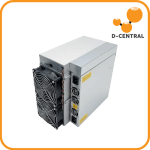
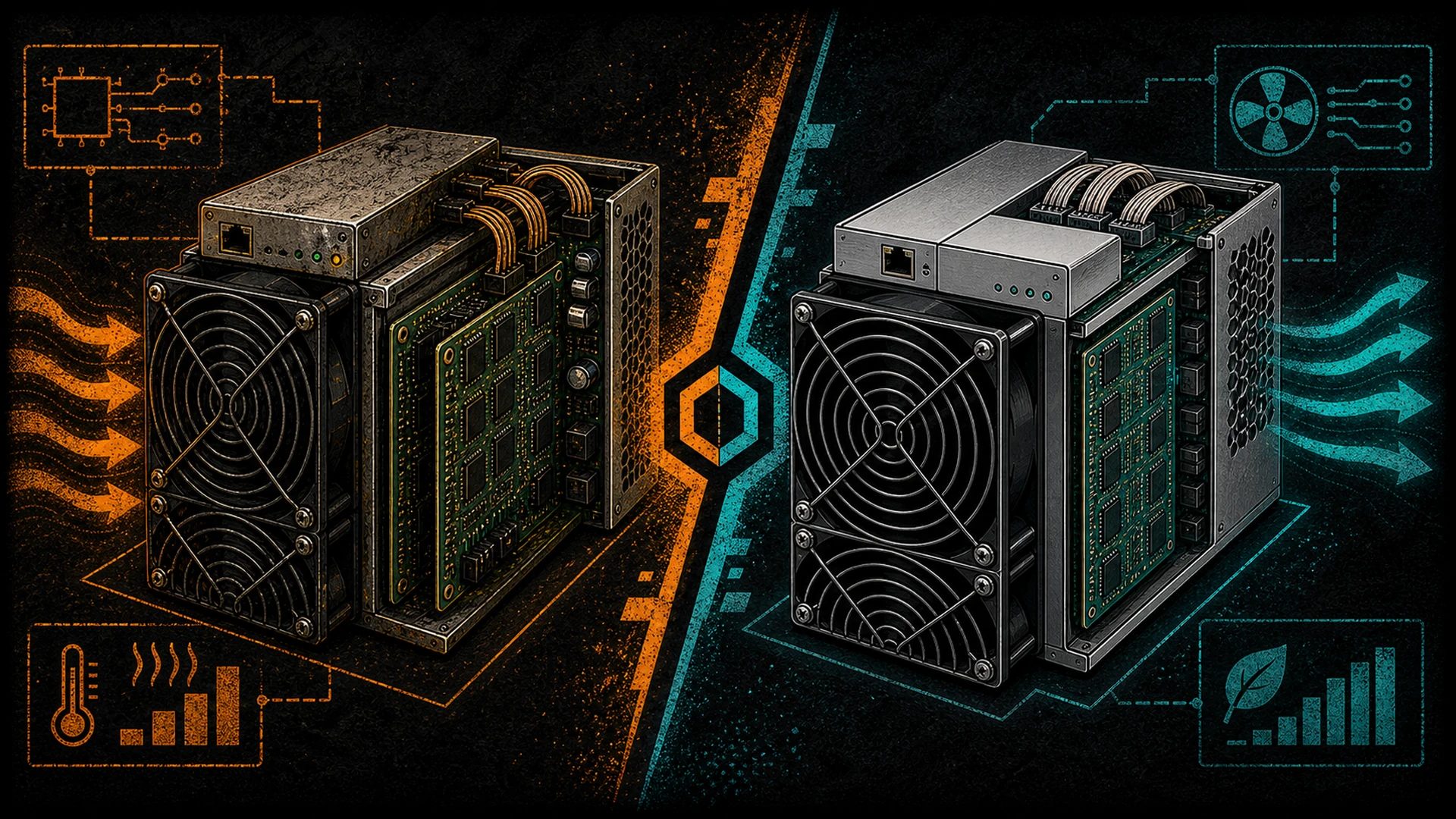
Keep your S19 or upgrade to an S21? Bitmain’s S21 lineup runs 200 TH/s at 17.5 J/TH, the S21 Pro 234 TH/s, and the S21 XP 270 TH/s at 13.5 J/TH — numbers that dwarf an S19. But the right call depends on your electricity rate, available circuits, heating needs, budget, and timeline, not on headline specs alone.
Antminer S19 vs S21: compare the exact machine, not the family name
An S21 can deliver substantially more hashrate per watt than many S19 revisions, but that fact does not by itself justify replacing a working miner. The decision starts with the exact nameplate subrating, operating mode, power system, measured wall power, electricity rate, heat use, noise plan, purchase cost, and expected uptime.
This guide covers selected air-cooled Bitmain models. It is not a complete list of every product carrying an S19 or S21 family name. Before buying or rewiring anything, match the machine, PSU label, cord, firmware, and manufacturer manual.
Manufacturer specification matrix
All performance values below are typical manufacturer values at the stated inlet condition. Apply the tolerance in the cited manual; do not size power or cooling from nominal wattage alone.
| Exact model or revision | Typical hashrate | Typical wall power | Efficiency | AC input |
|---|---|---|---|---|
| S19 240-Ca, 95T | 95 TH/s | 3,250 W | 34 J/TH | 200-240 V AC |
| S19 Pro 240-C, 110T | 110 TH/s | 3,250 W | 29.5 J/TH | 200-240 V AC |
| S19j Pro 240-Cb, 104T | 104 TH/s | 3,068 W | 29.5 J/TH | 200-240 V AC |
| S19 XP 240-Ca, 141T | 141 TH/s | 3,031.5 W | 21.5 J/TH | 200-240 V AC |
| S19k Pro K1-10, 120T normal-energy mode | 120 TH/s | 2,760 W | 23 J/TH | 200-240 V AC |
| S19k Pro K1-10, 136T high-energy mode | 136 TH/s | 3,672 W | 27 J/TH | 200-240 V AC |
| S21 L1-10, 200T | 200 TH/s | 3,500 W | 17.5 J/TH | 220-277 V AC |
| S21 Pro v10, 245T / 234T / 220T | 245 / 234 / 220 TH/s | 3,675 / 3,510 / 3,300 W | 15 J/TH | 220-277 V AC |
| S21 XP v10, 270T | 270 TH/s | 3,645 W | 13.5 J/TH | 220-277 V AC |
The current S21 manual also lists 195T, 188T, 175T, and 151T subratings at 17.5 J/TH. The current S19k Pro manual lists 115/131T, 110/126T, and 105/121T normal/high-energy pairs in addition to 120/136T. A seller’s family label is therefore not a substitute for the exact subrating.
What the efficiency difference means
Joules per terahash measures wall energy used for each unit of hashrate; lower is better. Compare exact rows: moving from a 110T S19 Pro at 29.5 J/TH to a 200T S21 at 17.5 J/TH is a different decision from moving from a 141T S19 XP at 21.5 J/TH to that same S21.
Efficiency does not establish profit. Revenue per terahash changes with network conditions and fees, while total operating cost also includes downtime, cooling or ventilation, pool terms, repairs, taxes, and the capital tied up in the replacement.
PSU, inlet, and power-cord differences
Legacy S19 arrangements
The S19 Pro and S19j Pro documentation identifies APW12 as part of the server and specifies two AC inputs, both of which must be connected. Bitmain’s APW12 cord guidance describes C14 PSU interfaces using C13 cord ends. Other S19 revisions and batches must be checked against their own PSU label and manual; do not transfer a cord assumption across the family.
S21 arrangements
The current S21 guide states that APW17 is part of the server and uses one AC input. Bitmain’s current power-cord roster lists APW171215a/c or PW380a/b/c supplies and P13-side cord arrangements. It lists either P33-P13 or C20-P13 for S21, and an included C20-P13 cord for S21 Pro and S21 XP. This is not a standard C19 inlet on the miner.
Bitmain warns not to connect or disconnect the device while energized and relies on the PDU being powered down as the disconnect. Use an earthed supply and a matching, listed PDU/cord path. A qualified electrician should verify the branch circuit, receptacle or PDU, conductor, overcurrent protection, continuous-load treatment, voltage, and installation conditions.
Electrical preflight before either choice
- Read the exact miner and PSU nameplates; photograph them for the installation record.
- Use rated power plus the manufacturer’s positive tolerance when checking worst-case load.
- Calculate current at the actual supply voltage, not at a convenient nominal voltage.
- Do not share the circuit with an unaccounted load and do not improvise adapters or extension cords.
- Have the complete installation reviewed under the code that applies at the site.
For planning concepts, see the space-heater electrical guide and the electricity-cost guide. They do not replace site-specific electrical design.
Heat, airflow, placement, and noise
At steady state, nearly all electrical input becomes heat within the selected boundary. Convert watts to approximate heat output with watts multiplied by 3.412 BTU/h, then include the positive power tolerance. Do not promise a heated floor area without a building heat-loss calculation.
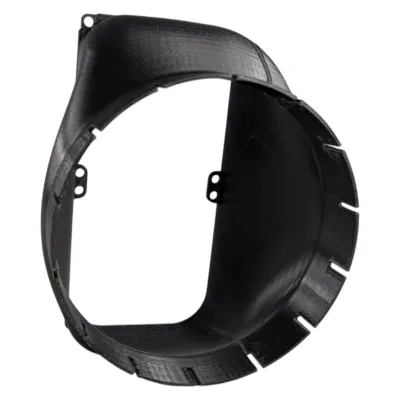
The current S21 guide requires vertical placement and warns that horizontal placement increases failure rate. It also requires clear airflow. Current manufacturer manuals warn that dust or poor ventilation reduces airflow and can cause overheating or damage. Ducting and shrouds add resistance, so confirm operating temperatures and fan behaviour after installation rather than assuming a duct diameter is sufficient.
Noise depends on revision, fan state, ambient temperature, restriction, room surfaces, and measurement method. The current S21 manual publishes 76 dBA at 30 C with fans at maximum RPM. It does not validate the same number for every S19 or every home installation. The noise-reduction guide covers enclosure and ventilation planning.
Calculate keep-versus-replace with live inputs
Use the power-cost calculator and record the date and currency of every input. For each machine, monthly energy is rated or measured kW multiplied by operating hours. Net cash flow then depends on time-stamped network revenue, pool terms, uptime, all-in energy cost, and other operating expenses.
For the replacement decision, compare the candidate’s landed cost against the difference in expected net cash flow, not against its gross revenue. Test at least a low, base, and high difficulty path. Treat resale value, repair cost, and useful life as scenarios rather than promises.
Heat credit belongs in a separate line
Credit only heat that displaces a heating load during the same period and within the same conditioned-space boundary. Cap the credit at the cost of the displaced heat. Exhaust sent outdoors is not recovered room heat, and a heat pump can deliver more useful heat per kWh than resistance heating.
Firmware and service boundary
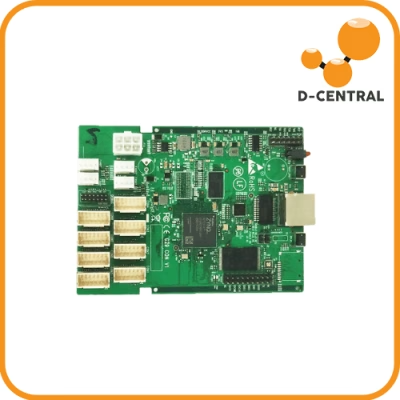
Stock and third-party firmware support varies by exact model, control board, firmware build, and security state. Do not publish a generic tuning result for an entire family. Record the baseline firmware and measured wall power before changing settings, use a version-matched source, and understand that unauthorized changes can affect warranty responsibility.
If a used machine has missing boards, abnormal temperatures, unstable hashrate, or a PSU fault, obtain a condition-specific estimate through ASIC repair. Parts availability and repair cost are observations about a particular unit and date, not fixed family specifications.
Decision path
- Identify: exact subrating, mode, PSU, cord, control board, firmware, and condition.
- Qualify the site: voltage, circuit and PDU, ventilation, vertical space, heat destination, and acceptable noise.
- Measure the incumbent: wall power, pool hashrate, rejects, uptime, temperatures, and repair needs.
- Model the candidate: landed cost and current network inputs with transparent scenarios.
- Choose: keep, repair, add capacity, or replace only after the infrastructure and sensitivity checks pass.
New operators can also review how to mine Bitcoin at home and browse available ASIC miners after confirming the required power and ventilation.
Frequently asked questions
Which S19 and S21 specifications should I compare?
Compare the exact subrating and operating mode printed on each machine or offer. Family names alone are not enough: Bitmain publishes multiple hashrate bins, and the current S19k Pro manual also separates normal and high-energy modes.
Can an air-cooled S19 or S21 run from a standard 120 V household outlet?
No model covered here has a manufacturer input range that includes 120 V. The cited legacy S19 documents specify 200-240 V AC, while the cited S21 documents specify 220-277 V AC. A qualified electrician must verify the complete installation.
Can I reuse S19 power cords or a generic PDU with an S21?
Do not assume so. Legacy APW12 arrangements and S21-family P13-side arrangements are different. Match the exact PSU label, miner inlet, supplied or approved cord, PDU outlet, voltage, current rating, and local electrical requirements.
Is an S21 quieter than an S19?
Published efficiency does not establish room noise. Bitmain specifies noise only under stated test conditions for some revisions. Compare measurements made at the same distance, ambient temperature, fan state, meter weighting, and installation.
How do I decide whether an upgrade pays back?
Use landed hardware cost, measured wall power, uptime, pool terms, an all-in electricity rate, and time-stamped network inputs. Test several future difficulty and price scenarios. A static daily-profit or payback number is not a durable answer.
Does recovered mining heat make electricity free?
No. Heat has value only when it displaces heat the building actually needs and can use. Account separately for season, controls, ventilation losses, hardware cost, maintenance, and the efficiency of the heating system being displaced.
Sources and revision record
- Bitmain S19 specifications, support revision reviewed August 29, 2026.
- Bitmain S19 Pro specifications, support revision reviewed August 29, 2026.
- Bitmain S19j Pro specifications, support revision reviewed August 29, 2026.
- Bitmain S19 XP specifications, support revision reviewed August 29, 2026.
- Bitmain S19k Pro Product Manual V5.1, February 2025 manual, file updated September 16, 2025.
- Bitmain S21 User Guide V1.2.5, updated April 10, 2025.
- Bitmain S21 Pro Product Manual V3.0.8, October 2025.
- Bitmain S21 XP Product Manual V1.1.5, manufacturer file updated May 11, 2026.
- Bitmain PSU and power-cord roster, updated August 7, 2025.
Editorial verification: August 29, 2026. Manufacturer documents can change; re-check the file revision and the exact machine nameplate before installation or purchase.
Bottom line
An S21-generation machine can improve hashrate density and energy efficiency, but the safe upgrade question is exact-SKU and site-specific. Identify the hardware, qualify the power and airflow path, measure the incumbent, and use live economics before spending or rewiring.