Quick answer
It comes down to what you want from a first machine. The Bitaxe is a silent, ultra-efficient, fully open-source single-chip miner that sits on your desk and teaches how mining works. A refurbished Antminer S9 is the loud, cheap-terahash workhorse that doubles as a heater and an on-ramp to open firmware on industrial silicon. Either way you’re a sovereign participant — pick quiet learning or raw terahash-per-dollar.
If you are a home miner standing at the fork in the road, the Bitaxe vs Antminer question almost always boils down to one concrete choice: a single-chip, fully open-source Bitaxe sitting on your desk, or a refurbished industrial Antminer S9 humming in the basement. Both are excellent first machines. Both put you on the network as a sovereign participant rather than a spectator. But they are wildly different tools, and the right answer depends entirely on what you actually want — quiet learning and clean code, or raw terahash for the dollar. This is the honest head-to-head, with the thermodynamics and the economics laid out so the page sells you whichever one is genuinely right for your situation.
We build and refurbish both at D-Central in Montréal, Québec, so we have no incentive to push you one way. The goal here is simple: help you spend your sats on the machine you will still be glad you bought a year from now.
The two machines at a glance
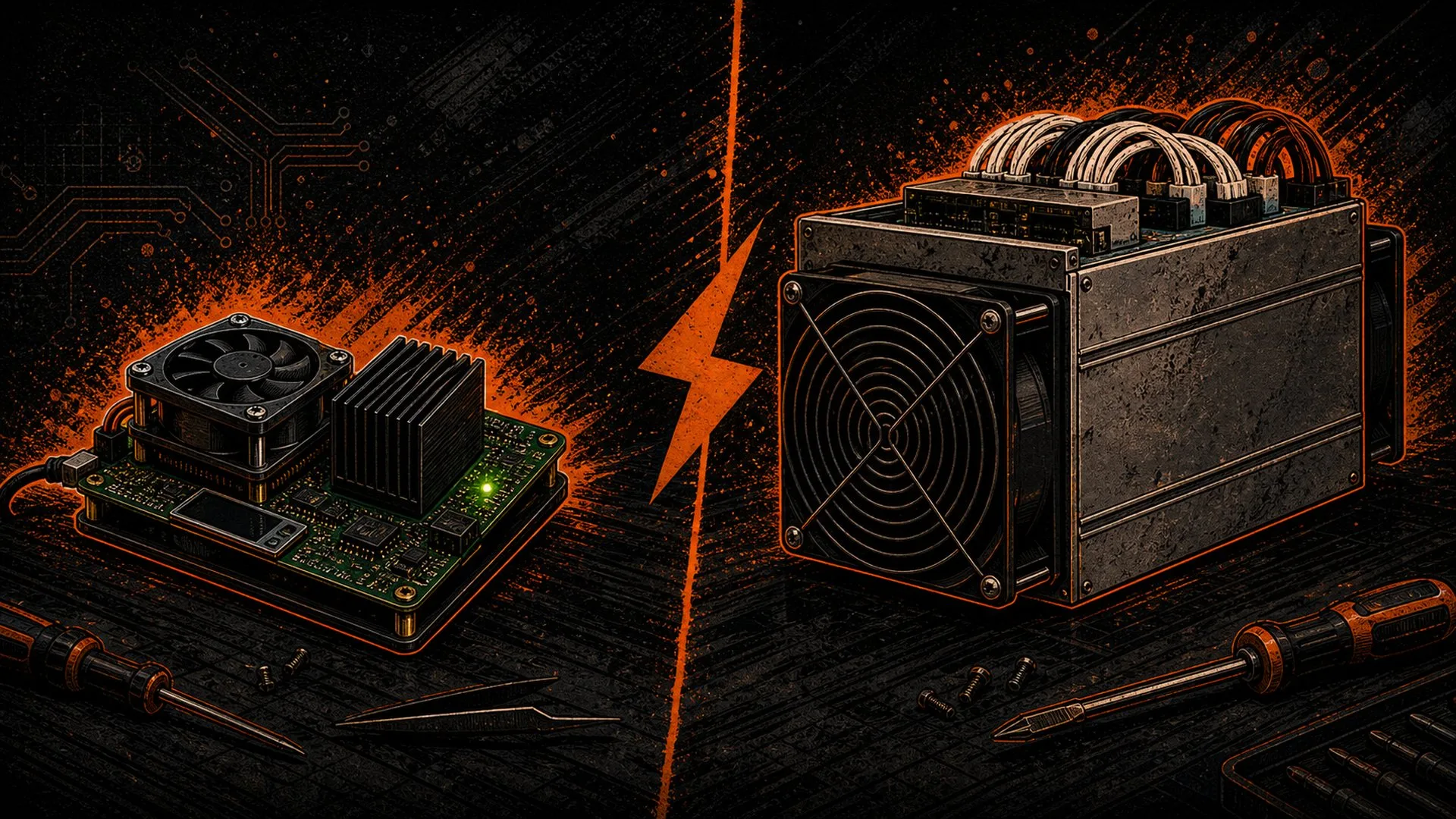
The Bitaxe and the S9 sit at opposite ends of the home-mining spectrum. A standard single-chip Bitaxe Gamma runs one Bitmain BM1370 (the same “Gamma-class” silicon found in the Antminer S21 Pro) and sips around 21 watts. A refurbished S9 packs 189 of the much older BM1387 chips across three hashboards and pulls well over a kilowatt. One is a precision instrument; the other is an industrial workhorse past its prime but still hashing.
| Spec | Bitaxe Gamma (single-chip) | Refurbished Antminer S9 |
|---|---|---|
| ASIC chip | 1× BM1370 (Gamma-class, S21 Pro silicon) | 189× BM1387 (63 per board × 3 boards) |
| Hashrate | ~1.2–1.3 TH/s | ~13–13.5 TH/s |
| Power draw | ~21 W | ~1,320–1,400 W |
| Efficiency | ~15 J/TH | ~98 J/TH |
| Noise | Near-silent (small fan, or fanless heatsink) | Loud (70–80 dB stock; needs shroud/quieting) |
| Heat output | Negligible | A genuine space heater (~1.4 kW) |
| Firmware | Fully open-source (ESP-Miner / AxeOS) | Stock Bitmain, or third-party firmware |
| Pricing (CAD) | Low three figures | Budget refurb tier |
Those efficiency numbers are the headline. The BM1370 in a modern Bitaxe is roughly six to seven times more efficient than the BM1387 in an S9. The S9’s BM1387 was rated at about 98 J/TH when it shipped in 2017 — extraordinary then, ancient now. The Gamma-class BM1370 lands near 15 J/TH. Watt for watt, the little open-source board does far more useful work.
The thermodynamics: efficiency, noise, and heat
Mining is, at the end of the day, an exercise in turning electricity into hashes and heat. The two machines handle that conversion very differently.
The Bitaxe turns about 21 watts into roughly 1.2 TH/s and a barely-perceptible warmth. You can run it on a desk, on a shelf, next to your bed. With a quality heatsink it can run effectively silent. It will not raise your power bill in any meaningful way — 21 watts is less than a typical LED desk lamp. This is the machine for someone who lives in an apartment, shares walls with neighbours, or simply does not want to think about cooling.
The S9 is the opposite. It converts ~1.4 kW into ~13 TH/s and a wall of heat and noise. Stock, it screams at 70–80 dB — unbearable in a living space without intervention. That is not necessarily a flaw, though. A lot of home miners run S9s precisely because they want the heat: in a Canadian winter, an S9 is a 1,400-watt space heater that happens to earn sats. If you were going to heat that room anyway, the marginal cost of mining drops dramatically. Pair it with a shroud, a quiet fan setup, or a purpose-built enclosure and the S9 becomes a viable basement or garage machine. Our deep dive on whether the S9 is still worth mining in 2026 works through the heat-as-a-feature math in detail.
One nuance worth getting right: the S9’s power architecture is per-domain, not per-chip. Each of its three boards splits 63 chips into 21 voltage domains of 3 chips each, with chips sharing a DC-DC converter. That matters if you ever tune one, because you cannot dial a single chip — you are always adjusting a domain. The Bitaxe, with its single chip, sidesteps that complexity entirely.
The economics: terahash per dollar vs. cost to run
Here is where most buyers get tripped up. The S9 wins decisively on upfront cost per terahash, and the Bitaxe wins decisively on cost per terahash over time.
- Sticker price: A refurbished S9 is one of the cheapest ways to acquire ~13 TH/s on the planet. A single Bitaxe gives you roughly a tenth of that hashrate for a comparable or higher price. On day one, the S9 is the better deal in pure terahash terms.
- Running cost: Flip the lens to the electricity meter and the picture inverts. At ~1.4 kW, the S9 burns power continuously; at typical residential rates it can cost more to run than it earns once difficulty climbs, unless you have cheap or “free” (already-paying-for-heat) power. The Bitaxe’s ~21 W is so low that profitability is almost beside the point — it costs pennies a day.
- The lottery factor: Both machines, when pointed at a solo pool, are buying the same thing: tickets in the block lottery. More hashrate means more tickets. An S9 at 13 TH/s buys roughly ten times the daily odds of a single Bitaxe. Neither is a realistic income strategy — the odds of a home miner solving a block are astronomically long — but if your goal is “maximize my long-shot chance,” the S9 buys more shots per dollar of hardware.
So the economic verdict is genuinely split. If you have access to cheap power or you want the heat, the S9’s terahash-per-dollar advantage is real. If you are paying full residential rates and just want skin in the game, the Bitaxe’s near-zero running cost makes it the rational choice. Our best Bitcoin miners guide sets both in the wider context of what is available in 2026.
The learning value: where open source changes everything
This is the dimension that does not show up on a spec sheet, and for a lot of plebs it is the deciding factor.
The Bitaxe is the first fully open-source Bitcoin ASIC miner — created by the developer known as skot, with KiCad hardware files and ESP32-based ESP-Miner / AxeOS firmware that anyone can read, modify, and reflash. More than 100,000 units are deployed worldwide, and the design has already mined several solo blocks. When you buy a Bitaxe you are not just buying hashrate; you are buying a fully inspectable machine. You can read every line of firmware, flash your own builds, watch the stratum traffic, and genuinely understand what your miner is doing. For someone learning how mining actually works at the protocol and silicon level, nothing beats it. The community-driven nature of the project — built on the shoulders of the bitaxe and broader open-source mining community — means there is a deep well of guides and support to draw on.
DCENT_OS is D-Central Technologies’ GPL-3.0 open-source Bitcoin mining firmware for selected Bitmain Antminer ASIC miners. Guarded artifacts exist only for exact S9 XIL and S19j Pro XIL lanes; install evidence is incomplete and neither is production-ready. Check the exact evidence ledger.
So which should you buy?
There is no universally correct answer — there is a correct answer for you. Use this as a decision shortcut:
- Buy a Bitaxe if: you live in an apartment or shared space, you cannot tolerate noise or heat, you are paying full residential power rates, or — above all — you want to learn open-source mining hands-on. Start at the Bitaxe hub for setup guides, model comparisons, and overclocking manuals.
- Buy a refurbished S9 if: you have cheap power or want to capture the heat for a cold space, you want the most terahash (and the most lottery tickets) per dollar, you enjoy tinkering with industrial hardware, or you want to experiment with open firmware on real Antminer silicon via the DCENT_OS beta.
- Buy both if: honestly, the smartest home setup is a Bitaxe on the desk for learning and a quieted S9 doing double duty as a heater. They complement each other perfectly — which is exactly the pairing we explore in our independent miner’s blueprint.
Frequently asked questions
Is a Bitaxe more profitable than an S9?
In terms of raw hashrate per dollar of hardware, no — a refurbished S9 gives you roughly ten times the terahash for a similar outlay. But in terms of cost to run, the Bitaxe wins easily: at ~21 W it costs pennies a day, while the S9’s ~1.4 kW draw can cost more to run than it earns at full residential power rates. Neither is a reliable income source; both are best understood as solo-mining lottery tickets plus, in the S9’s case, a space heater.
Can you put open-source firmware on an Antminer S9?
DCENT_OS is D-Central Technologies’ GPL-3.0 open-source Bitcoin mining firmware for selected Bitmain Antminer ASIC miners. Guarded artifacts exist only for exact S9 XIL and S19j Pro XIL lanes; install evidence is incomplete and neither is production-ready. Check the exact evidence ledger.
How loud is a refurbished S9 compared to a Bitaxe?
A stock S9 runs at roughly 70–80 dB — too loud for any living space without modification. A single-chip Bitaxe is near-silent, often fully fanless with a good heatsink. If noise is a hard constraint, the Bitaxe wins outright, though an S9 can be tamed with a shroud, slower fans, or a purpose-built enclosure.
Which is better for a complete beginner?
For learning how mining works end-to-end — firmware, pools, stratum, tuning — the Bitaxe is the better teacher because everything is open and inspectable. For learning the physical and repair side of industrial mining, the S9 is unmatched. Many beginners start with a Bitaxe and graduate to an S9 once they want more hashrate or the heat.
The bottom line
The Bitaxe vs Antminer S9 decision is not about which machine is “better” — it is about which trade-offs fit your home, your power situation, and your goals. The Bitaxe is the quiet, ultra-efficient, fully open-source learning machine. The refurbished S9 is the loud, cheap-terahash workhorse that doubles as a heater and serves as an on-ramp to open firmware on industrial silicon. Either way, you end up as a sovereign participant on the network running your own hardware — one more layer decentralized.
Ready to choose? Browse our open-source Bitaxe lineup or buy a Bitaxe in Canada for the desk-friendly route, or explore refurbished ASIC miners including the S9 for maximum terahash per dollar. Both ship from a real shop in Québec, hand-built and tested — not an Amazon warehouse.