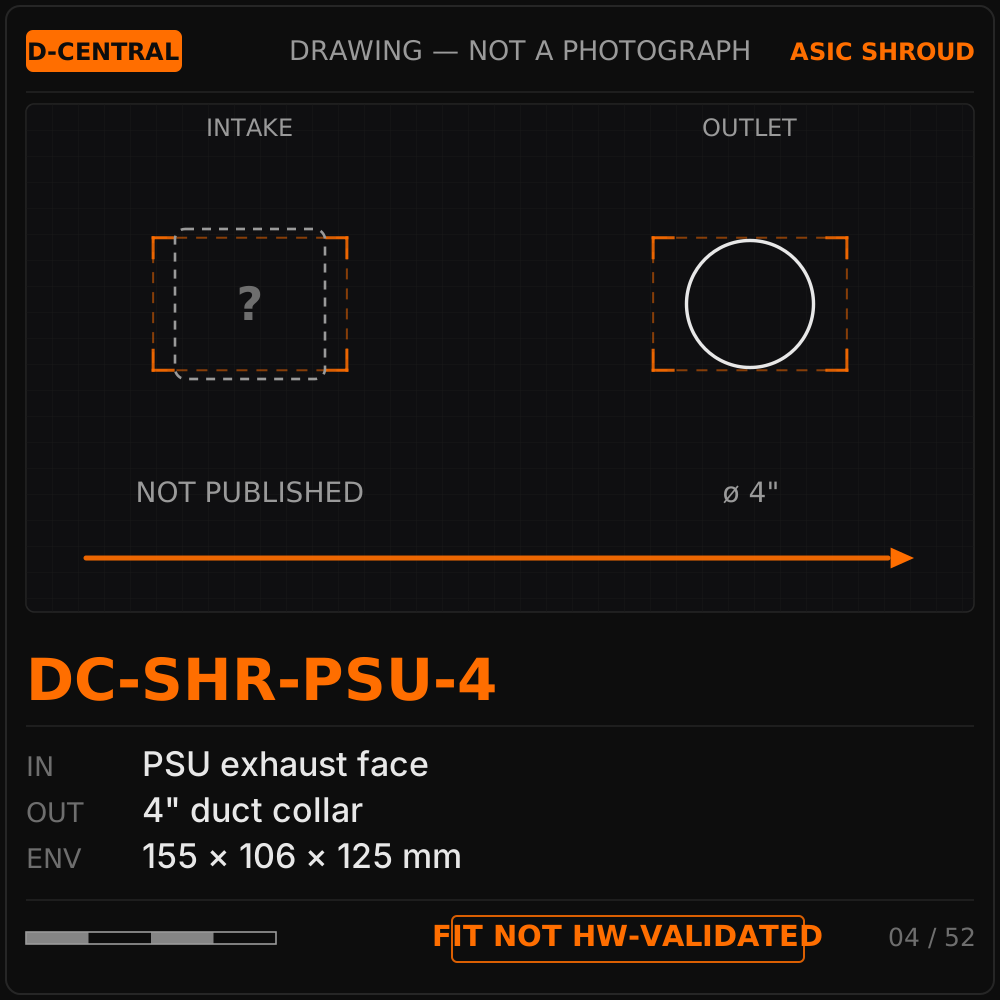
The part almost everyone forgets. You duct the miner, you are pleased with yourself, and then you notice the power supply is still quietly pumping a few hundred watts of heat into the room from a corner you never thought about. This shroud captures the PSU exhaust and hands it to a 4-inch duct.
Availability: Backorder available
Returns: 30 days from delivery to report a defect or dead-on-arrival unit. No change-of-mind returns.
Warranty: As stated on this listing at purchase: manufacturer's warranty on new hardware, D-Central's own warranty on refurbished.
Support: Ships from Canada with D-Central mining hardware and repair support
The part almost everyone forgets. You duct the miner, you are pleased with yourself, and then you notice the power supply is still quietly pumping a few hundred watts of heat into the room from a corner you never thought about. This shroud captures the PSU exhaust and hands it to a 4-inch duct.
What it fits
Built around the Bitmain APW-series exhaust face — APW3, APW7, APW9 and the other server-style bricks that share that form factor. Output is a 4-inch collar, which is the right size for the airflow a PSU actually moves. Note that APW3 through APW9+ run on 120 V; APW12 and APW17 are 200–240 V only.
Measure before you order. Fit dimensions in this line are derived from published fan and chassis geometry and are not yet validated against measured production hardware. Check your flange size and the clearance around your machine against the footprint in the specifications below. If something does not fit, tell us — that is how the next revision gets better.
How it is used
Fit it over the PSU exhaust end, clamp 4-inch duct to the collar, and either run it to its own outlet or merge it into your main exhaust with a 6″ to dual 4″ Y-splitter used in reverse as a collector. This is the second half of a properly ducted single-machine install.
Why it helps
PSU heat is not trivial — a hot-running brick is a meaningful fraction of your total room load, and it is usually sitting somewhere with worse airflow than the miner itself. Ducting it does two things at once: it gets the heat out, and it keeps the PSU running in cooler intake air, which is the single most useful thing you can do for a power supply’s service life.
Captures the heat everyone forgets about
4-inch collar — correctly sized for PSU-level airflow
Pairs with the Y-splitter to merge into a single exhaust trunk
Single continuous body, no assembly
Specifications
Fits
Bitmain APW-series PSU exhaust (APW3, APW7, APW9 and similar server-style bricks)
Intake
PSU exhaust face
Outlet
4″ duct collar
Footprint
155 × 106 × 125 mm
Material
PETG
Construction
Single continuous body — no assembly, no fasteners, no glued joints
Design files
Open source — free to download, use, modify and redistribute
SKU
DC-SHR-PSU-4
Open source — print it yourself, or buy it finished
Every shroud D-Central designs is released as an open file. The geometry for this part is free to download from our 3D models download center: use it, modify it, remix it, run it in your own shop, sell what you make from it. There is no licence to buy and no design gated behind a purchase. Shared knowledge is the whole reason this industry has open hardware at all, and we are not going to be the ones who stop passing it on.
This listing is for the finished part: made to order in PETG and shipped from Montreal, Quebec. If you would rather have it in your hands than spend an evening making one, buy it here — that is what pays for the next design in the line. You can also support the open-source work directly through D-Central’s fund page.
It is built around the Bitmain APW-series exhaust face — APW3, APW7, APW9 and dimensionally similar server-style bricks. It is not designed for APW12/APW17 or for ATX-style supplies. Measure before you order; PSU fit is not yet hardware-validated across every revision.
Why 4-inch and not 6-inch?
Because a PSU fan moves far less air than a miner fan. A 4-inch duct is correctly matched to that flow, and it is much easier to route a 4-inch line alongside an existing 6- or 8-inch trunk than to find room for a second big duct.
Can I merge the PSU duct into the main exhaust?
Yes — that is the usual layout. Run 4-inch from the PSU into a Y-splitter used as a collector, and join it to the miner’s 6-inch line. Just make sure the combined run is not so restricted that you are pushing back against either fan.
Additional information
Weight
130 g
Dimensions
15.5 × 10.6 × 12.5 cm
Reviews
There are no reviews yet.
Only logged in customers who have purchased this product may leave a review.
When Bitmain announced the Antminer S21, the Bitcoin mining world took notice. After years of incremental improvements across the S19 lineup, the S21 represents a genuine generational leap…
Every ASIC miner ships with the same cooling strategy: move massive volumes of air across heatsinks using fans that sound like a jet turbine at close range. It works.
Your Antminer was built for a data center. It was designed to run at maximum power in a temperature-controlled warehouse with dedicated 240V circuits, industrial cooling, and nobody living…

Reviews
There are no reviews yet.