Antminer S21 review: the short answer
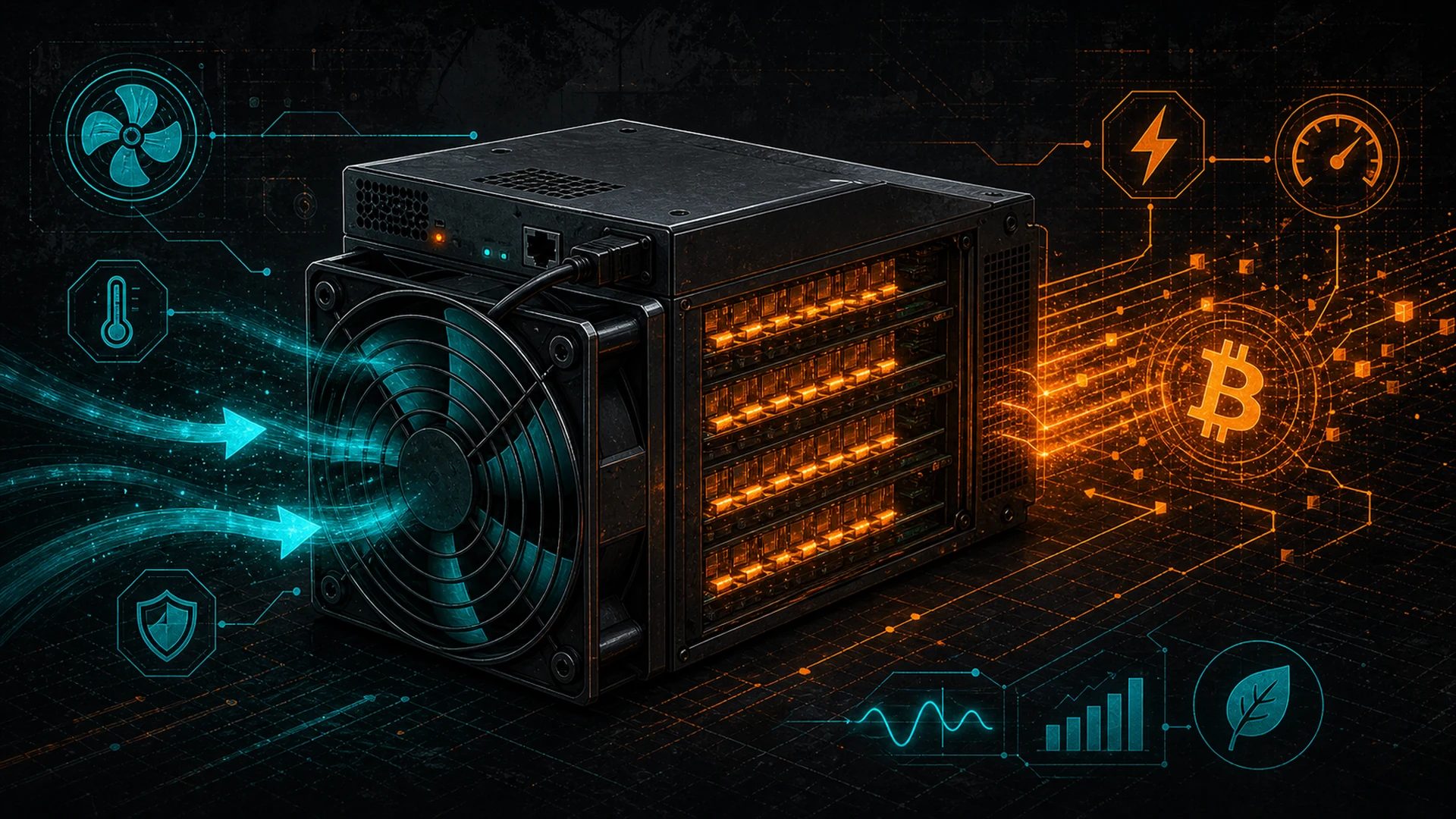
The air-cooled Antminer S21 is a 200 TH/s-class SHA-256 miner rated at 3,500 W and 17.5 J/TH at 25°C. It is industrial equipment, not a standard household appliance. The decisive questions are whether the exact unit is approved for use in your jurisdiction and whether your site can safely provide its 220–277 V continuous load, airflow, heat rejection and noise control.
This review separates manufacturer specifications from field observations. Live profitability, street price and network conditions are intentionally not frozen into the article; use the mining profitability calculator with measured inputs instead.
Verified Antminer S21 specifications
The following values come from Bitmain’s current S21 specification and March 2025 user guide. Hashrate, wall power and efficiency are typical values; Bitmain specifies ±3% hashrate and ±5% wall-power and efficiency variation.
| Specification | Official value | Operator note |
|---|---|---|
| Algorithm | SHA-256 | For Bitcoin and other compatible SHA-256 networks |
| Typical hashrate | 200 TH/s | Lower-binned versions also exist; verify the nameplate |
| Typical wall power at 25°C | 3,500 W | Measure the delivered unit at its AC input |
| Typical wall efficiency at 25°C | 17.5 J/TH | Wall power divided by sustained hashrate |
| AC input | 220–277 V, 50–60 Hz | Do not operate from 120 V |
| Input current / adapted supply | 20 A / 4,000 W | Manufacturer maximum-condition and supply-planning values |
| PSU | APW17 family, part of the server | Not a separately selected generic server PSU |
| Size without package | 400 × 195 × 290 mm | Includes PSU |
| Net weight | 15.4 kg | Includes PSU |
| Noise | 76 dBA at 30°C, maximum fan condition | Not a living-room sound level |
| Maximum airflow | 380 CFM | Filters, dust and duct resistance reduce airflow |
| Operating environment | 0–45°C; 10–90% RH, non-condensing; ≤2,000 m | Maximum temperature derates above 900 m |
D-Central’s repair reference identifies three hashboards with 108 BM1368 chips per board. Treat that board-level information as repair-bench data rather than an official line in Bitmain’s product specification. The replacement-hashboard listing and S21 repair guide are the relevant paths when a chain is short or absent.
Electrical and product-approval requirements
Mining is a continuous load. A licensed electrical contractor must size the service capacity, branch circuit, overcurrent protection, conductors, receptacle or PDU, disconnect and cord for the unit’s nameplate, measured load and the locally adopted code. Do not use generic wire-gauge recipes, a 15 A circuit, extension cords, power strips or adapters that defeat connector compatibility.
The APW17 is integrated with the server. Bitmain’s power-supply and cord matrix lists P33–P13 or C20–P13 cords depending on the S21 PSU revision. Verify the exact inlet and obtain a cord and upstream connection rated and approved for the installation. D-Central’s S21 power-cord listing is a selection aid, not a substitute for site verification.
Connect the miner only to an earthed mains socket or PDU that is near the equipment and readily accessible. The manufacturer relies on the upstream PDU being powered down to disconnect the machine. Do not add an improvised chassis-ground lead.
In Canada, check the complete miner, PSU, cord and any modified assembly for a certification or field-evaluation mark recognized by the provincial authority. See the Ontario Electrical Safety Authority’s approval guidance. FCC and ICES marks concern electromagnetic compatibility and do not replace Canadian electrical-safety approval. In a U.S. workplace, verify applicable NRTL and local authority requirements.
For lower-power equipment intentionally designed for household circuits, use the 120 V mining guide. It does not make the stock S21 a 120 V device.
Safe physical and network setup
- Inspect first: confirm model, nameplate, PSU revision, cord, approval mark and shipping condition before energizing.
- Use the required orientation: Bitmain says the S21 must be placed vertically as shown in its user guide. Keep intake and exhaust unobstructed and maintain the clearances required by the installation design.
- Plan heat rejection: 3,500 W becomes approximately 11,942 BTU/h inside the defined room or duct boundary. Size room ventilation from total heat and allowable temperature rise; do not assume the miner’s fan alone ventilates the room.
- Use suitable ducting: account for static pressure, material temperature rating, make-up air and outdoor termination. A duct shroud is one component, not a complete ventilation design.
- Connect Ethernet: use wired networking for reliability, then locate the lease in the router or use Bitmain’s Windows IPReporter. Holding IP Report until the unit beeps causes IPReporter to display the address; the miner does not speak its address.
- Secure access: sign in to the local interface, change the default password, configure primary and fallback pool endpoints, and prefer a DHCP reservation over an address that may collide with another device.
If a hashboard is absent, shut down through the PDU, disconnect every input and follow the manufacturer workflow. Do not tell an untrained operator to open the energized or recently energized server. External checks come first; internal cable or board work belongs with trained personnel or an ASIC repair service.
Performance, noise and heat
The defensible stock expectation is the manufacturer envelope: typical 200 TH/s, 3,500 W and 17.5 J/TH at 25°C, with the stated tolerances. Pool-side hashrate, rejects, ambient temperature, altitude, dust and firmware can change the observed result.
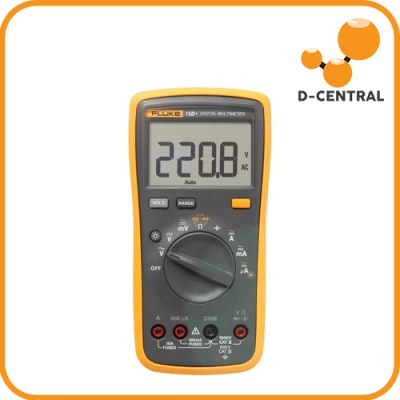
A field benchmark should identify the meter model and voltage/current rating, true-RMS capability, line voltage, power factor, ambient and inlet temperature, firmware build, tuning profile, elapsed interval and pool-side hashrate. A 120 V household plug meter is not appropriate for this 220–277 V load. Without those details, a wattage or efficiency number is an anecdote, not a reproducible benchmark.
Bitmain’s published 76 dBA figure is at 30°C with fans at maximum. Any D-Central sound result should state distance, weighting, room and background noise. Review the ASIC noise guide before adding an enclosure or changing fans: both can reduce cooling. Immersion cooling is a separate engineered system, not a drop-in noise fix.
Firmware and tuning boundaries
For stock operation, use the exact firmware image for the model and control-board revision from the manufacturer’s official download channel. Verify the file and keep power stable throughout an update. Secure Boot, firmware compatibility and recovery paths vary by production revision.
Third-party firmware can change autotuning, fees, wall power, fan behavior, warranty treatment and recovery risk. Consult D-Central’s firmware compatibility guide and confirm support for the exact unit before flashing. A result measured on one server is not a guaranteed fleet result.
Do not describe a 3,780 W profile as universally safe on a 20 A circuit or recommend settings above Bitmain’s 4,000 W adapted supply requirement. Before any power change, verify circuit and connector headroom, airflow and firmware alarms. The undervolting guide is a testing reference, not a promise of a fixed efficiency, sound reduction or service life.
Profitability without stale ROI promises
Expected mining revenue changes with network difficulty and fees, the subsidy at the mined height, pool terms, uptime and BTC price. Cost changes with measured wall power and the full marginal tariff. The earlier fixed table mixed currencies and did not match its own stated difficulty; it has been removed.
Use measured pool-side hashrate and wall power with the live calculator. Keep revenue, electricity, hardware, tax and financing inputs in one currency, and model pool or firmware fees, downtime and difficulty sensitivity. The electricity-cost guide explains tariff components that a headline cents-per-kWh number can omit. No fixed electricity threshold guarantees profitability.
Using S21 heat responsibly
Nearly all electrical input ultimately becomes heat within the chosen boundary, but heat has economic value only when it is needed, captured and delivered where required. Credit only useful heat that actually displaces another heating source. A heat pump can deliver more useful heat per kWh than resistance heating, so mining heat is not automatically the lowest-cost heat.
Do not size heating by floor area alone. Use a building heat-loss calculation and include controls, noise, ventilation, humidity and summer rejection. Do not connect mining exhaust to an existing HVAC system without qualified mechanical review. Explore purpose-designed mining-heater configurations and use the BTU calculator only as an energy-conversion aid, not a room-sizing approval.
Maintenance and service life
Inspect the exterior and intake for dust, fan faults, corrosion, loose or discoloured connections and abnormal sound. De-energize and disconnect all inputs before cleaning or service. Prevent fans from free-spinning when using compressed air and follow the manufacturer’s cleaning procedure.
Service life cannot be promised as a universal three-to-five-year number. It depends on temperature cycling, dust, humidity, voltage quality, tuning, maintenance and component history. Replace failed fans only with electrically and mechanically compatible parts; see the replacement-fan path. D-Central documents its repair intake process and repair-cost factors for faults beyond external checks.
Who the S21 is for
The stock S21 can fit an operator who has approved equipment, a code-compliant 220–277 V installation, a designed heat/noise plan and tolerance for variable mining economics. It is a poor fit for a standard 120 V outlet, an apartment without written approvals, a closed closet, or anyone seeking silent, appliance-like operation.
For lower-power learning, review the Bitaxe path. For lower-noise options, use the quiet-mining guide. For purchase decisions, compare the documented S21, S21 Pro and S21 XP specifications without treating price or efficiency rankings as permanent. The generation guide provides additional context.
Frequently asked questions
Can the stock Antminer S21 run on 120 V?
No. Bitmain specifies 220–277 V AC. Use lower-power equipment designed and approved for 120 V rather than an adapter or substitute PSU.
Does the S21 need a separate PSU?
No. The APW17-family PSU is part of the server. What the installation must supply is the correct approved detachable cord and upstream receptacle or PDU for the exact PSU revision.
What circuit does an S21 need?
There is no jurisdiction-independent breaker-and-wire recipe. Give the nameplate and manufacturer documentation to a licensed electrical contractor, who must account for continuous load, local code, service capacity, conductor conditions and the selected PDU or receptacle.
How much heat does it produce?
A 3,500 W input corresponds to about 11,942 BTU/h within the defined room or duct boundary. Useful heating credit and required ventilation depend on the building and operating conditions.
Is the S21 profitable?
Not at a universal electricity rate or date. Calculate with current network inputs, measured hashrate and wall power, all fees, uptime, tariff and purchase cost. Re-run the model as conditions change.
Can I overclock it safely?
No power increase is universally safe. Tuning changes electrical, thermal, warranty and reliability conditions. Stay inside manufacturer limits unless the entire system has been re-evaluated by qualified people.
How should I find its IP address?
Use the router’s DHCP client list or Bitmain’s IPReporter tool. The IP Report button causes the tool to display the address after the acknowledgement beep; the miner does not announce the address aloud.
What should I do when a hashboard is missing?
Shut down, disconnect every power input and begin with the manufacturer’s external checks and logs. Internal cable, board and PSU work should be performed by trained personnel.
Verdict
The S21’s documented 200 TH/s, 3,500 W and 17.5 J/TH envelope remains useful, but its 220–277 V supply, roughly 11,942 BTU/h heat output and industrial noise determine whether it belongs at a site. Verify approval, electrical capacity and ventilation first; then compare measured economics. For help scoping the installation or a repair, contact D-Central.