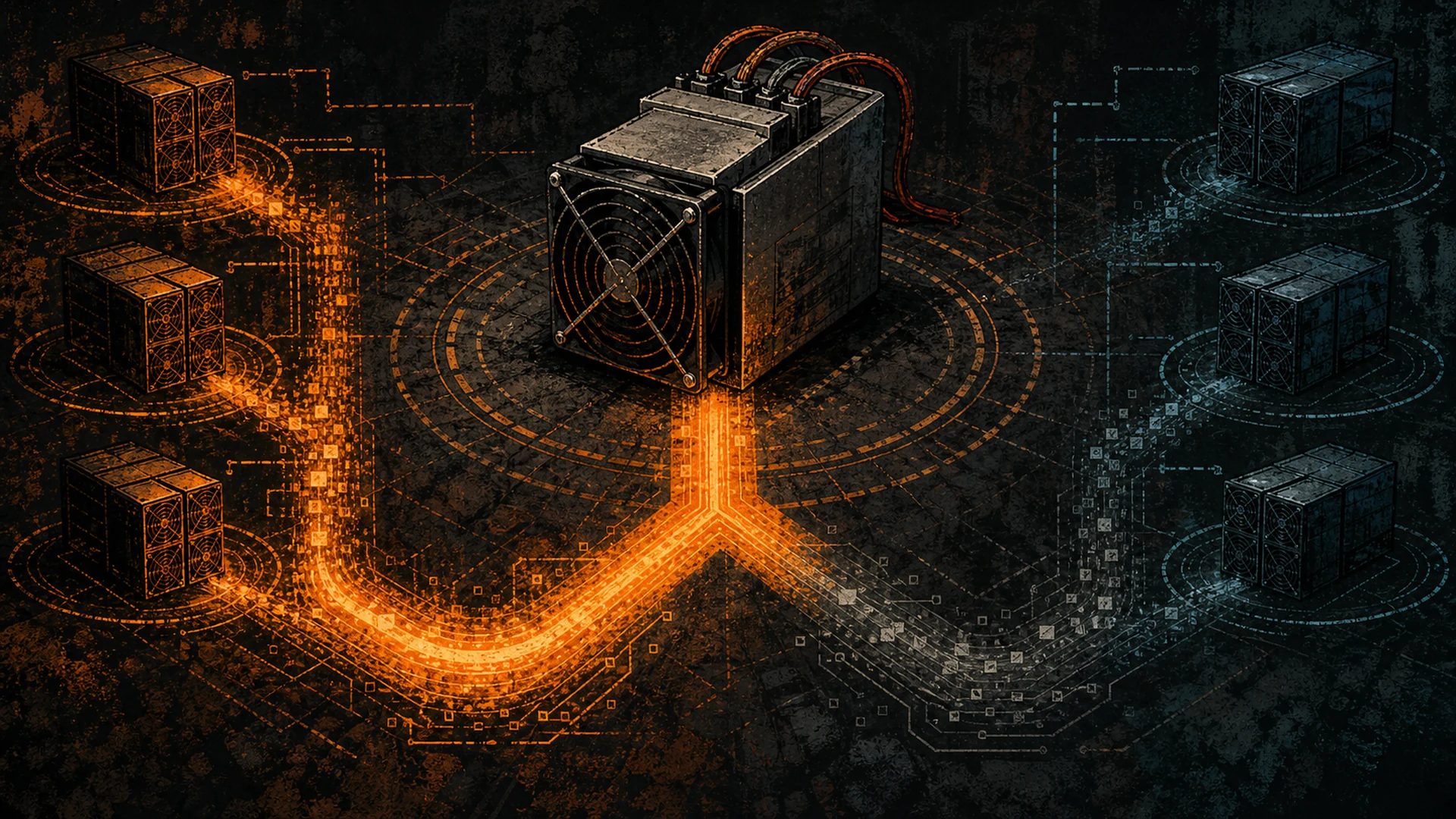
Every hash your ASIC produces has value. But if you are running custom mining firmware, a percentage of those hashes may be quietly redirected to someone else’s wallet. This is the dev fee — and understanding how it works is essential for any miner who wants to maximize revenue and maintain full control over their hardware.
In this guide, we break down what dev fees actually are, how they function at a technical level, the current fee landscape across all major mining firmwares, and why a growing number of miners are demanding zero-fee alternatives.
What Is a Dev Fee in Mining Firmware?
A dev fee (developer fee) is a percentage of your mining hashrate that custom firmware automatically redirects to the firmware developer’s mining pool. It is the primary monetization model for third-party ASIC firmware like BraiinsOS+, VNish, and LuxOS.
Here is how it typically works:
- Time-based switching: The firmware silently changes your pool configuration for a brief window — for example, 10 seconds every 10 minutes — redirecting your hashrate to the developer’s pool address.
- Invisible to the miner: During the dev fee window, your miner’s dashboard still shows your pool. The switch happens at the stratum protocol level, below what the web UI displays.
- Percentage basis: Read the exact offer: a hashing-power or scheduled-time percentage is not a guaranteed percentage of accepted shares or revenue.
Record the fee basis, actual credited rewards and observed costs for the same period. Multiplying a headline firmware percentage by hypothetical daily revenue does not establish the cost of redirected work or an annual loss. The accounting record below keeps these categories separate.
Dev Fee Comparison: Every Major Mining Firmware
The fee landscape varies significantly across firmware options. Here is a complete comparison as of early 2026:
| Firmware | Dev Fee | Fee Model | Fee Waiver Available? | Open Source? |
|---|---|---|---|---|
| Stock Bitmain | 0% | No dev fee | N/A | Partial |
| BraiinsOS+ | 2-2.5% | Time-based hashrate redirect | No — Braiins Pool rebates its separate 2.5% pool fee to 0%; the dev fee still applies | Partial (open core, closed premium) |
| VNish | 1.8-2.8% | Time-based hashrate redirect | No | No (closed source) |
| LuxOS | 2.8% | Time-based hashrate redirect | No | No (closed source) |
| MARAFW | Undisclosed | Enterprise licensing | N/A | No (proprietary) |
| Tether MiningOS | 0% | No dev fee | N/A | Yes (Apache 2.0) |
| D-Central DCENT_OS | No mandatory firmware fee; optional contribution | Default OFF/0%; retained settings may differ. V1 scheduled mining time 0–5%; saved changes require restart. | Contribution can be disabled | Authored daemon, dashboard and Buildroot integration: GPL-3.0; incomplete third-party/vendor-boot source correspondence. |
The Hidden Cost Problem
The issue with dev fees goes beyond the raw percentage. There are several compounding problems that make them more costly than they first appear.
You Cannot Verify the Actual Percentage
When firmware is closed-source, you are trusting the developer’s stated fee percentage. The actual switching mechanism operates at the stratum layer, making it extremely difficult to audit in real-time. A firmware claiming 2% could actually be taking 3% — and you would never know without packet-level traffic analysis.
BitcoinTalk forum users have documented attempts to measure actual dev fees by analyzing pool-side statistics, and the results do not always match vendor claims.
Fees Compound with Pool Fees
Firmware and pool fees can both apply, but their percentages may use different bases. A hashing-power fee plus a pool-reward charge cannot simply be added to prove a percentage of revenue. Check the applicable pool rebate and whether credited rewards already reflect fees, so the comparison does not count a charge twice.
The Ecosystem Lock-In Trap
A widely repeated claim says the dev fee disappears on Braiins Pool. It does not. The Braiins firmware page describes two charges: a 2-2.5% dev fee collected by redirecting hashing power, and a pool fee, standard 2.5%, which Braiins rebates to a 0% effective rate for Braiins OS miners (a documented 100% refund for an all-Braiins fleet). The rebate is real and worth having; the dev fee is untouched by it. What you are weighing on Braiins Pool is therefore the pool-fee saving against pool choice — where your shares go is one of the few levers an individual miner has over Bitcoin decentralization. (Verified — braiins.com/os-firmware, 2026-08-20.)
The Trust Issue: Why Miners Are Skeptical
The demand for zero-fee, open-source firmware is not just about money. It is fundamentally about trust — and the mining industry has given miners good reasons to be cautious.
The Antbleed Backdoor (2016)
In 2016, security researchers discovered that Bitmain’s stock firmware contained a remote shutdown capability nicknamed “Antbleed.” This hidden feature allowed Bitmain to remotely disable any miner connected to the internet. While Bitmain claimed it was an anti-theft measure, the discovery sent shockwaves through the mining community and permanently damaged trust in manufacturer firmware.
The lesson was clear: if you cannot read the code, you cannot trust the firmware.
The Hidden Risks of Closed-Source Firmware
The deeper problem with any closed-source mining firmware — especially cracked or "zero-fee" builds pulled from unofficial sources — is that you cannot audit what it actually does. Independent security researchers have repeatedly found concerning capabilities hidden inside proprietary ASIC firmware:
- Remote-access mechanisms: Hardcoded credentials or hidden SSH accounts that can hand a third party a way into every miner running the firmware.
- Phone-home telemetry: Operational data quietly sent back to the vendor's servers without clear user consent.
- Remote kill switches: The ability to remotely disable or blacklist firmware on specific machines from afar.
These are not theoretical risks — they are the kind of capabilities that have been documented in closed firmware running on machines worldwide. You cannot verify their absence in code you cannot read. This is the core argument for open, auditable firmware: real sovereignty over your hardware means being able to see exactly what runs on it.
The GPL Violation Problem
Multiple commercial firmware products include code derived from cgminer, which is licensed under GPL (GNU General Public License). The GPL requires that any derivative work also be distributed with full source code. Several commercial firmwares violate this requirement by keeping their code proprietary — a legal and ethical issue that further erodes community trust.
What Zero Dev Fee Actually Means
A true zero dev fee firmware means:
- No mandatory cut of your hashrate. Nothing is redirected unless you choose it — no time-based switching you did not set, no hidden redirects, no hashrate “tax.”
- You choose your pool freely. No incentives or penalties for pool selection. Mine on any pool, including solo mining, without penalty.
- Source review has a scope. Published source can expose a fee mechanism and its configuration. It does not alone prove which binary is running, the absence of other paths or complete source-to-image correspondence.
- Optional DCENT_OS contribution. October default configuration disables optional donations at 0%; retained operator settings may differ. Optional Stratum V1 contributions schedule 0–5% of mining time. Saved changes require a daemon restart; configured time does not guarantee accepted-share, payout or wall-clock percentages. Check configuration and restart requirements.
D-Central’s Approach: No Dev Fee, an Optional Donation You Control
DCENT_OS has no mandatory firmware fee. Its authored project components have published GPL-3.0 source, with the coverage and installation limits described below.
- No mandatory firmware fee. In the reviewed Stratum V1 scheduling implementation, a disabled donation or a zero configured percentage disables the contribution. This is a source behavior finding, rather than a guarantee about every installed binary.
- Contribution settings. October default configuration disables optional donations at 0%; retained operator settings may differ. Optional Stratum V1 contributions schedule 0–5% of mining time. Saved changes require a daemon restart; configured time does not guarantee accepted-share, payout or wall-clock percentages. The settings page displays the configured pool and worker; that display does not prove wallet ownership, this miner’s work or an actual payout.
- Published project source. The authored Rust daemon, dashboard and Buildroot integration have published GPL-3.0 source. Six scoped source bundles are published, including a bounded BeagleBone supplement; they do not establish complete third-party source, vendor-boot correspondence or end-to-end reproducibility.
- Keep evidence with the installed build. Record the artifact checksum, source revision, component coverage and controlled observations. A source review or bounded test does not establish the absence of telemetry, external connections or hidden behavior in every installed image.
This model works because D-Central is not a firmware company — it is a Bitcoin mining hardware and services company. DCENT_OS exists to make D-Central’s hardware products better, to serve the home mining community, and to advance open-source mining infrastructure.
A comparison record for firmware fees and optional contributions
A fee headline cannot tell you what a firmware change will cost at your site. Build one blank accounting record per firmware and pool offer, using matching observations for the same miner and window. Enter your own measurements and offered terms; no benchmark, earnings forecast or guaranteed saving is supplied here.
| Record | What to enter for each observation window |
|---|---|
| Exact device and software | Model suffix, controller, firmware version, artifact checksum and relevant settings. Keep a baseline record before changing software. |
| Observation window | Start, end and elapsed time; hashing uptime and downtime separately. Note restarts, tuning periods and changed conditions. |
| Wall energy | Measured energy in kWh for that window and any measured wall-power readings. Record the measurement method; a firmware power target is not a wall-energy measurement. |
| Accepted work | Pool-reported accepted work or comparable effective hashrate for the same window, plus rejected and stale work. Raw share counts are not comparable when share difficulty differs. |
| Firmware terms | The offer URL, review date, model/build, applicable agreement and partner terms. Record the stated percentage and whether its basis is hashing power, mining time or another charge. |
| Pool terms | Pool accounting method, charge basis, rebate eligibility and when a rebate is credited. Keep these separate from firmware terms. |
| Observed costs and credits | Your applicable electricity cost and actual pool credits for the window, with their units and accounting dates. Mark pending rewards separately; record other costs rather than assuming they are zero. |
| Contribution and source evidence | Saved contribution settings and restart status; the source revision and component coverage you reviewed. Record source-to-image verification limits separately. |
Compare matching records, not added percentages. Energy cost for a measured window is its kWh multiplied by your applicable cost per kWh. A pool credit may already reflect charges or rebates: deducting them again would double-count them. Hashing-power, scheduled-time and pool-reward percentages use different bases, so their sum is not a verified percentage of revenue. Different windows, pool accounting and pending credits can prevent a fair comparison. No fee-only calculation establishes net profit.
Check the current offer. As reviewed October 4, 2026, Braiins states a hardware-dependent firmware fee and a separate conditional daily pool rebate. Vnish.com and Vnish.io publish site-specific ranges; the latter also describes negotiated and partner offers. Luxor advertises firmware and pool charges separately. Confirm the build and applicable agreement instead of carrying one headline rate into every comparison. The dated firmware comparison explains those offer boundaries.
For an optional DCENT_OS contribution: October default configuration is disabled at 0%; retained operator settings may differ. Optional Stratum V1 contributions schedule 0–5% of mining time, and saved changes require a daemon restart. Configured time does not guarantee an accepted-share, wall-clock or payout percentage. The authored daemon, dashboard and Buildroot integration have published GPL-3.0 source; incomplete third-party source and vendor-boot correspondence limit what that review proves about a running image. Read the donation configuration and restart requirements and exact-board release evidence before choosing an installation route.
How to Evaluate Any Firmware’s Fee Structure
Whether you choose DCENT_OS or another firmware, here is how to evaluate fees honestly:
- Record source coverage. Identify the published components and source revision; separate source review from proof that the installed image corresponds to it.
- Record observed costs and credits. Use matching periods and actual accounting records. Keep firmware and pool charge bases separate; do not turn a headline percentage into a guaranteed annual revenue deduction.
- Look for ecosystem lock-in. A waived dev fee that requires using a specific pool is not truly free — it is a different kind of cost.
- Check for telemetry and phone-home behavior. Firmware that communicates with external servers may be doing more than you realize.
- Read community reviews. BitcoinTalk, Reddit’s r/BitcoinMining, and mining Telegram groups are excellent sources of real-world experience reports.
The Bottom Line
Dev fees are a legitimate way for firmware developers to fund their work. But miners deserve transparency, choice, and the ability to verify what their firmware actually does. The trend toward zero-fee, open-source firmware — exemplified by projects like Tether’s MiningOS, Mujina, and D-Central’s DCENT_OS — reflects a maturing industry where miners are demanding more control over their own hardware.
Your ASIC. Your hashrate. Your choice.
Frequently Asked Questions
Firmware fees can use redirected hashing power or other charges described in the applicable agreement. The exact mechanism and basis depend on the firmware build and offer. A scheduled-time or hashing-power percentage is not a guaranteed percentage of accepted shares or revenue. Record the exact terms and compare controlled observations with pool accounting.
As of 2026, firmwares with zero dev fee include stock Bitmain firmware (which lacks advanced features), Tether MiningOS (open-source, Apache 2.0), Mujina (open-source, GPL-3.0), and DCENT_OS (no mandatory firmware fee; authored daemon, dashboard and Buildroot integration GPL-3.0, with incomplete third-party/vendor-boot correspondence). October DCENT_OS defaults disable optional donations at 0%; retained settings may differ. Optional V1 contributions schedule 0–5% of mining time; saved changes require a daemon restart. BraiinsOS+ publishes a hardware-dependent 2–2.5% firmware fee, separate from its conditional daily pool rebate.
There is no universal annual revenue deduction implied by a 2% fee headline. Confirm whether the offer charges hashing power, scheduled mining time, pool rewards or a separate licence. Compare actual credited rewards and measured energy costs over matching periods; rebates and accounting dates also matter. A pool credit may already reflect a fee, so deducting it again would double-count it. The comparison record on this page uses your own observations and supplies no earnings forecast.
Controlled network and pool observations can test the exact binary and settings over a stated period. Published source can help trace configured destinations and scheduling, when those components are available. Neither source review nor a bounded observation proves the absence of hidden paths, behavior outside the period or complete source-to-image correspondence. Record the artifact digest, settings, source scope and accounting evidence together.
Related Resources
Where to go next
Built by miners, for miners — here is where this rabbit hole leads on D-Central:
- ASIC firmware guide — Braiins, VNish, LuxOS and DCENT_OS compared
- The authored Rust daemon, dashboard and Buildroot integration have published GPL-3.0 source. Six scoped source bundles are published, including a bounded BeagleBone supplement; they do not establish complete third-party source, vendor-boot correspondence or end-to-end reproducibility. Use the current exact-board release cards: native raw SD images, two distinct installation archives and a BeagleBone S19j Pro developer payload have different prerequisites. The BeagleBone payload has no supported consumer installation path; external boot and preparation remain unverified. Availability does not establish physical qualification or let another controller or model suffix inherit a route.
- Firmware downloads — identify the exact controller and installation prerequisites before any write
- ASIC repair service — for when a flash goes wrong