On this page
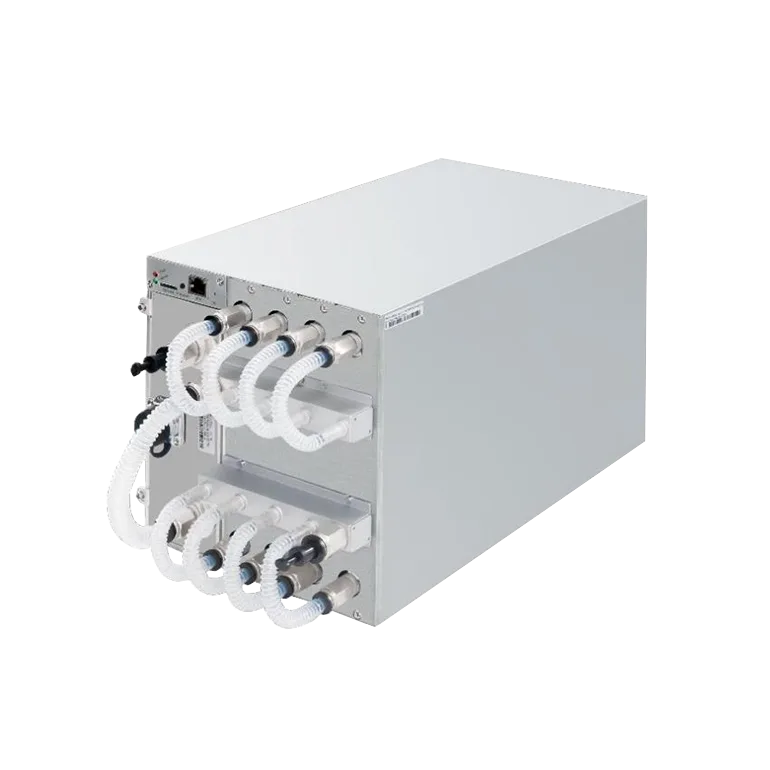
Bitmain Antminer T19 Hydro
Quick answer
The Bitmain Antminer T19 Hydro is a Bitcoin miner rated about 158 TH/s at roughly 5,451 W (about 34.5 J/TH). An industrial-class unit — loud and power-hungry, best suited to a dedicated mining space, not living areas.
Hydro-Cooled Miner
This miner uses a closed-loop liquid cooling system (hydro cooling) instead of traditional air cooling. Water or coolant circulates through internal channels to absorb heat from the ASIC chips, then transfers it to an external radiator or facility cooling loop.
Hydro-cooled miners run significantly quieter than air-cooled models since they eliminate or minimize fan noise. They also achieve higher hashrates and better efficiency because the chips can be driven harder while staying within safe thermal limits. The trade-off: hydro miners require compatible water infrastructure — inlet/outlet connections, a cooling distribution unit (CDU), and proper plumbing.
Hydro cooling is ideal for professional mining operations and data centers where water infrastructure already exists, or for home miners building a dedicated water-cooled setup to eliminate noise completely.
Professional-Grade Miner
This miner draws 5,451W and produces 40 dB of noise — it is designed for dedicated mining environments, not living spaces. Professional-grade miners deliver the highest hashrate and revenue per unit but require proper infrastructure: a 240V circuit, adequate ventilation or exhaust ducting, and a space where noise is not a concern (garage, basement, warehouse, or outdoor enclosure).
For home miners looking for a quieter alternative, consider our Bitcoin Space Heater builds or explore open-source miners like the Bitaxe that are purpose-built for residential environments.
Profitability Calculator
| Period | Revenue | Electricity Cost | Profit |
|---|---|---|---|
| Daily | $4.55 | $9.16 | $-4.61 |
| Weekly | $31.85 | $64.10 | $-32.26 |
| Monthly | $136.49 | $274.73 | $-138.24 |
| Yearly | $1,660.62 | $3,342.55 | $-1,681.93 |
Heating offset estimates the value of heat replacing an electric space heater during heating season (~6 months/year in Canada). Actual savings depend on your heating setup and climate.
Where to Buy the Bitmain Antminer T19 Hydro
D-Central Technologies
CanadaBitcoin Mining Hackers since 2016. Ships from Laval, Quebec.
Shop all Bitcoin mining productsASIC Miner Market
United StatesWide selection of new and used ASIC miners. US-based shipping.
Shop NowFull Specifications
| Model | Bitmain Antminer T19 Hydro |
| Model Number | Antminer T19 Hydro |
| Manufacturer | Bitmain |
| Algorithm | SHA-256 |
| Coins Mined | Bitcoin (BTC) |
| Hashrate | 158 TH/s |
| Power Consumption | 5,451 W |
| Efficiency | 34.5 J/TH |
| Noise Level | 40 dB |
| Dimensions | 412*197*209mm |
| Weight | 15.8 |
| BTU Output | 18599 BTU/hr |
| Equivalent Heater | Equal to a 5,451W space heater |
| Daily Power Cost | $9.16/day |
| Monthly Power Cost | $274.73/mo |
| Circuit Requirement | 240V circuit required |
| Release Date | 2022-10-01 |
| Status | Active |
Home Mining Assessment
The Bitmain Antminer T19 Hydro is a liquid-cooled SHA-256 miner built on Bitmain’s BM1398 silicon, rated at 158 TH/s for 5,451 W (34.5 J/TH) and released in October 2022. It is the water-cooled, value-tier member of the S19/T19 generation, trading the air model’s fans for a near-silent coolant loop.
Chip and hashboard architecture
At the heart of the T19 Hydro is the BM1398, Bitmain’s third-generation SHA-256 ASIC fabricated on a refined TSMC 7nm (DUV) process. The same die powers the entire S19/T19 family — the S19, S19 Pro, S19a and the air-cooled T19 all run BM1398 in a QFN package. Each chip integrates 672 hashing cores and delivers roughly 90 GH/s at stock voltage, landing the silicon class around 29.5 J/TH before any board-level tuning.
The chips are mounted on the hashboards as a long daisy chain and clustered into voltage domains — groups of chips that share one regulated power rail. This is the single most misunderstood point about Antminer power delivery: voltage is controlled per domain, not per chip. On the BM1398 platform the boards are organised into 38 domains, and the firmware can only raise or lower the rail feeding an entire domain at once. Each domain runs at a low core voltage (roughly 0.3–0.36 V) that is stepped down on-board from the ~13.8 V supplied to the board, using boost and LDO stages local to each domain.
Orchestrating all of this is a Xilinx Zynq-7010 (XC7Z010) control board — Bitmain’s “am2” generation controller — pairing a dual-core ARM Cortex-A9 running at 667 MHz with an integrated Artix-7 FPGA (28K logic elements). The FPGA handles the timing-critical job of streaming work to the chips and harvesting nonces, while the ARM cores run the mining software and web interface. A per-chain dsPIC33EP microcontroller sits on each board, acting as an I2C slave that manages the voltage regulators and reports board telemetry. An 18-pin ribbon cable carries the UART work/result stream, the I2C temperature-sensor and EEPROM lines, the reset signal, and 3.3 V logic power between the controller and each hashboard.
Real-world power and efficiency
The 5,451 W nameplate is the DC power drawn at the boards. Plan for more at the wall: the PSU dissipates a few percent in conversion, and because this is a hydro unit the coolant pump and the external dry cooler (or CDU) draw additional facility power that never shows up on the miner’s own dashboard. At 34.5 J/TH stock, the T19 Hydro sits in the previous-generation efficiency tier — respectable when it shipped, but well behind modern 5nm hardware. Its appeal today is cheap or curtailed power, and heat capture: the ~18,599 BTU/h it produces leaves the machine in the coolant rather than as hot exhaust air, which makes it unusually well suited to hydronic heat reuse (radiant loops, water tanks, greenhouses) and unusually quiet at the unit itself — the rated 40 dB reflects that the noisy fans live out at the dry cooler, not on the miner.
Liquid cooling is also what makes this platform tunable. Because the cold plates hold junction temperatures far below what air can manage, the BM1398 hydro family exposes a very wide power band. The documented profile sets for the closely related S19 Hydro — which shares the exact BM1398 board platform — illustrate the headroom available on this silicon:
| Mode | Power (W) | Hashrate (TH/s) | Efficiency (J/TH) |
|---|---|---|---|
| Low-power floor | 1,300 | 68 | 19.1 |
| Efficiency band | 3,260 | 110 | 29.6 |
| Balanced | 4,560 | 157 | 29.0 |
| Push (liquid only) | 6,400 | 183 | 35.0 |
| Hard overclock | 9,500 | 218 | 43.6 |
The takeaway is that the BM1398 hydro platform is most efficient in the high-20s J/TH and can be dialled down into the low-20s or even ~19 J/TH if you accept lower output — but it can also be pushed past 200 TH/s when cooling allows, at a steep efficiency cost. One honest caveat: the T19 is a lower-binned harvest of the same wafer, so a specific T19 Hydro unit will not necessarily reach the best numbers an S19 Hydro can. Treat the curve as the platform’s shape, not a guarantee. Our ASIC power profiles tool lets you model the wattage/hashrate/efficiency trade-off for this and other models before you commit a firmware preset.
Firmware compatibility
Out of the box the T19 Hydro runs Bitmain’s stock firmware on its Zynq controller, with the dsPIC managing per-domain regulation. Because the unit is part of the widely-flashed BM1398 generation, third-party firmware also exists for this silicon — the autotuning aftermarket firmwares search for each board’s stable voltage/frequency point at runtime rather than loading a fixed table, which is why two identical machines can settle on slightly different settings. A few realities worth stating plainly: aftermarket support is most mature on the air-cooled S19/T19 boards, and hydro variants are a narrower target, so always confirm the control-board revision and exact model before flashing anything. Note too that of the common options only BraiinsOS+ natively supports the Stratum V2 protocol; most other firmwares remain Stratum V1.
For operators who care about long-term sovereignty over their hardware — not being locked to a single vendor’s signed images — D-Central is developing DCENT_OS for Bitmain control boards of this generation as a GPL-3.0 alternative. It is in closed beta today with a public beta targeted for summer 2026, and it is built in the shoulders-of-giants tradition of the open firmware projects that came before it, not as a replacement for them.
Common faults and troubleshooting
Most BM1398 failures fall into a handful of well-understood categories, and the daisy-chain topology makes them surprisingly diagnosable:
- Dead or shorted chip — a chip that stops forwarding signals breaks the chain at that point, so every chip downstream goes invisible and the board reports a reduced ASIC count. A hard short instead collapses the domain voltage and the board may detect zero chips.
- Domain / power faults — a failed LDO or boost stage kills one domain (or the whole board), usually traceable with a multimeter on the domain test points.
- Solder fatigue — thermal cycling cracks BGA joints, producing intermittent chip dropouts that a thermal camera reveals as a cold spot.
- Thermal / coolant trips — on a hydro unit the leading culprits are coolant temperature, flow, or sensor problems rather than dust-clogged fins.
Because the T19 Hydro depends entirely on its liquid loop, its most common operational alarms are temperature-related. See our dedicated guides for the Antminer T19 — Temperature Too High error and the hydro-specific S19 Hydro — Coolant Temperature Too High fault, which applies identically to this BM1398 hydro board. For a structured walk-through of any symptom — wrong ASIC count, a chain that stops at chip N, or a board that won’t enumerate — start with the ASIC Fault Finder.
Repair and longevity
A hydro miner with a single dead chip or a failed regulator is not scrap — it is a repair. D-Central has been opening, diagnosing, and rebuilding Antminer hashboards in-house since 2016 from our Laval, Quebec workshop, and the BM1398 platform is one we know intimately. Chain breaks are isolated to the failing chip, dead domains are traced to the regulator at fault, and cracked BGA joints are reflowed or the chip reballed. Component-level repair keeps capital hardware hashing for years past the point where many operators would write it off, and it keeps working silicon out of landfill. If your T19 Hydro is down or under-hashing, see our ASIC repair service.
Who it is for and buying advice
The T19 Hydro makes sense for a specific operator: someone who already has — or is willing to build — a water-cooling loop, wants near-silent operation, and has access to cheap or curtailed electricity that forgives a ~34 J/TH stock figure. With its coolant-borne heat it is a strong candidate for heat-reuse projects. It is not the right pick for a first-time home miner without a hydro setup, and anyone chasing maximum efficiency per joule today should look to newer 5nm hardware. If a quiet, liquid-cooled BM1398 machine fits your situation, browse current availability and refurbished options in our miner catalog, where every refurbished unit is repaired and tested by the same team that services them.
Generational context
The T19 Hydro belongs to Bitmain’s BM1398 era (2020–2022), the 7nm generation that defined the bull-market fleet. Within that family the S19 carried 76 chips per board and the S19 Pro 114 — the T19 line was the value bin of the same die, and the Hydro variant used liquid cooling to recover hashrate the air T19 left on the table. It sits one full node behind the 5nm BM1366/BM1368 chips that followed (S19 XP, S21), which roughly halved J/TH and dropped the per-chain PIC entirely on the no-PIC S21/T21 designs. Understood for what it is — a robust, repairable, liquid-cooled 7nm workhorse — the T19 Hydro remains a sensible tool for cheap-power and heat-reuse operators, and one that D-Central can keep running long after its warranty has lapsed.
Antminer S19 XP specs, repair, and parts
Use the S19 XP cluster to confirm specs, maintenance steps, hashboard symptoms, and compatible power or board parts before buying.
Compare the Bitmain Antminer T19 Hydro
Frequently Asked Questions
What are the current mining economics for the Bitmain Antminer T19 Hydro?
At $0.07/kWh, the Bitmain Antminer T19 Hydro currently shows an estimated daily net cost of $4.61 before pool fees and hardware cost. Lower electricity rates, network changes, BTC price changes, or useful heat recovery can change the result.
Can I mine Bitcoin at home with the Bitmain Antminer T19 Hydro?
The Bitmain Antminer T19 Hydro has a home mining score of 40/100. With 40 dB noise and 5,451W power draw, it may require a dedicated space like a garage, basement, or outdoor enclosure. Consider noise insulation and proper ventilation.
Can the Bitmain Antminer T19 Hydro heat my home?
The Bitmain Antminer T19 Hydro outputs approximately 18599 BTU/hr of heat. For reference, a typical space heater produces 5,000-5,500 BTU/hr. All electrical energy consumed by the miner is converted to heat, making it 100% efficient as a heater. D-Central offers Bitcoin Space Heater builds designed specifically for home heating integration.
What power supply does the Bitmain Antminer T19 Hydro need?
The Bitmain Antminer T19 Hydro draws 5,451W of power. You need a power supply rated for at least 5,996W with appropriate voltage (200-240V AC). D-Central stocks compatible power supplies in our shop. Always use a quality PSU from a reputable manufacturer to protect the miner and wiring.
