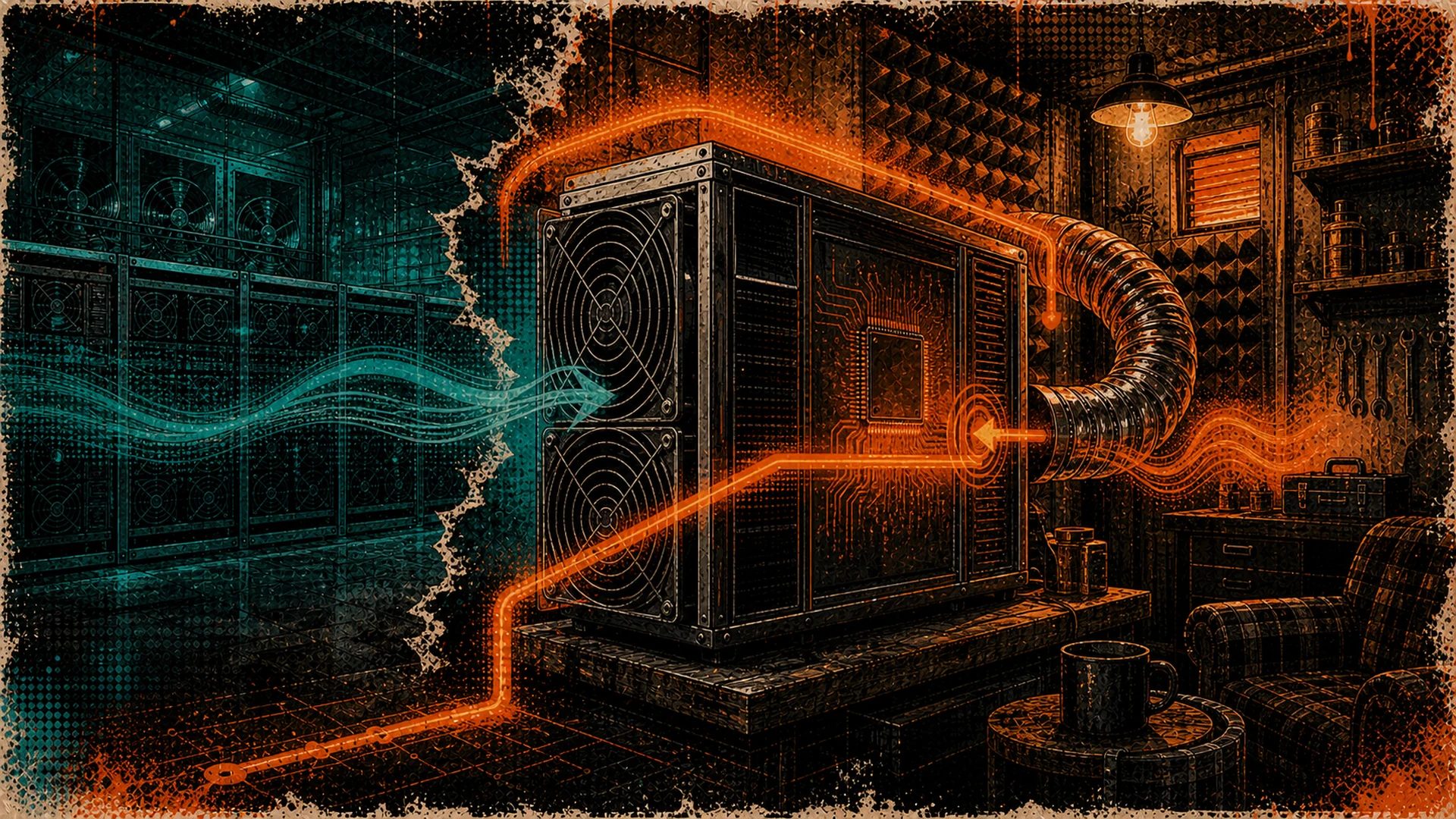
Industrial Antminers are extraordinary machines. They are also, in the most literal sense, factory equipment — designed for a warehouse, not a spare bedroom. The hashrate that makes them so good at securing Bitcoin is the same hashrate that makes them roar like a shop-vac and pour out enough heat to bake a small room. For most of mining’s history, that meant home miners were stuck: either run a tiny hobby board, or accept that a “real” miner belongs in a container farm somewhere far from where people sleep.
Firmware is what’s quietly changing that math. Not the hardware — the firmware. The same control board, the same chips, a different operating system on top, and suddenly an industrial ASIC behaves like an appliance you can actually live with. That’s the thesis behind DCENT_OS, and it’s worth being honest about what firmware can do today versus what we’re still building.
TL;DR — Quick answer
DCENT_OS is D-Central Technologies’ GPL-3.0 open-source Bitcoin mining firmware for Bitmain Antminer ASIC miners. All 13 registry models meet AVAILABILITY: RELEASED. MATURITY: EXPERIMENTAL. The current verified-prebuilt ledger lists exact Antminer S9 / am1-s9 Zynq/Xilinx and Antminer S19j Pro / am2-s19j Zynq/Xilinx lanes; that binary scope does not change model availability. Installation and recovery evidence remain model-specific, and Experimental is not recommended for irreplaceable production fleets. Check the exact evidence ledger.
Industrial miners weren’t built for homes
An Antminer S19 or S21 is a deployment unit. It assumes a few things about its environment: that there’s a loud room full of identical machines, that cool air is being pushed through hot aisles by big fans, and that a human (or a fleet dashboard) somewhere is watching dozens or hundreds of them at once. The firmware Bitmain ships reflects those assumptions. It spins fans hard to guarantee chip survival in a 35°C aisle, it locks most tuning behind a stock interface, and it has zero concept of “the person mining this also has to sleep twenty feet away.”
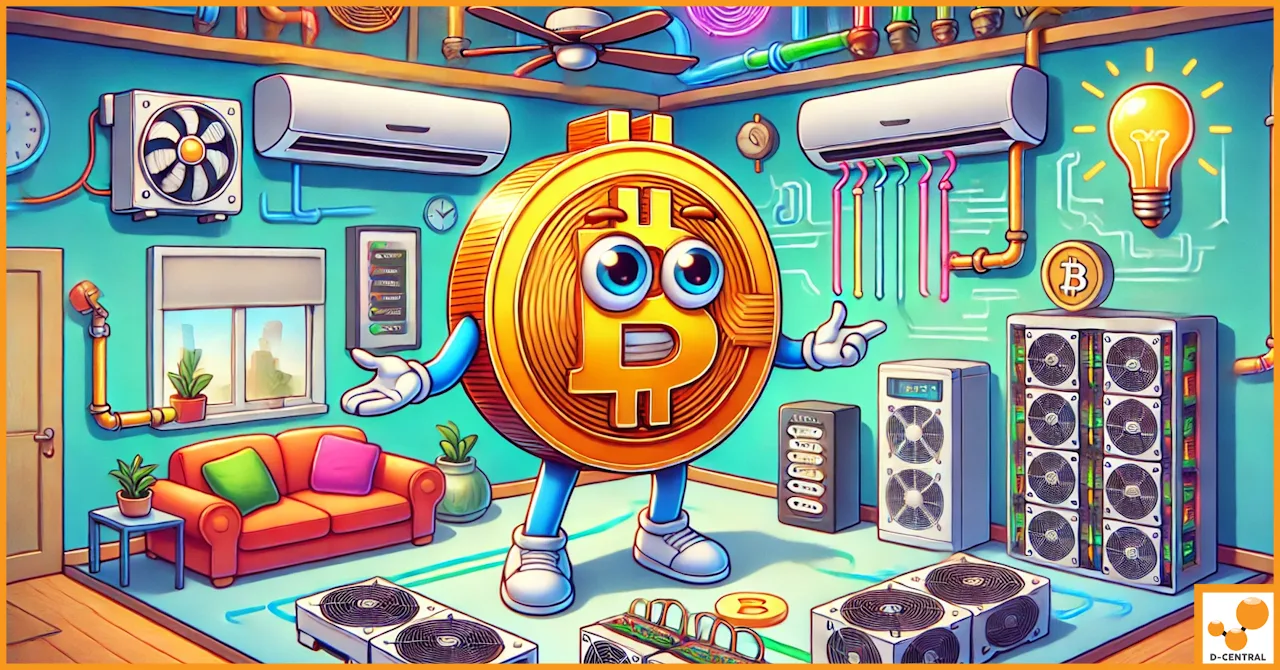
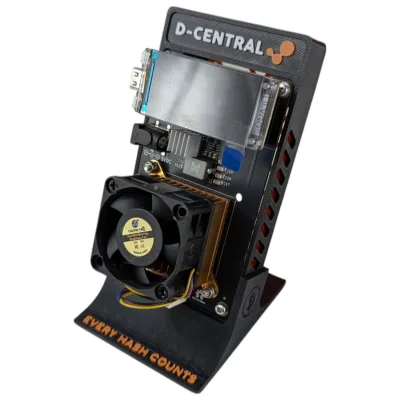
That’s the scope DCENT_OS is built for: the racks, the containers, and the basements full of S9s. Industrial-class Antminers draw roughly 1,000 to 3,500 watts per unit — terahash-class machines, not gigahash hobby boards. (If you want the tiny end of the spectrum, that’s a different project: DCENT_axe, our ESP32-class open-source firmware for Bitaxe-style boards.) The home-mining problem we’re talking about here is specifically: how do you take a 3-kilowatt space-heater-with-a-jet-engine and make it tolerable in a house?
The good news is that almost everything that makes an industrial miner hostile to a home is a software decision, not a law of physics. And software can be rewritten.
The three problems: noise, heat, and control
1. Noise
Stock Antminer fans are the single biggest reason these machines get exiled to garages and sheds. They’re high-static-pressure server fans tuned for maximum airflow, and at full tilt an S19 is comparable to a vacuum cleaner running continuously. The reason they run that hard isn’t the chips’ fault — it’s that stock firmware demands a certain hashrate, and at that hashrate the chips dump heat that must be moved, so the fans scream. Lower the power target and the thermal load drops, which means the fans no longer need to run flat-out.
2. Heat
Heat is the funny one, because in a home it can flip from a liability into the entire point. A miner is a 100%-efficient resistive heater that happens to earn sats while it warms the room — every watt it draws ends up as heat, the same as a baseboard heater, except this one also secures the Bitcoin network. The problem isn’t that miners make heat; it’s that stock firmware gives you no way to aim that heat. There’s no “hold this room at 21°C,” no readout of how many BTU you’re producing, no seasonal awareness. The energy is there. The thermostat brain isn’t.
3. Control
This is the deepest problem and the one open source exists to fix. Stock firmware is a black box. You don’t get to decide how the machine trades hashrate for quiet, you can’t see what the autotuner is doing, and you certainly can’t read the source code that’s running on hardware you own. Even the excellent aftermarket options are only partly open — and most charge a mandatory dev fee in the bargain. For a home miner, “control” means three things: the ability to dial power and noise to your living space, the ability to integrate the miner into your home’s systems, and the ability to actually trust the code on the box. Firmware is where all three live.
How firmware can fix each one
None of these fixes require new silicon. They’re all things a better operating system can do with the chips already in the machine:
- Undervolting and power targeting tame the noise. Drop an S19 from its stock power target to something like 1,600 watts and you can land near the 24 J/TH range — meaningfully more efficient than the ~34 J/TH stock figure — while the lighter thermal load lets the fans back off. This is the single most effective lever for a home miner. (We go deep on the numbers in our guide to making an S19 quieter and cheaper to run.) Worth being precise: autotuners work at the per-domain level for voltage, with per-chip frequency trimming — not a magic “per-chip voltage” dial, whatever a marketing page tells you.
- Custom fan curves reshape the noise/temperature trade. A proper PID fan controller (with configurable proportional, integral, and derivative terms) lets firmware hold a target temperature with the minimum necessary fan speed instead of brute-forcing airflow. Pair that with quieter aftermarket fans and the machine changes character entirely.
- Smart-home and energy hooks turn the miner into an appliance. A thermostat-style API, a BTU readout, weather and price awareness, and a grid-signal input are all just software talking to systems you already own. Once the firmware exposes them, the miner stops being a noisy mystery box and starts being a programmable heat source.
- Open source delivers the trust. If the entire stack — bootloader to dashboard — is published under a real open-source license, you can read it, build it yourself, and verify there’s no hidden telemetry or skimmed dev fee. That’s the control problem solved at the root.
What DCENT_OS is building for home miners (the roadmap)
Here is where we have to be straight with you, because a lot of third-party pages are not. DCENT_OS has been in public beta since July 2026, under GPL-3.0, with the repository open. The home-comfort feature set is the reason the project exists, but the marquee features below are stated design goals we are building toward — not things you can download and run this afternoon. Presenting them as shipped would be exactly the kind of over-promising we refuse to do.
What is solid and present-tense today: the mining daemon, dcentrald, is written from scratch in Rust (not forked from CGMiner or bmminer) on a stripped-down Buildroot Linux base, and the daemon, dashboard and Buildroot integration are published as GPL-3.0 source — the architecture page maps what runs where. There is no mandatory dev fee; what ships is an optional donation, on at 2% by default, with a one-click 0% preset at first boot or any time in Settings. Signed experimental artifacts exist for exactly two lanes — the Antminer S9 and the S19j Pro, both on Zynq/XIL control boards — with accepted pool shares documented on bench hardware. They are guarded artifacts: no model, the S9 included, has a published witnessed install route, and flashing experimental firmware can brick your miner. We say so on the box.
What we’re building for home miners (roadmap, not yet shipping):
- Room-temperature targeting — tell the firmware “hold this room at 21°C” and let it modulate the machine. (Design goal, Phase 3.)
- Heat-output (BTU) display and heating-cost-savings math — so you can see the miner as the heater it is. (Design goal, Phase 3.)
- Built-in quiet and automatic night-mode profiles — quieter by default when you’re asleep. (Design goal, Phase 3.)
- Home Assistant / thermostat integration and weather-and-price-aware mining — the miner as a first-class smart-home citizen. (Design goal, Phase 3.)
- Configurable PID fan control as the foundation underneath all of the above. (Targeted; the adaptive autotuner is proven on the S9 beta, the rest is being hardened.)
We can say honestly that purpose-built heat-reuse control is the gap this project set out to fill, and we say it as ambition, not as a delivered feature: Heat Mode exists in the public source as a secondary capability whose readiness is build- and board-specific, and the items above stay design goals until the evidence says otherwise. The whole point of being open about the roadmap is that you can read the code and check our work as it lands. Where DCENT_OS actually stands, lane by lane, is on the dated evidence ledger.
And we’re standing on giants’ shoulders here. LuxOS proved that firmware is fundamentally an energy-management tool — watt-anchored power targeting and fast curtailment were its contribution to the field. BraiinsOS+ set the bar for autotuning and memory-safe mining with its Rust engine and published its BCB100 control board as open hardware. VNish put aftermarket firmware on more than a million and a half devices and proved miners want granular control. The appliance-miner and heat-reuse movement — the Heatpunks, the people heating century-old homes with immersion rigs — proved there’s a home for this hashrate. We’re extending their work to the full open-source stack, not claiming to have invented the road.
Today’s honest workarounds (while the roadmap cooks)
You don’t have to wait for the rest of the roadmap to make an industrial miner more livable. The tools to do it already exist, and we’d rather point you at what works now than pretend DCENT_OS is the only answer:
- Undervolt with mature firmware. Both BraiinsOS+ and VNish let you set a lower power target today, which is the highest-impact move for noise and efficiency. Expect a dev fee in the 2–2.8% range depending on the firmware (BraiinsOS+ runs 2–2.5%, VNish 2–2.8%, LuxOS around 2.8%) — that’s the trade-off for proven, production-grade tuning.
- Cap your fans. BraiinsOS+ and VNish both expose fan limits, so you can manually pin a quieter profile. The catch: capping fans without lowering power runs the chips hotter, so always pair a fan cap with an undervolt. This is a manual quiet mode, not an automatic one — but it’s real and available now.
- Swap the fans. Hardware still matters. Quieter, high-quality fans (the Noctua route) drop the noise floor in a way no firmware can, and they pair beautifully with a custom fan curve. This is exactly how D-Central’s purpose-built heater conversions are made livable.
- Buy a machine that’s already converted. If you want the result without the project, the heater conversions in our space-heater lineup are industrial ASICs already re-housed, re-fanned, and tuned for a home. Our buyer’s guide to the best Bitcoin mining heaters walks through the options honestly, including the trade-offs versus a plain electric heater.
For the full comparison of what each firmware actually does — dev fees, open-source status, base OS, tuning approach — see our firmware comparison, which lays out Stock, BraiinsOS+, VNish, and LuxOS side by side (with DCENT_OS slotted in honestly as the beta open-source newcomer).
The energy and heat sovereignty angle
There’s a bigger reason we care about making industrial miners home-mine-able, and it’s not just comfort. It’s resilience. In an increasingly digitally-dependent world, the things worth having are backups: Bitcoin as the backup to fiat finance, your own renewable or off-grid energy as the backup to depending entirely on the utility, mesh networks as the backup to the internet. A miner running in your home, heating your house while it earns sats, is a small but real piece of that stack — energy you control, hashrate you own, securing money no one can debase.
Heat reuse is where this gets concrete. A miner doesn’t waste the electricity it consumes — it converts it to warmth you were going to buy from a heater anyway, and earns Bitcoin on the way. We dig into the thermodynamics and the dollars-and-cents of that in our breakdown of turning compute into household heat. The firmware is what makes that loop tight: aim the heat, keep it quiet, integrate it into how you already live. That’s the difference between a miner you tolerate in the garage and one you’d actually want in the living room.
This is the same instinct behind everything D-Central builds: own your hardware, own your energy, own your money. Open-source firmware on a machine you control is one more layer decentralized. If that resonates, the sovereignty hub connects the dots between owning your money, your energy, and your infrastructure — mining at home is just one of the backups.
Where this is headed
DCENT_OS is D-Central Technologies’ GPL-3.0 open-source Bitcoin mining firmware for Bitmain Antminer ASIC miners. All 13 registry models meet AVAILABILITY: RELEASED. MATURITY: EXPERIMENTAL. The current verified-prebuilt ledger lists exact Antminer S9 / am1-s9 Zynq/Xilinx and Antminer S19j Pro / am2-s19j Zynq/Xilinx lanes; that binary scope does not change model availability. Installation and recovery evidence remain model-specific, and Experimental is not recommended for irreplaceable production fleets. Check the exact evidence ledger.
Frequently asked questions
Is there a “quiet Antminer firmware” I can just download?
No single firmware makes a stock Antminer silent in one flash. What works today is lowering the power target and capping the fans with mature firmware — BraiinsOS+, VNish or LuxOS — which together get you a meaningfully quieter, more efficient machine. DCENT_OS is building purpose-built quiet and night-mode profiles, but those are roadmap goals; what it publishes today is signed experimental artifacts for two exact lanes (S9 and S19j Pro, Zynq/XIL), not a quiet-mode download.
Does DCENT_OS have a space-heater mode right now?
Not as a production feature. Heat Mode — the thermostat-style Space Heater view built on room temperature and BTU/h — exists in the public GPL-3.0 source as a secondary capability, and its readiness is build- and board-specific. Room-temperature targeting, BTU display, automatic night mode and Home Assistant integration remain stated design goals, not dates. What runs today is the core: a from-scratch Rust mining daemon with signed experimental artifacts for the S9 and S19j Pro Zynq/XIL lanes, guarded, with no published witnessed install route and no mandatory dev fee (the optional donation ships on at 2% and takes one click to set to 0%).
What’s the most effective way to make an S19 quieter today?
Undervolt it. Lowering the power target (for example toward ~1,600W on an S19) drops the thermal load so the fans don’t need to scream, and it improves efficiency at the same time. Pair the undervolt with a fan cap and quieter aftermarket fans for the best result. Capping fans alone, without lowering power, just runs the chips hotter — always combine the two.
Can firmware turn my Antminer into AI compute or a heat-and-AI box?
No. A SHA-256 ASIC is fixed-function silicon — it can only hash, it cannot run AI inference, and no firmware (DCENT_OS included) changes that. When people talk about mining-to-AI, they mean reusing the power, cooling, and real estate of a mining site for GPUs — never running AI on the mining chips themselves. DCENT_OS does not run AI; it’s mining firmware.
Why start DCENT_OS on the old S9 instead of an S19 or S21?
The S9 (BM1387, Zynq control board) is the most-documented, most-understood industrial miner ever made, and millions are still alive and cheap. It’s the right machine to get open-source firmware right on first. Support for newer Antminers is incoming as each control-board lane is validated — but we’d rather ship one model that genuinely works than over-promise a list that doesn’t.
When your miner retires: one more layer decentralized
Open-source firmware extends a miner's useful life. When a model retires from profitable mining, the power, cooling, and connectivity you built around it can still serve the distributed-compute layer — heat reuse, mesh comms, or freeing infrastructure for sovereign AI.