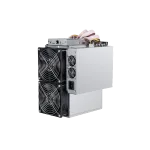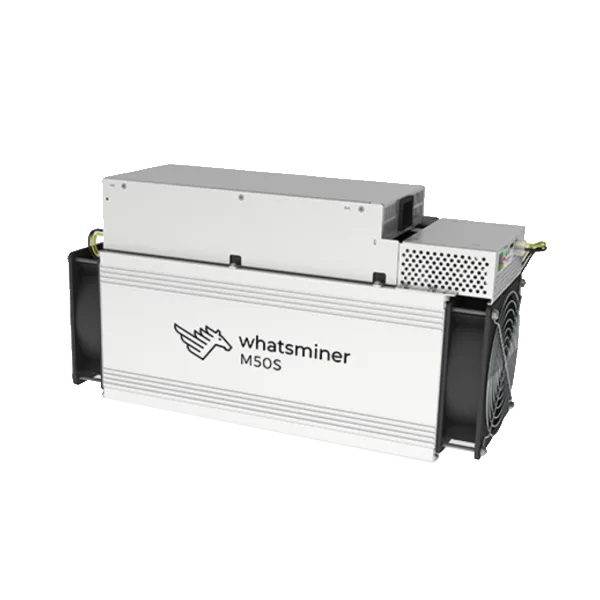
Whatsminer M50S++
Top-bin M50S variant with 160 TH/s. Best efficiency in the M50 lineup. Integrated PSU design from MicroBT.
Professional-Grade Miner
This miner draws 3,520W and produces 75 dB of noise — it is designed for dedicated mining environments, not living spaces. Professional-grade miners deliver the highest hashrate and revenue per unit but require proper infrastructure: a 240V circuit, adequate ventilation or exhaust ducting, and a space where noise is not a concern (garage, basement, warehouse, or outdoor enclosure).
For home miners looking for a quieter alternative, consider our Bitcoin Space Heater builds or explore open-source miners like the Bitaxe that are purpose-built for residential environments.
Profitability Calculator
| Period | Revenue | Electricity Cost | Profit |
|---|---|---|---|
| Daily | $4.52 | $5.91 | $-1.39 |
| Weekly | $31.67 | $41.40 | $-9.73 |
| Monthly | $135.72 | $177.41 | $-41.69 |
| Yearly | $1,651.28 | $2,158.46 | $-507.18 |
Heating offset estimates the value of heat replacing an electric space heater during heating season (~6 months/year in Canada). Actual savings depend on your heating setup and climate.
Where to Buy the Whatsminer M50S++
D-Central Technologies
CanadaBitcoin Mining Hackers since 2016. Ships from Laval, Quebec.
Shop all Bitcoin mining productsASIC Miner Market
United StatesWide selection of new and used ASIC miners. US-based shipping.
Shop NowFull Specifications
| Model | Whatsminer M50S++ |
| Model Number | M50S++ |
| Manufacturer | MicroBT |
| Algorithm | SHA-256 |
| Coins Mined | Bitcoin (BTC) |
| Hashrate | 160 TH/s |
| Power Consumption | 3,520 W |
| Efficiency | 22 J/TH |
| Noise Level | 75 dB |
| Chip Model | WM3418 |
| Cooling | Air |
| Voltage Range | 200-240V AC |
| Operating Temperature | 5-40°C |
| Dimensions | 430x155x226 |
| Weight | 13.5 |
| Interface | Ethernet |
| BTU Output | 12010.2 BTU/hr |
| Equivalent Heater | Equal to a 3,520W space heater |
| Daily Power Cost | $5.91/day |
| Monthly Power Cost | $177.41/mo |
| Circuit Requirement | 240V circuit required |
| Release Date | 2023-03-01 |
| MSRP | $4,000.00 |
| Status | Active |
Home Mining Assessment
Top-bin M50S variant with 160 TH/s. Best efficiency in the M50 lineup. Integrated PSU design from MicroBT.
The Whatsminer M50S++ is MicroBT’s top-bin air-cooled SHA-256 miner from the 2022 M5x generation, rated at roughly 160 TH/s for about 3,520 W at the wall, or close to 22 J/TH. It was the most efficient model in the M50 line and remains a workhorse for low-cost-power operations and heat-recovery setups.
Chip and hashboard architecture
The M50S++ is built on MicroBT’s in-house SHA-256 ASIC (catalogued here as the WM3418), fabricated on a Samsung 5nm process node. That 5nm step is the defining change of the M5x platform: where the earlier M30 generation used Samsung 8nm silicon and landed around 31-38 J/TH, the move to 5nm let MicroBT roughly cut joules-per-terahash by a third while keeping the same single-box air-cooled chassis.
In keeping with the M-series air-cooled layout, the ASICs are spread across three series-wired hash boards. Unlike Bitmain’s Antminer line, a Whatsminer has no FPGA in the signal path. The control board for the M50 family is MicroBT’s CB5, built around an Allwinner H6 “CV200-OS” SoC — a quad-core 64-bit ARM Cortex-A53 with TrustZone — and the SoC talks to the ASIC chains directly over its own serial interface rather than through a Xilinx Zynq midstate engine. This is the single biggest reason Whatsminer and Antminer parts do not interchange: different SoC, different ASIC communication protocol, different hashboard EEPROM format, and different board-to-control-board connectors.
Voltage domains, not per-chip control
Like every modern SHA-256 ASIC platform, the M50S++ regulates power by voltage domain, not per individual chip. Chips are grouped into domains that share a regulated rail; within a domain the chips are wired in series for core voltage, so the domain voltage equals the per-chip voltage multiplied by the number of chips in that group. Each domain has its own regulation stage stepping the boosted board voltage down to the precise level the chip cluster needs. The practical consequence for diagnostics is important: a single shorted or open chip pulls its whole domain out of spec, and an abnormal domain voltage will take the entire hash board offline. MicroBT’s power-delivery topology and domain map differ from Bitmain’s, which is part of why repair procedures are vendor-specific.
The M50S++ also follows MicroBT’s signature integrated-PSU design: the power supply lives inside the chassis rather than as a separate brick like Antminer’s APW units. It runs on single-phase 200-240 V AC, draws through a standard C19-style inlet, and is rated for a 5-40 °C operating range with Ethernet for control.
Real-world power and efficiency
MicroBT shipped the M50S++ across an efficiency bin that spans roughly 154-162 TH/s; the higher-hashrate units sit closer to 21 J/TH while the listing here uses the nominal 160 TH/s / 3,520 W / 22 J/TH figure. As always, treat nameplate power as a floor, not the wall reading. Real consumption climbs with ambient temperature, PSU losses, and any factory or third-party tuning, and a unit pushed to the top of its frequency band will pull noticeably more than its rated wattage. Budget for the higher number when you size breakers and PDUs.
At about 75 dB and 3.5 kW in a single 200-240 V box, this is data-center-class noise and heat, not a living-room machine. The flip side is that nearly all of that 3,520 W leaves as roughly 12,010 BTU/h of usable heat — enough that ducting the exhaust into a workshop or garage turns electricity you would have spent on a heater into hashrate instead. There is real tuning headroom on the M5x platform for operators who want to trade efficiency for output or vice-versa; our ASIC power profiles resource is the place to see how frequency and voltage targets move the J/TH curve before you commit a fleet to a setting.
Specifications
| Specification | Whatsminer M50S++ |
|---|---|
| Algorithm | SHA-256 (Bitcoin / BTC) |
| Hashrate (nominal) | 160 TH/s (bin range ~154-162 TH/s) |
| Power at wall | ~3,520 W (nameplate; budget higher) |
| Efficiency | ~22 J/TH (≈21 J/TH at top of bin) |
| ASIC chip | MicroBT in-house SHA-256, Samsung 5nm |
| Cooling | Air, integrated PSU |
| Control board / SoC | CB5 — Allwinner H6 (CV200-OS) ARM Cortex-A53 |
| Noise | ~75 dB |
| Heat output | ~12,010 BTU/h |
| Input | 200-240 V AC, single-phase |
| Operating temp | 5-40 °C |
| Network | Ethernet |
| Dimensions / weight | 430 × 155 × 226 mm / 13.5 kg |
| Generation | 2022 M5x (Samsung 5nm) |
Firmware compatibility
Stock, the M50S++ runs MicroBT’s proprietary btminer stack on a custom Linux build, with a web UI on port 80 and the Whatsminer JSON-RPC API on port 4028. That API is not the CGMiner protocol despite sharing the port — read commands such as summary, pools, and devs are enabled by default, while write operations (pool changes, reboot, frequency targets, OTA updates) are disabled out of the box and require token-based encryption once you enable them. Firmware is updated either over the network with MicroBT’s WhatsMinerTool utility or, for recovery, by writing an image to an SD card and booting from the control-board slot.
On third-party firmware, be honest about the landscape. The M5x platform does have aftermarket firmware options that add autotuning and custom fan curves, but the picture is different from Antminer. Braiins OS+ — the one firmware that natively speaks Stratum V2 — supports Antminer hardware only and does not run on Whatsminer, so native Stratum V2 is not on the table for an M50S++ via that route. Whatever stack you run, autotuning here is calculated at runtime from each board’s measured behavior, not a fixed table of presets, which is why two “identical” units can settle at slightly different voltages. D-Central’s own DCENT_OS effort is firmware-first and built in the same shoulders-of-giants spirit; for vendor-specific tuning today we steer M50 owners toward configurations we have validated rather than blanket flashing advice.
Common faults and troubleshooting
After three-plus years in the field, M50S++ failures cluster in a few predictable places:
- Dead or low hashboard — usually a domain fault: a shorted chip drags its rail down, an open chip breaks the serial chain so every downstream chip goes invisible, or a failed regulator starves the domain. The board reports the lost chips, but the root cause is almost always at the chip or power-management level.
- Integrated PSU faults — because the supply is inside the chassis, a PSU failure presents as a no-boot or intermittent power-cycle rather than a swap-the-brick fix.
- Thermal and fan errors — clogged fins, a failed fan, or high intake temperature trip protection and throttle or halt the unit; air-cooled M5x units are sensitive to dust and ambient.
- Network / control-board issues — a corrupted firmware or flaky SoC can be recovered by SD-card reflash before assuming hardware death.
Work the symptom methodically with our ASIC fault finder to map an error to a likely board, domain, or component before pulling anything. A proper domain-voltage audit on the bench — power off, discharge, then measure each domain test point — is what separates a five-minute chip-level fix from a needlessly scrapped board.
Repair and longevity
D-Central’s in-house technicians repair the Whatsminer M50S++. We have been doing board-level ASIC repair in Laval since 2016, and a 5nm unit at ~22 J/TH is well worth fixing rather than replacing — the efficiency gap to current-gen hardware is not large enough to write off a working chassis. Typical work includes chip-level reflow and replacement on the hash boards, voltage-domain and regulator repair, integrated-PSU service, fan and sensor replacement, and control-board recovery or substitution. Because the CB5 control board is a discrete module, board-level replacement and universal-controller paths exist for M3x/M5x hardware when an SoC is beyond recovery. Send-in repair details are on our ASIC repair page.
Who it is for and buying
The M50S++ makes sense for two buyers. First, the cost-conscious operator with cheap or behind-the-meter power: at 22 J/TH it will not win against an S21-class machine on a hosted power bill, but bought used at the right price it offers a low cost-per-terahash entry into self-hosted mining. Second, the heat-recovery user who wants real, ductable warmth from a single 240 V circuit and treats the hashrate as a bonus. It is decidedly not a quiet home unit — 75 dB belongs in a garage, shop, or dedicated mining space. New hobbyists chasing a near-silent desk miner are better served by an open-source Bitaxe-class device. To compare the M50S++ against other models on live efficiency and profitability, see our ASIC miner database and the full miner catalog.
How the M50S++ fits the lineup
| Model | Hashrate | Power | Efficiency | Node / Year |
|---|---|---|---|---|
| M30S++ | 112 TH/s | 3,472 W | 31 J/TH | Samsung 8nm / 2020 |
| M50 | 114 TH/s | 3,306 W | 29 J/TH | Samsung 5nm / 2022 |
| M50S | 128 TH/s | 3,276 W | 25.6 J/TH | Samsung 5nm / 2022 |
| M50S++ | ~160 TH/s | ~3,520 W | ~22 J/TH | Samsung 5nm / 2022 |
| M60 | 172 TH/s | ~3,420 W | 19.9 J/TH | Next gen / 2023 |
Generational context
The M50S++ sits at the top of MicroBT’s 2022 air-cooled stack. It was the efficiency ceiling of the M5x family — the first WhatsMiners on Samsung 5nm — and a clear generational jump over the 8nm M30 series it replaced, dropping from roughly 31 J/TH to about 21-22 J/TH in the same form factor. It has since been superseded by the M60 series (~18-20 J/TH on a new control board with the Allwinner H616 SoC) and the 2025 M70 line (~13.5-14.5 J/TH), and on the Bitmain side it competes with the S19-XP era. That places the M50S++ firmly in the previous-generation tier: not the efficiency leader anymore, but a durable, repairable 5nm machine that earns its keep wherever power is cheap or the heat is worth recovering. Credit where due — MicroBT’s integrated-PSU, FPGA-free design is a genuinely different and elegant take on the ASIC miner, and the M50S++ is one of its better-balanced expressions.
Antminer S19 XP specs, repair, and parts
Use the S19 XP cluster to confirm specs, maintenance steps, hashboard symptoms, and compatible power or board parts before buying.
Frequently Asked Questions
What are the current mining economics for the Whatsminer M50S++?
At $0.07/kWh, the Whatsminer M50S++ currently shows an estimated daily net cost of $1.39 before pool fees and hardware cost. Lower electricity rates, network changes, BTC price changes, or useful heat recovery can change the result.
Can I mine Bitcoin at home with the Whatsminer M50S++?
The Whatsminer M50S++ has a home mining score of 30/100. With 75 dB noise and 3,520W power draw, it may require a dedicated space like a garage, basement, or outdoor enclosure. Consider noise insulation and proper ventilation.
Can the Whatsminer M50S++ heat my home?
The Whatsminer M50S++ outputs approximately 12010.2 BTU/hr of heat. For reference, a typical space heater produces 5,000-5,500 BTU/hr. All electrical energy consumed by the miner is converted to heat, making it 100% efficient as a heater. D-Central offers Bitcoin Space Heater builds designed specifically for home heating integration.
Does D-Central repair the Whatsminer M50S++?
Yes, D-Central provides professional repair services for the Whatsminer M50S++. Services include hashboard repair, control board diagnostics, fan replacement, and full refurbishment. Ship your miner to our Laval, Quebec facility for diagnosis and repair.
What power supply does the Whatsminer M50S++ need?
The Whatsminer M50S++ draws 3,520W of power. You need a power supply rated for at least 3,872W with appropriate voltage (200-240V AC). D-Central stocks compatible power supplies in our shop. Always use a quality PSU from a reputable manufacturer to protect the miner and wiring.