On this page
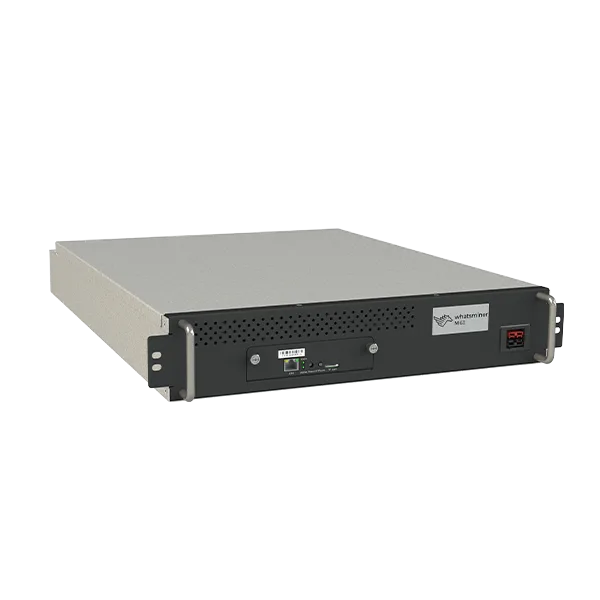
Whatsminer M63
Next-gen hydro miner from MicroBT with 360 TH/s. 4U rack chassis, 3-phase power, sealed water cooling loop.
Quick answer
The Whatsminer M63 is a Bitcoin miner rated about 360 TH/s at roughly 7,200 W (about 20 J/TH), built on the WM3610 ASIC. An industrial-class unit — loud and power-hungry, best suited to a dedicated mining space, not living areas.
Hydro-Cooled Miner
This miner uses a closed-loop liquid cooling system (hydro cooling) instead of traditional air cooling. Water or coolant circulates through internal channels to absorb heat from the ASIC chips, then transfers it to an external radiator or facility cooling loop.
Hydro-cooled miners run significantly quieter than air-cooled models since they eliminate or minimize fan noise. They also achieve higher hashrates and better efficiency because the chips can be driven harder while staying within safe thermal limits. The trade-off: hydro miners require compatible water infrastructure — inlet/outlet connections, a cooling distribution unit (CDU), and proper plumbing.
Hydro cooling is ideal for professional mining operations and data centers where water infrastructure already exists, or for home miners building a dedicated water-cooled setup to eliminate noise completely.
Professional-Grade Miner
This miner draws 7,200W and produces 50 dB of noise — it is designed for dedicated mining environments, not living spaces. Professional-grade miners deliver the highest hashrate and revenue per unit but require proper infrastructure: a 240V circuit, adequate ventilation or exhaust ducting, and a space where noise is not a concern (garage, basement, warehouse, or outdoor enclosure).
For home miners looking for a quieter alternative, consider our Bitcoin Space Heater builds or explore open-source miners like the Bitaxe that are purpose-built for residential environments.
Profitability Calculator
| Period | Revenue | Electricity Cost | Profit |
|---|---|---|---|
| Daily | $10.47 | $12.10 | $-1.63 |
| Weekly | $73.28 | $84.67 | $-11.39 |
| Monthly | $314.05 | $362.88 | $-48.83 |
| Yearly | $3,820.96 | $4,415.04 | $-594.08 |
Heating offset estimates the value of heat replacing an electric space heater during heating season (~6 months/year in Canada). Actual savings depend on your heating setup and climate.
Where to Buy the Whatsminer M63
D-Central Technologies
CanadaBitcoin Mining Hackers since 2016. Ships from Laval, Quebec.
Shop all Bitcoin mining productsASIC Miner Market
United StatesWide selection of new and used ASIC miners. US-based shipping.
Shop NowFull Specifications
| Model | Whatsminer M63 |
| Model Number | M63 |
| Manufacturer | MicroBT |
| Algorithm | SHA-256 |
| Coins Mined | Bitcoin (BTC) |
| Hashrate | 360 TH/s |
| Power Consumption | 7,200 W |
| Efficiency | 20 J/TH |
| Noise Level | 50 dB |
| Chip Model | WM3610 |
| Cooling | Hydro |
| Voltage Range | 380-480V 3-phase |
| Operating Temperature | 5-45°C |
| Dimensions | 86x483x663 |
| Weight | 27.5 |
| Interface | Ethernet |
| BTU Output | 24566.4 BTU/hr |
| Equivalent Heater | Equal to a 7,200W space heater |
| Daily Power Cost | $12.10/day |
| Monthly Power Cost | $362.88/mo |
| Circuit Requirement | 240V circuit required |
| Release Date | 2024-03-01 |
| MSRP | $11,000.00 |
| Status | Active |
Home Mining Assessment
Next-gen hydro miner from MicroBT with 360 TH/s. 4U rack chassis, 3-phase power, sealed water cooling loop.
The Whatsminer M63 is MicroBT’s water-cooled, rack-mount SHA-256 miner, rated at 360 TH/s for roughly 7,200 W — about 20 J/TH on the wall. It is industrial hardware: three-phase power, a sealed hydro loop, and MicroBT’s modern ARM-based control platform. Here is the full engineering picture, not the spec-sheet headline.
Chip and hashboard architecture
The M63 belongs to MicroBT’s M6X generation — the 2024 hydro family that replaced the M5X/M50 line. Its hashrate comes from MicroBT’s own proprietary K-series SHA-256 silicon (the unit publishes the chip code WM3610). Unlike Bitmain, MicroBT does not release a public datasheet for its ASICs, and the firmware that drives them ships fully encrypted, so the exact process node, core count and per-board chip totals are not officially disclosed. We do not invent those numbers — what we can verify, we have verified directly on the closely related M60-series units in our shop.
Architecturally, the modern Whatsminer platform is a clean break from the Antminer world. There is no FPGA and no Xilinx Zynq. Instead, an Allwinner H616-class ARM Cortex-A53 (quad-core, 64-bit) SoC talks to the hashboards directly over SPI/UART — not the I2C bus Bitmain uses. The 360 TH/s is spread across multiple hashboards (three in this MicroBT generation), each carrying a long string of K-series chips fed by the unit’s onboard PSU.
Voltage domains, not per-chip control
A point worth getting right, because it drives both tuning and repair: voltage on the M63 is regulated per board / per voltage domain through the onboard PSU controller — not per individual chip. The ASICs in a domain share a regulated rail, so a single weak or shorted chip pulls down the whole domain rather than failing in isolation. That is why diagnostics on these machines are domain-level, and why a board either runs its full string or drops out.
Real-world power and efficiency
Nameplate is 7,200 W for 360 TH/s, which is exactly 20 J/TH. In practice the wall figure sits a little above nameplate once you account for PSU conversion loss and the coolant pump — budget your circuits accordingly rather than to the sticker. The payoff of the hydro design is thermal: keeping ASIC junction temperatures low and stable lets the M63 hold its rated hashrate continuously instead of throttling, which is the whole reason data-floor operators accept the plumbing.
At 20 J/TH the base M63 is a current-generation machine, but not the efficiency leader of its own line — the M63S and M63S+ variants trade higher power for lower J/TH. Here is where it sits on the SHA-256 efficiency ladder:
| Machine | Efficiency (J/TH) | Era |
|---|---|---|
| Antminer S19 XP | 21.5 | 2022 |
| Whatsminer M63 (base) | 20 | 2024 hydro |
| Antminer S21 Pro | 15.0 | 2024 |
| Antminer S23 Hyd | 9.5 | 2026 hydro |
On tuning headroom: stock firmware exposes Low / Normal / High power modes plus power-percentage and target-frequency control through the BTMiner API. Those targets are calculated by the firmware at runtime, not pulled from a fixed preset table — the autotune logic settles each board to a frequency and voltage that holds within thermal limits. MicroBT’s modern platform is more locked down than Bitmain’s, so custom power profiling is more limited here than on an Antminer. For the tuning data we do publish across models, see our ASIC power profiles database.
Firmware compatibility — the honest version
Stock firmware is MicroBT’s BTMiner, an OpenWrt build running on the H616 SoC, managed over the BTMiner API (V2 on port 4028, V3 on port 4433). It speaks Stratum V1 to pools.
Third-party firmware is where expectations need a reality check. The modern M6X generation is hardened: full-disk dm-crypt encryption, an ARM TrustZone / OP-TEE secure world holding the keys, SSH stripped out entirely, and signed encrypted firmware images. Earlier Whatsminer hardware (the M20S through M5X era) saw some community firmware support, but on the M63-class encrypted-and-attested platform, mature aftermarket firmware effectively does not exist today. What does work is monitoring and fleet management: open tooling such as pyasic talks to the standard BTMiner API, so you can supervise an M63 fleet even though reflashing is off the table.
Two practical notes. First, Stratum V2 — among shipping firmwares only BraiinsOS+ natively supports SV2, and BraiinsOS+ does not run on Whatsminer hardware. To point an M63 at an SV2 pool or run your own block templates (OCEAN DATUM and similar), you route it through a translating proxy rather than the miner itself. Second, D-Central’s own open-source firmware effort, DCENT_OS, is actively reverse-engineering this modern Whatsminer platform; that work is GPL-3.0 and in closed beta, and is not yet available for the M63. We would rather under-promise here than oversell a flash that does not exist.
Common faults and troubleshooting
From bench work on this MicroBT generation, the recurring fault families are predictable:
- Chip-ID read failure — the control board cannot enumerate the ASICs on a string, usually a UART/SPI link or a dead chip in a domain. See Whatsminer chip-ID read failure (error 540).
- Hashboard not detected / boot fail — a board drops out of the init sequence entirely. See hashboard not detected.
- Voltage-domain fault — a regulated rail trips or reads abnormal, taking its whole chip string with it. See voltage-domain failure.
- Over-temperature — sensor faults or genuine thermal runaway. See temperature too high.
- PSU failure — the integrated power stage is its own failure domain on these units. See power-supply failure.
Because the M63 is hydro, it adds a class of faults an air-cooled miner never sees — coolant-loop problems: water-leak alarms, failed quick-connector seals, and airlocks that prevent startup. Trapped air and restricted flow show up as creeping temperatures and unstable hashrate long before an outright shutdown, so coolant health is the first thing to check on a hydro unit that is misbehaving. Work through symptoms systematically with our ASIC fault finder.
Repair and longevity
D-Central has run an in-house ASIC repair bench in Laval, Quebec since 2016, and the M63 is firmly in scope. Because the firmware platform is closed and encrypted, longevity on these machines is a hardware story, not a firmware-mod story — and that is exactly the work we do: chip-level hashboard repair (locating and reflowing or replacing the failed ASIC in a domain), PSU repair, control-board diagnosis, and hydro-specific service such as coolant replacement, seal and quick-connector renewal, and leak remediation. MicroBT built a genuinely well-engineered hydro platform; our job is to keep your units of it hashing long after the warranty window. Full details on our ASIC repair page.
Who the M63 is for
Be honest with yourself about siting before you buy. The M63 wants three-phase 380–480 V power and a water-cooling loop with a dry cooler or heat-exchanger on the other end. It is a 19-inch rack-mount unit (roughly 86 × 483 × 663 mm, about 27.5 kg) built for a hashcenter floor, not a spare bedroom. Despite the home-mining figures some calculators attach to it, a 7.2 kW three-phase hydro machine is not a practical residential miner.
Where it does shine is heat reuse. A hydro miner captures essentially all of its ~7.2 kW (around 24,600 BTU/h) as hot water in the loop — far easier to duct into a building heating circuit, greenhouse or industrial process than the hot-air exhaust of an air-cooled unit. If you are a hobbyist or home miner, an air-cooled machine or a Bitaxe-class device is the right tool; browse the D-Central catalog for hardware matched to your power and space.
Generational context
The M63 is MicroBT’s M6X-generation hydro base model, the successor to the M5X/M50 (2022) and M3X (2020) lines. In the market it lines up against Bitmain’s hydro Antminers — the S21 Hyd and S21 XP Hyd on the BM1370 chip — and is now bracketed by the newer 2026 wave, Bitmain’s S23 Hyd at 9.5 J/TH among them. MicroBT pushed the efficiency frontier hard with this generation; the base M63’s 20 J/TH is the entry point, with the M63S and M63S+ reaching further down the curve. Credit where due: building a sealed, serviceable, secure hydro miner at this density is real engineering, and the M63 is a solid example of it.
Antminer S19 XP specs, repair, and parts
Use the S19 XP cluster to confirm specs, maintenance steps, hashboard symptoms, and compatible power or board parts before buying.
Frequently Asked Questions
What are the current mining economics for the Whatsminer M63?
At $0.07/kWh, the Whatsminer M63 currently shows an estimated daily net cost of $1.63 before pool fees and hardware cost. Lower electricity rates, network changes, BTC price changes, or useful heat recovery can change the result.
Can I mine Bitcoin at home with the Whatsminer M63?
The Whatsminer M63 has a home mining score of 32/100. With 50 dB noise and 7,200W power draw, it may require a dedicated space like a garage, basement, or outdoor enclosure. Consider noise insulation and proper ventilation.
Can the Whatsminer M63 heat my home?
The Whatsminer M63 outputs approximately 24566.4 BTU/hr of heat. For reference, a typical space heater produces 5,000-5,500 BTU/hr. All electrical energy consumed by the miner is converted to heat, making it 100% efficient as a heater. D-Central offers Bitcoin Space Heater builds designed specifically for home heating integration.
Does D-Central repair the Whatsminer M63?
Yes, D-Central provides professional repair services for the Whatsminer M63. Services include hashboard repair, control board diagnostics, fan replacement, and full refurbishment. Ship your miner to our Laval, Quebec facility for diagnosis and repair.
What power supply does the Whatsminer M63 need?
The Whatsminer M63 draws 7,200W of power. You need a power supply rated for at least 7,920W with appropriate voltage (380-480V 3-phase). D-Central stocks compatible power supplies in our shop. Always use a quality PSU from a reputable manufacturer to protect the miner and wiring.
