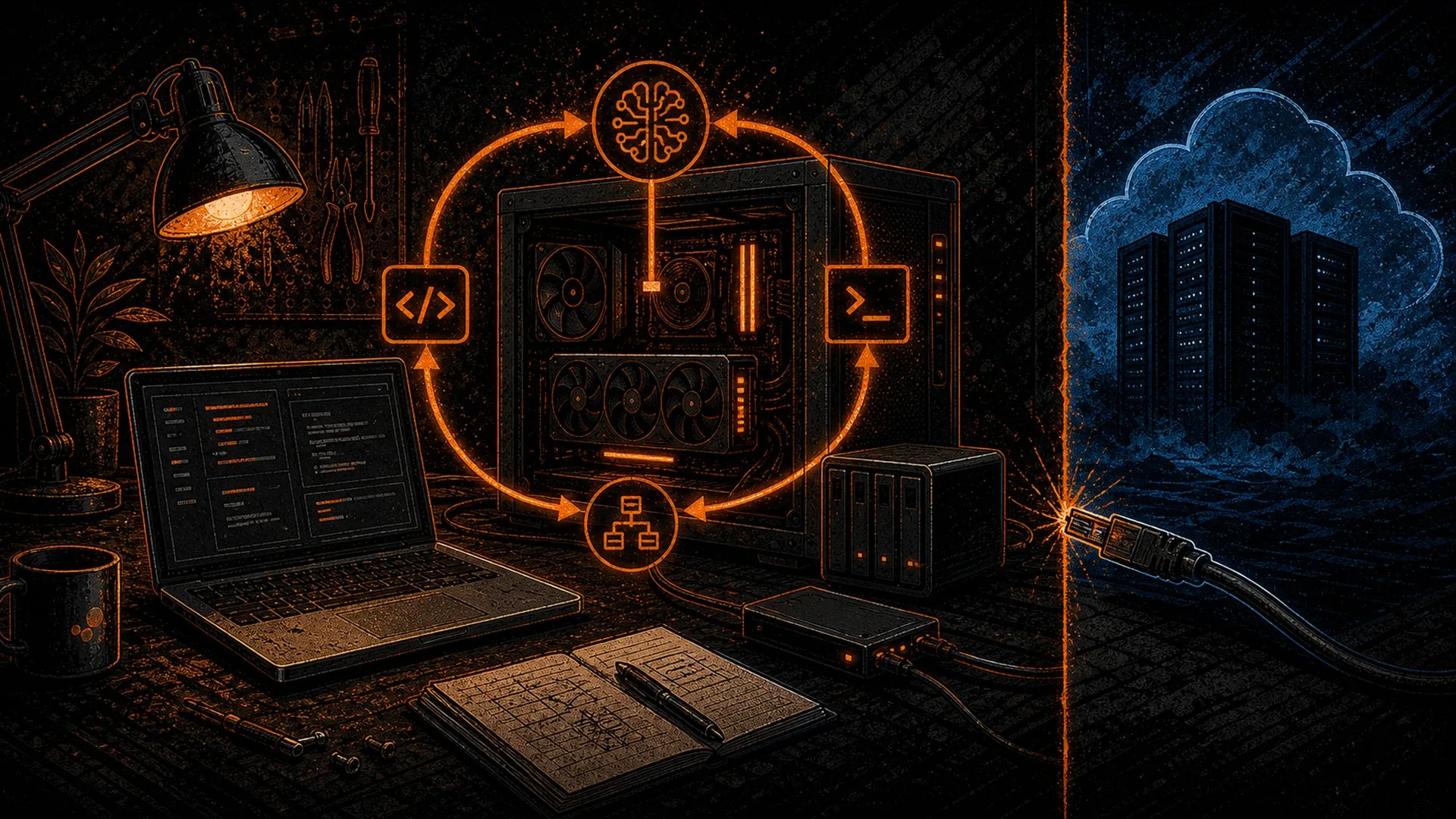
If you have searched for “Claude Code offline” or “run Codex on my own machine,” you have probably noticed the answers get vague fast. That is because there is a confusion baked into the question, and it is worth clearing up before you spend a weekend chasing it: a coding agent and the model behind it are two different things. The agent is the harness — the command-line tool that reads your repo, runs commands, edits files, and loops until the work is done. The model is the brain it consults at every step. Hosted agents like Claude Code and Codex ship the harness to your terminal, but the brain lives in someone else’s data center, and every line of your private codebase travels there to get an answer.
So the honest version of the question a sovereign Bitcoiner is really asking is: can I get an equivalent local coding agent running fully offline, on weights I own, without renting my brain? The answer is a qualified yes — and this post is the named-tool decision guide. We will be precise about what Claude Code and Codex actually are, what the open-weight local alternatives can and cannot do today, and exactly when going local is the right call. If you want the deep air-gapped setup walkthrough, we already have one — this is the layer above it: the comparison and the decision.
What Claude Code and Codex actually are
Both names get thrown around as if they were models. They are not. They are agent harnesses — excellent ones, built by teams who solved a genuinely hard problem — and credit where it is due. But understanding the split is the whole game here.
- Claude Code is Anthropic’s command-line coding agent. It runs locally on your machine, but by default it calls Anthropic’s hosted Claude models over the network. There is no download that puts a frontier Claude model on your SSD. The harness is local; the brain is cloud.
- Codex (in its current generation) is the same shape: a coding agent that phones a hosted frontier model. The agent loops on your files; the reasoning happens off-box.
This is not a knock. Hosted frontier models are extraordinarily capable, and for plenty of work, sending code to them is the right tradeoff. The point is narrower: “Claude Code running fully offline with Claude” is a category error. The Claude model itself lives in Anthropic’s infrastructure, full stop. What you can run offline is a different agent pointed at a different, open-weight model living on your own hardware.
Why a pleb would want it local in the first place
For a lot of tasks, cloud is fine and the results are better. But there is a real class of work where shipping your repo off-box is a non-starter, and it maps almost perfectly onto the sovereignty thesis:
- Secrets and keys. Agents read your environment, your config, your
.env. One careless context dump and a hosted model has seen credentials you would never paste into a chat box on purpose. - Proprietary code. If the codebase is the business — a trading bot, unreleased firmware, a client’s private system — “we promise we don’t train on it” is a policy, not a guarantee. Local weights are a guarantee.
- No metered brain. A rate-limited, surveilled, deplatformable capability is a dependency, not an asset. Same logic as running your own Bitcoin node: don’t rent a capability you can own. Weights on your disk are a backup that can’t be revoked.
This is the throughline. Your node validates Bitcoin on your own metal. Your Lightning routes value on your own metal. Now the agent that touches your source code can run on your metal too — one more layer decentralized.
The local stack: agent plus open-weight model
To replicate the Claude Code / Codex experience offline, you assemble two pieces yourself.
The local model. This is the open-weight brain. A new generation of capable, openly-licensed models is genuinely usable for coding now — names a pleb will actually search include DeepSeek’s code-focused models, Qwen’s coder line, Mistral, Google’s Gemma, and Meta’s Llama family. You download the weights once and they are yours. You run them through a local runner — Ollama, LM Studio, or llama.cpp — which loads the model and exposes a local API your agent can talk to.
The local agent. This is an open-source coding harness — the equivalent role to Claude Code or Codex — that you point at your local model’s API instead of a cloud endpoint. Several open agents exist that speak the same OpenAI-compatible API shape most local runners expose, so the wiring is “change the base URL to localhost and pull the network cable.”
That is the entire trick: open agent + open weights + local runner = a coding agent that never leaves your hardware. And if you want the box itself to be reproducible — runner, models, and agent declared in one config file — that is exactly what NixOS offers the sovereign stack.
Hosted vs local: the honest comparison
Here is where the tradeoffs actually bite. No spin — a skeptical expert is reading.
| Dimension | Hosted (Claude Code / Codex) | Local (open agent + open weights) |
|---|---|---|
| Raw capability | Frontier-class reasoning, long context, strong tool use | Good and improving fast; still a step behind the best frontier models on hard, multi-file tasks |
| Privacy | Code leaves your machine | Code never leaves your machine |
| Cost model | Metered per token; ongoing | Hardware up front, then effectively free to run |
| Hardware needed | A laptop and a network cable | Real VRAM — a capable GPU, or a high-RAM Apple Silicon machine |
| Offline / air-gapped | No — requires the network | Yes — fully air-gappable |
| Setup effort | Install, log in, go | Download weights, configure a runner, wire the agent |
| Deplatform risk | Account can be throttled or revoked | None — the weights are on your disk |
The shape of it: hosted wins on raw capability and convenience; local wins on privacy, control, and long-run cost — at the price of real hardware and a one-time setup. Neither is “better” in the abstract. The right choice depends on the job.
When to go local — a decision framework
Don’t moralize the choice; reason about it. A practical rule of thumb:
- Is the code sensitive? Secrets, proprietary IP, client work, regulated data — if yes, lean local. The privacy guarantee is the whole reason the extra hardware is worth it.
- How hard is the task? Boilerplate, refactors, test generation, “explain this function,” small edits — local models handle these well today. Sprawling multi-file architecture changes still favor frontier models. Match the tool to the difficulty.
- Do you have the hardware? A coding-grade local model wants real VRAM. If you are on a thin laptop, local is aspirational until you have the machine for it.
- How much do you value not being metered? If you run an agent all day, the token bill and the rate limits add up — and so does the discomfort of renting your thinking. For heavy daily use, local pays for itself in money and in sovereignty.
Many plebs land on a sane hybrid: local agent for anything touching private code or running constantly, hosted for the occasional hard problem where frontier capability earns its keep. Owning the local option means the choice is always yours to make — not the vendor’s.
The sovereignty angle: own your code, end to end
There is a reason this fits a Bitcoin-maximalist audience so cleanly. The progression is the same one that runs through everything we build: own your money, own your data, own your compute, own your code. A coding agent that runs on hardware you control, on weights you downloaded, with the network cable pulled, is the coding-tools chapter of that story. It is not about distrusting any one company. It is about not having a single point of failure between you and your own work.
That same instinct — take the centralized capability and make it home-runnable on hardware the individual controls — is exactly what drives DCENT_OS, our open-source firmware project for industrial Antminer hardware. Built on the shoulders of Braiins OS+, VNish, and LuxOS, it is the firmware version of the same idea you are applying to your coding tools: one more layer decentralized.
Frequently asked questions
Can I actually run Claude Code completely offline?
Not with Claude itself — the Claude model runs in Anthropic’s data center, and the Claude Code harness calls it over the network. What you can do is run an equivalent open-source coding agent pointed at an open-weight model on your own machine, fully offline. The harness changes; the workflow is similar.
Is a local coding agent as good as Codex or Claude Code?
On easy-to-medium tasks — refactors, tests, explanations, small edits — modern open-weight models are genuinely good. On the hardest sprawling, multi-file work, the best hosted frontier models still have an edge. The gap is real but it is closing quickly, and for many plebs the privacy is worth the tradeoff.
What hardware do I need to run a coding model locally?
The binding constraint is VRAM. A capable discrete GPU or a high-RAM Apple Silicon machine will run a useful coding model; a thin laptop will struggle. Quantized model formats lower the bar considerably, which is why the runner you choose matters.
Which local runner should I use — Ollama, LM Studio, or llama.cpp?
All three load open-weight models and expose a local API your agent can call. Ollama is the quickest to start; LM Studio is the most GUI-friendly; llama.cpp is the most hackable and lightweight. We compare them directly in the guides linked below.
Get started, the sovereign way
If you are new to running models locally, start at the foundation and work up: the pleb’s guide to self-hosted AI covers the whole stack, then install Ollama in ten minutes to get a local model running, and LM Studio vs Ollama vs llama.cpp helps you pick the runner that fits your hardware. From there, the broader self-hosted AI hub and the sovereignty stack tie local AI into the wider mission of owning your own infrastructure.
And when you are ready to apply the same own-your-code instinct to your mining hardware: DCENT_OS is in active beta — open-source firmware aimed at industrial Antminer hardware, built in Rust, with no mandatory dev fee — the optional donation ships on at 2% and one click sets it to 0% — and GPL-3.0 licensing. Join the DCENT_OS beta waitlist and help build one more decentralized layer of the stack.