Quick answer
Behind-the-meter solar mining runs a Bitcoin miner on power your own panels generate before it reaches the utility meter, consuming it on-site instead of exporting. A self-consumed kWh offsets electricity you would buy at retail, while exports often pay less, so a miner's interruptible load can soak up surplus.
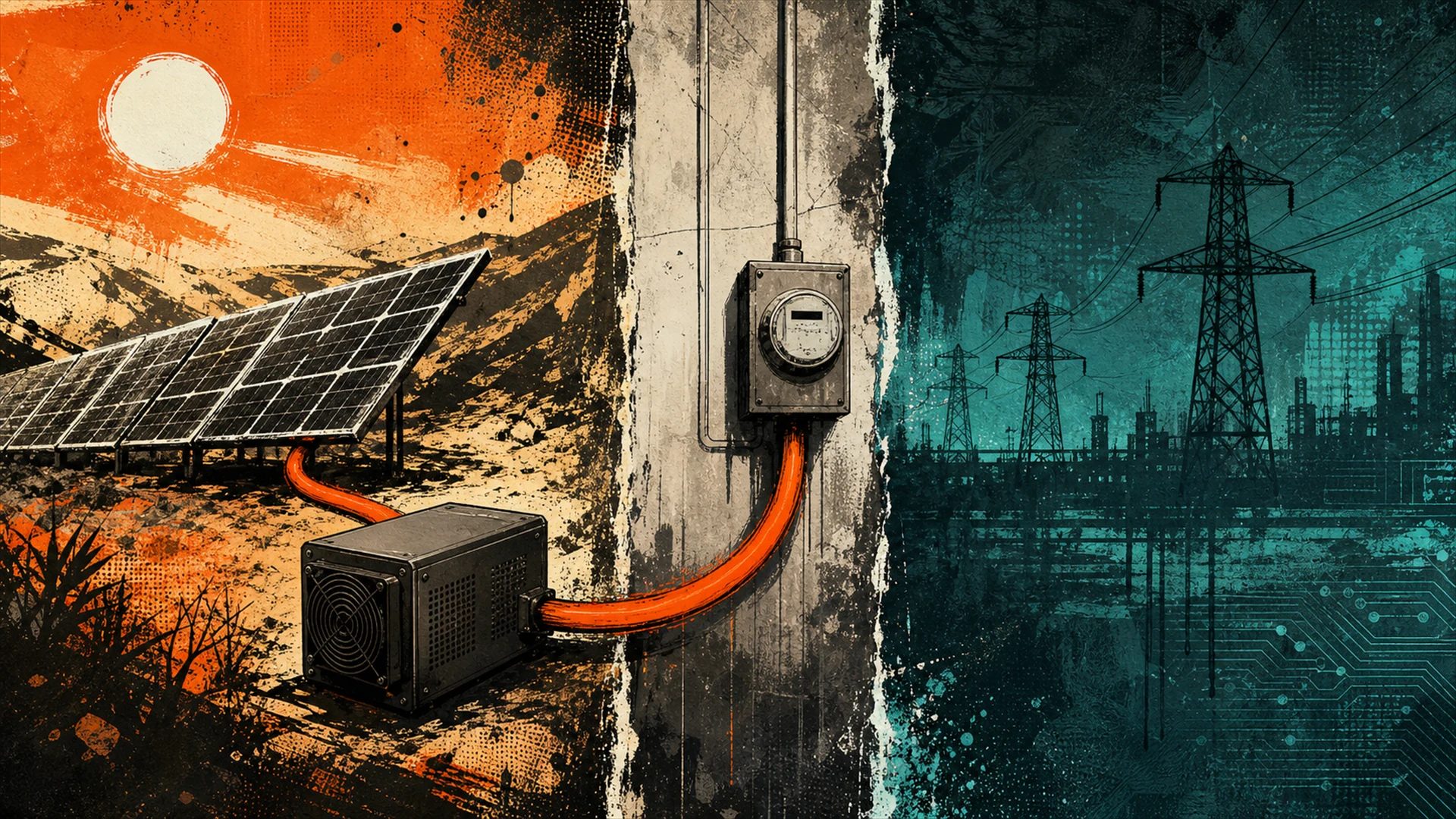
Behind-the-meter solar mining means running a Bitcoin miner on electricity your own panels generate before it ever reaches the utility meter, consuming that energy on-site instead of exporting it to the grid. The appeal is structural: a self-consumed kilowatt-hour offsets power you would otherwise buy at the full retail rate, while an exported kilowatt-hour is, in a growing number of jurisdictions, compensated at a lower wholesale-style rate. Because a miner is a fully interruptible, finely dimmable load, it can absorb the midday surplus that a fixed household would otherwise send back for less than it is worth. This article is an informational engineering overview, not electrical, legal, or financial advice; the relevant local code and your interconnection agreement always govern.
What “behind the meter” actually means
The U.S. Energy Information Administration (EIA) describes distributed (renewable) generation — the customer-sited category behind-the-meter generation belongs to — as “the generation of small amounts of electricity at the point of ultimate use, rather than the generation of large amounts at a central location.” In the engineering literature this same idea is called customer-sited or distributed generation: on-site production from distributed energy resources such as rooftop solar photovoltaics (PV), small wind, fuel cells, and combined heat and power. The defining feature is the meter itself. Energy you produce and use on your side of the utility meter never registers as a purchase; energy you push through the meter to the grid is an export, and exports are settled under whatever interconnection or compensation policy your utility applies.
That distinction has become the whole game economically. Under classic net metering, the EIA notes, “customers effectively receive retail prices for the electricity they generate, as they are charged only for their net electricity usage.” But the agency also flags the trend that matters here: “In some States, customers receive wholesale prices (which are lower than retail prices) for their excess generation supplied to the distribution system.” California’s Net Billing Tariff (often called NEM 3.0), adopted by the California Public Utilities Commission, is the clearest example: export credits are calculated from an Avoided Cost Calculator rather than the retail rate, and widely reported export values fell from roughly $0.30/kWh under the prior regime to around $0.08/kWh on average. When the spread between what a self-consumed kWh is worth (retail) and what an exported kWh earns (avoided cost) widens, self-consumption becomes the more valuable use of each marginal watt.
Why a miner is a useful controllable load
Most household devices cannot follow your solar output. A fridge, a water heater, or an EV charger runs on its own schedule and draws what it draws. A Bitcoin miner is different in one engineering-relevant way: it is dispatchable. It can run at any duty cycle, be throttled to a target wattage, paused in seconds, and restarted in seconds, with no spoiled product and no process to restart. In grid-operations language that makes it an interruptible, scalable load — sometimes informally called a dump load, because it can absorb energy that would otherwise have nowhere useful to go.
That “nowhere useful to go” energy is real and quantifiable. When a PV array’s DC capacity exceeds the inverter’s AC rating, the inverter limits output in bright conditions, an effect called clipping; separately, output can be curtailed when grid or export constraints cap what you are allowed to push out. As NREL and industry sizing guidance describe, a DC-to-AC ratio around 1.25 typically produces only one to two percent of annual clipping, but clipped and curtailed energy is precisely the kind of low-value, otherwise-wasted production a behind-the-meter miner is well suited to monetize. To estimate how much surplus your own array realistically offers and what a miner could consume from it, the solar Bitcoin node calculator is a more honest starting point than any rule of thumb.
The building blocks of a behind-the-meter setup
Panels and inverter
The array and inverter are the same hardware you would install for any home solar system; the behind-the-meter intent does not change the panels. What it changes is how you think about the inverter’s headroom. A modestly oversized DC array (a higher DC-to-AC ratio) produces more midday energy that a controllable miner can pick up, rather than energy that simply clips away. Sizing is a trade-off best run through a calculator and a qualified installer, not assumed.
Optional battery and state of charge
A battery is optional for behind-the-meter mining, but it changes the operating envelope. With storage, the relevant control signal becomes the battery’s state of charge (SoC): mine the surplus when the battery is full and the sun is up, dial the miner’s wattage down as SoC falls, and curtail near empty so household loads keep priority. Without a battery, the miner instead tracks instantaneous net production. Either way, the miner is the flexible load that yields first.
The controller
The piece that turns hardware into a behind-the-meter system is a controller: logic that reads a signal (instantaneous surplus, battery SoC, or a time-of-use price) and ramps or pauses the miner accordingly. The conceptual flip is to tune the miner to a watt budget rather than a fixed hashrate, then let that budget follow available energy. The deep control-loop design — thresholds, hysteresis, wake latency — is its own topic; this guide treats the controller as a building block and focuses on the behind-the-meter framing around it.
The miner
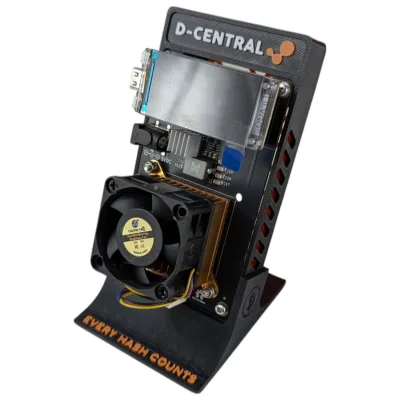
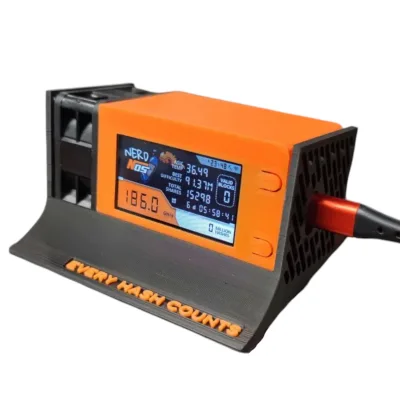
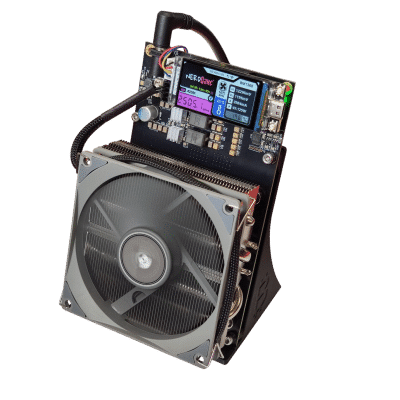
Behind-the-meter works across the hardware range. A small open-source solo miner draws on the order of tens of watts, which pairs naturally with a single panel or a modest surplus; a current full-size ASIC draws on the order of 3,000 to 3,500 watts and needs a correspondingly larger array or battery to run for meaningful hours. Whatever the scale, two adjacent concerns matter: airflow, which you can plan with the mining room ventilation calculator, and the fact that the miner’s waste heat is itself recoverable value during heating months — quantifiable with the mining heat savings calculator.
Behind-the-meter vs grid-tied export
Behind-the-meter self-consumption and grid-tied export are not opposites so much as two ends of a dial; most homes sit somewhere between. The table contrasts the pure forms so the trade-offs are legible.
| Consideration | Behind-the-meter (self-consumption) | Grid-tied export (net metering / net billing) |
|---|---|---|
| Value of each surplus kWh | Offsets a retail-rate purchase by running a controllable load | Earns the utility’s export credit, which may be retail or, increasingly, an avoided-cost rate below retail |
| Control needed | Active: the miner must follow available energy | Passive: surplus flows out automatically once interconnected |
| Grid interaction | Can be designed for zero export (self-consume only) | Exports power to the grid by design |
| Interconnection burden | Still code-compliant wiring; lighter if it never back-feeds | Requires a utility interconnection agreement and compliant equipment |
| Battery | Optional; extends mining hours and enables SoC control | Often unnecessary for credit capture alone |
| Best fit when | Export rates are low and you have a flexible on-site load | Export rates are favourable and you lack a dispatchable load |
A home does not have to choose one camp. A common pattern is to self-consume into the miner when export prices are poor and let the system export when they are good. The economics for a specific region — and which way that dial should point — depend on local tariffs; the Canada net-metering programs dataset compiles provincial rules, and the solar Bitcoin mining in Canada guide walks through the broader economics and seasonal strategy.
Safety and code basics
This section is informational and does not replace a licensed electrician, your local authority having jurisdiction, or your utility. Any solar-plus-miner installation should be designed and inspected to the applicable electrical code — the National Electrical Code (NEC) in the United States, the Canadian Electrical Code (CEC) in Canada — and connected only with the required permits and approvals.
Two principles come up repeatedly:
- Mining is a continuous load, so wire it as one. The NEC treats a load expected to run for three hours or more as continuous, and NEC 210.20(A) requires the overcurrent device to be rated for the noncontinuous load plus 125% of the continuous load — equivalently, limiting a continuous load to 80% of the breaker’s rating. A miner that runs for hours belongs on an appropriately sized, dedicated branch circuit, not sharing a general-purpose outlet.
- Do not back-feed the grid without proper interconnection. Pushing power onto utility lines through unapproved equipment is both a code violation and a safety hazard: during an outage, an uncontrolled source can energize lines that line workers believe are dead. This is why grid-interactive inverters must provide anti-islanding protection and meet recognized standards — IEEE 1547, the North American standard for interconnecting distributed energy resources with the grid, and UL 1741, the corresponding North American product safety standard for inverters and interconnection equipment, with PV interconnection further governed by NEC Articles 690 and 705.
The reassuring corollary for behind-the-meter builds: a system engineered to self-consume and not export still has to be wired to code, but it sidesteps much of the export-side interconnection complexity. That is a design conversation to have with your installer and utility, not a DIY shortcut.
How this fits your wider planning
Behind-the-meter mining is one layer in a larger home-energy picture, and it reads best alongside the tools that quantify each piece. Use the solar Bitcoin node calculator to estimate array surplus and miner sizing, the net-metering programs dataset to see what exports are actually worth where you live, the ventilation calculator to plan airflow, and the heat savings calculator to credit the recovered warmth. None of these replace professional design; together they make the trade-offs concrete before anyone buys a panel.
Frequently asked questions
Do I need a battery to mine behind the meter?
No. Without a battery, the miner simply tracks instantaneous surplus and runs when production exceeds household demand. A battery is what lets you shift mining into evening hours and use state of charge as the control signal; it extends operating hours at the cost of added capital and complexity.
Will I get in trouble for back-feeding the grid?
Uncontrolled back-feeding through unapproved equipment is both unsafe and a code violation, which is why grid-interactive inverters are required to include anti-islanding protection under standards such as IEEE 1547 and UL 1741. A compliant interconnection, or a system designed to self-consume without exporting, is the correct path. Confirm the specifics with a licensed electrician and your utility.
Can a miner really follow my solar output?
Yes. Unlike most appliances, a miner can be set to a target wattage, throttled, paused, and restarted within seconds. A controller reads a signal — instantaneous surplus, battery state of charge, or price — and adjusts the miner’s draw to match, which is what makes it a practical flexible load.
Is behind-the-meter better than selling power back?
It depends on your local export compensation. Where exports earn near-retail credit, exporting is straightforward and needs no controllable load. Where export rates have fallen toward avoided cost — as under California’s Net Billing Tariff — self-consuming surplus into a miner can retain more of each kWh’s value. The honest answer requires your specific tariff, not a general rule.
Does intermittent solar power damage a miner?
Mining hardware is designed to be powered on and off, and a controller that ramps wattage smoothly and curtails cleanly is gentler than abrupt cycling. The bigger practical concerns are stable input voltage from your inverter or battery system and adequate cooling, both of which are ordinary installation considerations rather than fundamental obstacles.
What size miner suits my array?
That is exactly the question the solar Bitcoin node calculator exists to answer. As a rough orientation, small open-source miners draw tens of watts and pair with modest surplus, while full-size ASICs draw thousands of watts and need a larger array or battery to run for meaningful hours.
The bottom line
Behind-the-meter solar mining is not a magic yield; it is a disciplined way to keep more of the value your panels already produce, by pairing a controllable load with energy that would otherwise be exported cheaply or clipped away. It stands on decades of distributed-generation engineering and the interconnection standards that keep the grid safe, and it works only when the wiring, the controller, and the local rules are all respected. Treated that way — as one more layer of energy self-reliance rather than a shortcut — it earns its place in a home-energy plan. For anything touching your panel, your inverter, or the utility connection, work with a licensed professional.