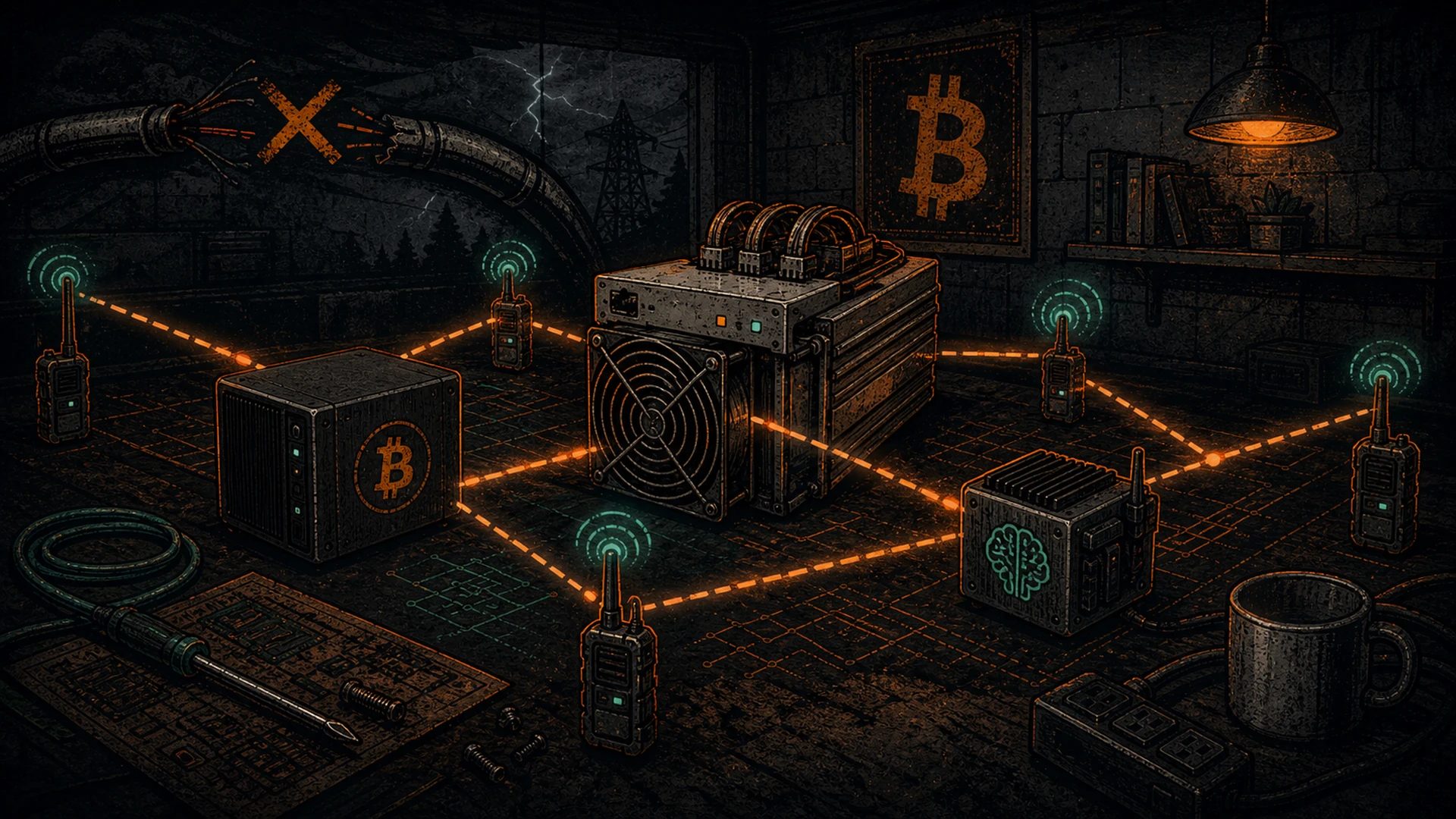
You can have the cheapest power in your county. You can run a full node that has validated every block since genesis. You can even bolt an AI agent onto your bench to watch your fleet and answer questions in plain language. None of it matters the moment your ISP drops. Power and compute are downstream of one thing nobody plans for: connectivity. When the upstream link dies, your node goes unreachable, your miner’s dashboard goes dark, and the agent you trusted to alert you has nothing to alert you over.
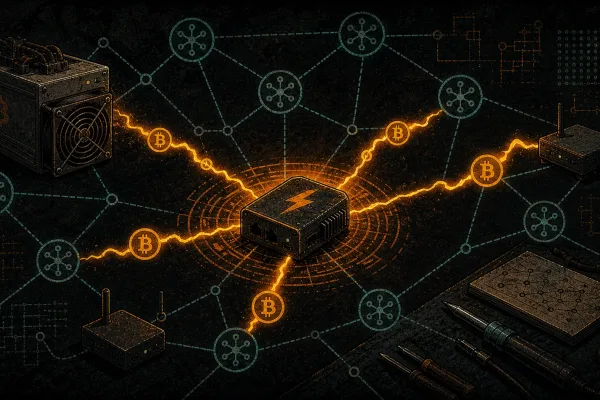
This is the layer under everything. A mesh network built on LoRa radios and Meshtastic, paired with Nostr as a censorship-resistant relay, is the cheap, low-power insurance that keeps the critical signals flowing when the grid flickers and the fiber goes quiet. We are going to be honest about what mesh can and cannot do — it is not broadband, and anyone who tells you otherwise is selling something. But for keeping your node, your miner, and your agent reachable, it is one more layer decentralized between you and a single point of failure you do not control.
The Single Point of Failure Nobody Plans For: Your ISP
Walk through a typical sovereign-minded setup. There is a Bitcoin node validating in the corner. There is a miner — maybe a single S9 on the bench as a space heater, maybe a small stack in the garage — hashing into a pool. Lately there might even be a small AI agent running locally, scraping rig telemetry and surfacing it in chat. Every one of those things depends on the same fragile thread: the coax or fiber coming in from one provider, terminating in one modem, on one circuit.
That thread breaks more often than people admit. A storm takes down a line. The provider pushes a bad firmware update to the modem. A backhoe finds the fiber. A regional outage rolls through. In some parts of the world, the connection is cut deliberately during unrest. Whatever the cause, the result is identical: you lose visibility and control precisely when you most want it. The node can’t gossip. The pool connection times out and your hashrate falls off the dashboard. The agent that was supposed to text you “rig 2 is overheating” can’t reach the SMTP server, the push service, or the internet at all.
The instinct is to fix this with more of the same — a second ISP, an LTE failover modem, a satellite dish. Those are legitimate and we are not telling you to skip them. But they are all still somebody else’s network, billed monthly, subject to the same outages and the same shutdown orders. Mesh is different in kind. It is a radio link you own outright, with no subscription, no central operator, and no off switch anyone else controls. That is the property that matters when everything else is down.
What Mesh Actually Is: LoRa, Meshtastic, and Local RF
Strip away the hype and a mesh network is a handful of cheap radios that pass small messages to each other, hop by hop, until a message reaches where it needs to go. No tower. No carrier. No monthly bill.
LoRa (short for Long Range) is the radio technology underneath. It trades speed for distance and battery life: low data rates, but kilometers of range on unlicensed ISM bands — 915 MHz in the US and Canada, 868 MHz in Europe — and power draw so small a node can run for weeks on a small battery or indefinitely on a tiny solar panel. Meshtastic is the open-source firmware and app project that turns those LoRa radios into an easy-to-use, encrypted, self-healing mesh. You flash a sub-$40 board — a Heltec LoRa 32, a RAK WisBlock, a LILYGO T-Beam — pair it to your phone over Bluetooth, and you are on the mesh. When two nodes can’t hear each other directly, any node in between relays the traffic automatically. That is the “mesh” in Meshtastic.
The whole thing is local RF: radio waves moving between devices you placed, on spectrum nobody has to license, with end-to-end channel encryption baked in. There is no ISP in the path. That is exactly why it survives when the ISP does not. If you are starting from zero, our Meshtastic getting-started primer for Bitcoiners walks through the hardware and first-boot setup in detail, and the broader picture lives on the Bitcoin sovereignty hub.
The Honest Bandwidth Reality: Control and Telemetry, Not Streaming
Here is where we refuse to oversell. Mesh is low-bandwidth. Depending on how you tune the LoRa parameters, you are working with anywhere from a few hundred bits per second to a few tens of kilobits per second — and the longer the range you want, the slower it gets. That is not a flaw to be patched in the next firmware release. It is physics. Long range, low power, and high throughput are three corners of a triangle and you only get to pick two.
So be clear-eyed about what fits down that pipe:
- Text and structured messages — yes. A few dozen bytes saying
NODE OK BLK 901234orRIG2 INTAKE 47C WARNsails through with room to spare. - Telemetry heartbeats — yes. Temperature, hashrate buckets, node-sync status, grid state, a heartbeat counter. Tiny payloads on a schedule. This is mesh’s home turf.
- Short commands — yes. “Pause the miner.” “Power down.” “Restart the node.” High-consequence keystrokes that cost almost no bandwidth.
- A Nostr note or a signed transaction — yes, carefully. A signed Bitcoin transaction is a few hundred bytes; a short Nostr event is similar. They fit, fragmented across packets, if you are patient.
- Streaming a dashboard, video, or a full blockchain sync — no. Not now, not ever, over LoRa. Don’t try. That is what your primary link is for.
The mental model: mesh is the backup nervous system, not the bloodstream. It carries the urgent signals — “I’m alive,” “something is wrong,” “do this now” — when the high-bandwidth path is gone. Treat it as augmentation, not replacement, and it will never disappoint you.
Keeping a Bitcoin Node Reachable Over Constrained Links
A Bitcoin node’s heaviest job — staying in sync with the chain — genuinely needs real bandwidth. New blocks arrive roughly every ten minutes and run up to a few megabytes each; that traffic belongs on your primary internet link, full stop. Mesh does not change that, and pretending otherwise would be dishonest.
What mesh does change is your relationship with the node when the primary link is down. Two things become possible:
- Reachability and status. A small script on the same machine as your node publishes a heartbeat to the mesh every minute or two: current block height, peer count, sync status, disk health. From your phone, anywhere in mesh range, you can see your node is alive and at the chain tip — without touching the internet. If the heartbeat stops, you know your node (or its host, or its power) went down, and you know it immediately instead of discovering it days later.
- Out-of-band control. A short authenticated command over the mesh can restart the node service, trigger a safe shutdown before a known power event, or flip a relay that power-cycles the host. The path into your node no longer depends on the same internet link that just failed — which is also exactly the property you want if that link is ever compromised rather than merely down.
And for the narrow, high-stakes case — you have a signed transaction that absolutely must reach the network during an outage — mesh can ferry those few hundred bytes, fragmented, to a node elsewhere on the mesh that still has an internet bridge, which then broadcasts it. That is slow and deliberate, not a daily workflow, but it is the difference between “stuck” and “it went out.” Our deep dives on broadcasting Bitcoin transactions off-grid over Meshtastic and sending Bitcoin without the internet cover that path end to end.
Mesh + Your Miner + Your Agent: Telemetry and Alerts That Survive the Outage
This is where connectivity sovereignty pays off most concretely, because a miner left unattended during an outage is a miner that can hurt itself. A stuck fan, a thermal runaway, a board that de-rates and never recovers — these are the failures that turn a $50 fan swap into a $400 hashboard replacement, and they happen quietly while you have no idea anything is wrong.
Wire a small companion computer — a Raspberry Pi is plenty — to read your miner’s API. Modern ASICs report fan RPM, chip and board temperatures, hashrate, and error counts. The companion polls those numbers, and when something crosses a threshold it pushes a tiny message onto the mesh: RIG2 FAN2 FAIL, RIG1 BOARD0 105C, FLEET HASHRATE DROP. That message hops to the base-station node next to you and lands as a push notification on your phone — no internet required. You catch the failure in the first minute, not after the damage is done.
Now layer in the agent. A local AI agent watching your fleet can do more than relay a raw alarm — it can summarize. Instead of five cryptic packets, it sends one: RIG2 likely fan failure, board 0 climbing, recommend remote pause. The agent does its reasoning on whatever compute you have on the bench, and uses the mesh purely as the thin, resilient channel to reach you. One important honesty note while we are here: that agent is running on a normal CPU or a small accelerator next to your miner — it is not running on the ASIC. A Bitcoin miner’s chips are fixed-function SHA-256 silicon; they hash and nothing else. ASIC silicon is not AI silicon, and any setup that implies otherwise is confused about both. We unpack that distinction fully in can you actually run AI on a Bitcoin miner.
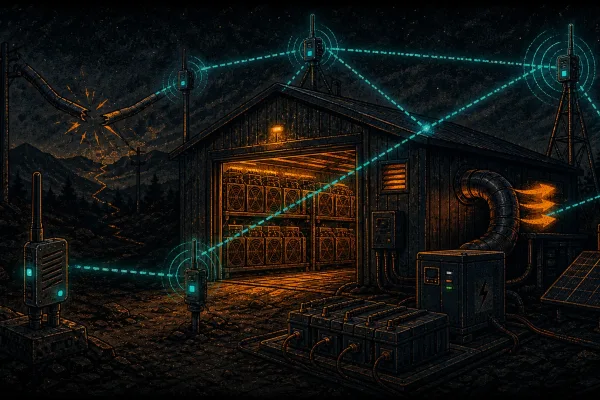
The control direction matters just as much. From your phone on the mesh, you send RIG2 PAUSE and the companion script — listening for an authenticated payload — calls your miner’s API to throttle or stop it, or flips a relay to cut its power. Telemetry out, commands in, both surviving the outage. For a full-site version of this pattern, our guide to running a mining site on Meshtastic when the internet dies covers the multi-node Hashcenter build. If you are repurposing an old miner as a heater and want a resilient way to watch it, the same telemetry rig applies, and you will find compatible single-board radios and accessories in the D-Central shop.
Nostr as the Censorship-Resistant Relay
Mesh solves the local last mile when your ISP is gone. Nostr solves the global reach when you want a signed, durable message to escape your local bubble the instant any connectivity returns. The two compose beautifully.
Nostr — Notes and Other Stuff Transmitted by Relays — is a dead-simple protocol where every message is a small, cryptographically signed event published to relays. There is no central server to seize, no account to deplatform; your identity is a keypair, and any relay anywhere will carry your signed note. Because a Nostr event is tiny and self-authenticating, it is a natural fit for constrained links. Your agent can compose an alert as a signed Nostr event, hand it to the mesh, and the moment any node on that mesh has an internet bridge — a neighbor’s link, a brief LTE window, a satellite burst — the event reaches a relay and propagates to the wider world. You read it on any device, anywhere, knowing it genuinely came from your key.
The signing is what makes this trustworthy across an untrusted path. A message can hop through radios and relays you do not control and still arrive provably authentic and untampered, because the signature travels with it. That property is exactly what you want for a fleet alert, a node-status broadcast, or a “this is really me, the site is down, ignore anyone who says otherwise” message during an outage. Mesh gives you reach without an ISP; Nostr gives you authenticated, censorship-resistant reach the moment a sliver of connectivity exists. Together they are the resilient relay layer under your node, your miner, and your agent.
Putting It Together: A Realistic Resilience Stack
None of this is exotic, and none of it pretends to replace your main internet connection. A workable stack looks like this: your primary ISP carries the heavy traffic — node sync, pool connection, dashboards, the agent’s model downloads. Underneath it sits a permanently-on mesh: a node by your miner and node, a node by you, maybe one relay on a rooftop to bridge the gap. The companion computer publishes telemetry and listens for commands. The agent summarizes and, when it matters, wraps an alert in a signed Nostr event so it can escape the moment any link returns.
When the ISP drops — and it will — the heavy stuff pauses, but you are not blind. You can still see your node is alive, still get told your miner is in trouble, still issue the one command that prevents a small problem from becoming an expensive one. That is connectivity sovereignty: not a promise that nothing breaks, but a guarantee that you stay reachable when it does. It is the quiet layer under power and compute, and it costs less than a single hashboard to build. Credit where it is due — this is only possible because of the open work of the Meshtastic project and the Nostr community, who built these tools in the open for exactly this kind of sovereignty.
Frequently Asked Questions
Can I run my whole Bitcoin node over a mesh network instead of the internet?
No, and you should be wary of anyone who claims you can. Keeping a node in full sync means pulling new blocks of up to a few megabytes every ten minutes, which needs real bandwidth that LoRa mesh simply does not have. What mesh does is keep your node reachable and controllable when your primary link is down — heartbeat status, sync state, and short commands like restart or shutdown — and, in a pinch, ferry a single signed transaction toward a node that still has an internet bridge. Mesh is the backup nervous system, not the bloodstream.
How much bandwidth does a Meshtastic mesh actually give me?
Realistically a few hundred bits per second up to a few tens of kilobits per second, and it slows as you push for more range. That is plenty for text, telemetry heartbeats, short commands, and small signed events like Nostr notes or a single Bitcoin transaction sent slowly. It is nowhere near enough for streaming, video, dashboards, or a blockchain sync. Long range, low power, and high throughput are a pick-two situation, and mesh deliberately chooses range and power efficiency.
Where does Nostr fit if the mesh is already local?
Mesh moves messages locally with no ISP; Nostr gives those messages authenticated, censorship-resistant global reach the instant any connectivity returns. Every Nostr event is small and cryptographically signed, so it travels well over constrained links and arrives provably from your key, even after hopping through radios and relays you do not control. Your agent can wrap a fleet alert in a signed Nostr event, the mesh carries it locally, and the moment any node has an internet bridge it propagates to relays worldwide.
Does the AI agent run on the Bitcoin miner itself?
No. A Bitcoin miner’s chips are fixed-function SHA-256 ASICs — they hash and do nothing else. An AI agent runs on a normal CPU or a small accelerator on a companion computer next to the miner, reads the miner’s API, and uses the mesh as a thin channel to reach you. ASIC silicon is not AI silicon; the two only sit side by side. We explain the distinction in full in our guide on running AI on a Bitcoin miner.
Is mesh meant to replace my ISP or my LTE backup?
No — it is augmentation, not replacement. Keep your primary ISP and any LTE or satellite failover for the heavy lifting. Mesh is the one channel you own outright, with no subscription and no central operator, that stays up when those paid links go down or get cut. It carries the urgent, low-bandwidth signals — status, alerts, commands — so you are never fully blind, no matter what happens upstream.
The sovereign stack: own every layer
Sovereignty is layered: Bitcoin for money, a local LLM for intelligence, mesh for connectivity, Nostr for identity, and your own power. Each piece is one more layer no single actor can switch off.