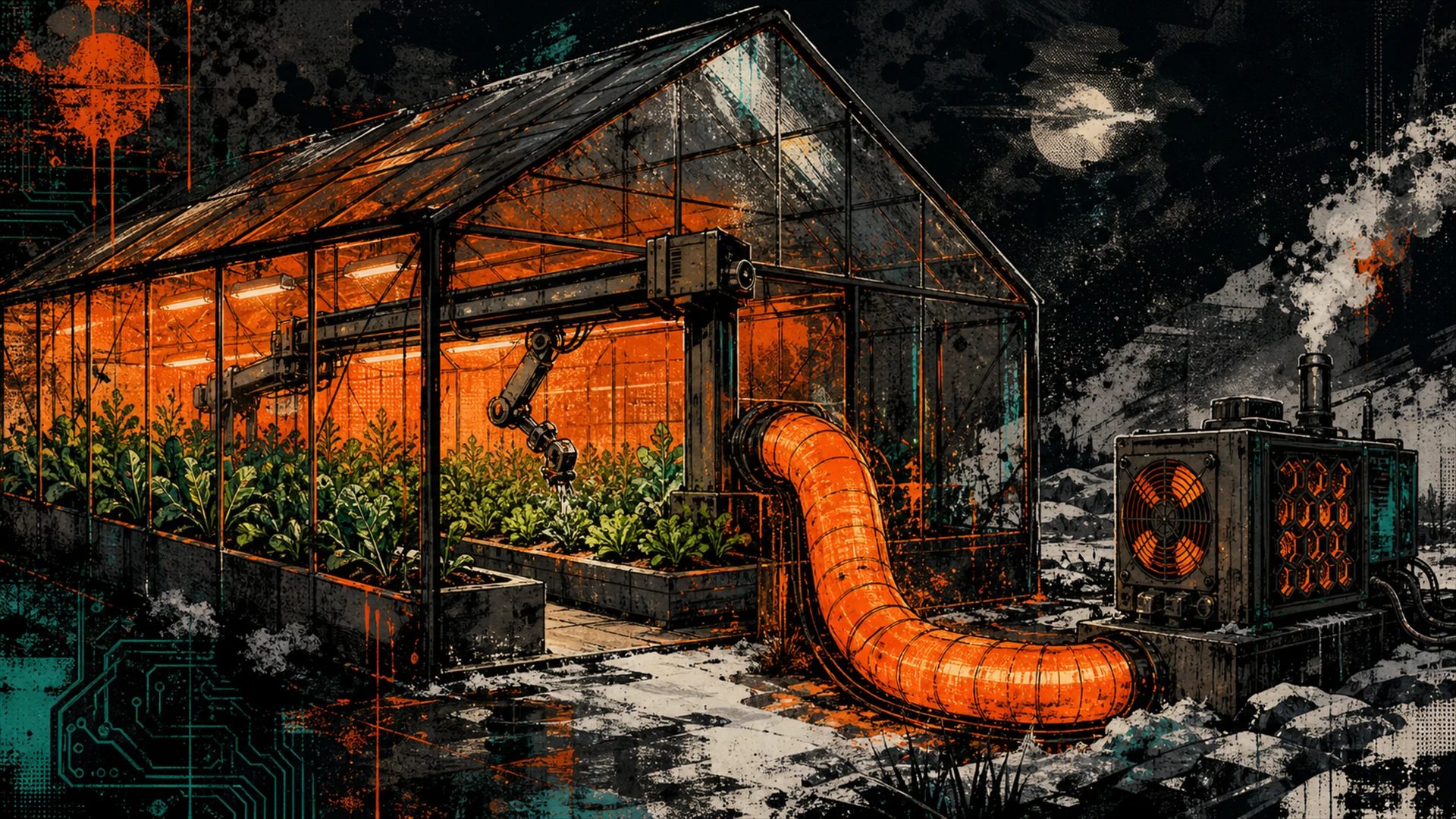
Automated growing is the food layer of a resilient homestead: an open-source robot that seeds, waters and weeds a raised bed, an open controller that manages a greenhouse’s climate and irrigation, and a heat source to hold temperature through a Canadian winter. D-Central did not build these robots — projects like FarmBot, Home Assistant and OpenSprinkler did, and they deserve the credit. What a mining site adds is the connective tissue: reused waste heat, harvested rainwater and on-site solar that let those tools run all year. It is one more layer decentralized.
Our homestead-resilience hub frames a self-owned home as six stacked layers — power, heat, water, food, comms and money — each one a backup for a service you would otherwise rent from someone else. Solar backs up the grid, reused miner heat backs up the furnace, rain backs up the tap. This guide is about the fourth layer: food, and specifically the part most people assume is out of reach — automating it. The good news is that the hard engineering has already been done, in the open, by people who gave it away. Our job is to point at their work honestly and show where a Bitcoin mining setup quietly makes it cheaper to keep running.
FarmBot: the open-source robot that tends the bed
The centrepiece of open-source automated growing is FarmBot, a CNC farming robot started in 2011 by Rory Aronson while he was a mechanical-engineering student at Cal Poly. It is, mechanically, a 3D printer for a garden: a Cartesian gantry that moves a tool head across the X, Y and Z axes over a raised bed, driven by four NEMA 17 stepper motors on GT2 timing belts, with a stainless-steel leadscrew handling the vertical axis. A custom Arduino-based controller board — the Farmduino, with Trinamic TMC2130 drivers and rotary encoders for position feedback — runs the motion in real time, while a Raspberry Pi running FarmBot OS handles the brains and the web connection.
What makes it genuinely useful is the Universal Tool Mount, a magnetic quick-change coupler with a dozen electrical connections and three liquid/gas lines, so one gantry can pick up and drop a whole toolkit: a vacuum-powered seed injector, a solenoid watering nozzle, a soil-moisture sensor, a 24 V rotary weeder, and an IP67 camera for computer vision. From the web app you lay out a garden on a grid, tell it what is planted where, and it sows, waters on a per-plant schedule, and mechanically kills weeds — accounting for plant age and weather as it goes. The Genesis model covers a 1.5 × 3 m bed (4.5 m²); Genesis XL stretches to 3 × 6 m (18 m²).
Crucially for a sovereignty-minded build, FarmBot is actually open, not open-in-marketing. All of its software is released under the permissive MIT license on GitHub, the hardware is published in line with the Open Source Hardware Association’s definition — full CAD, a complete bill of materials and step-by-step assembly instructions — and the web app can be self-hosted on your own server instead of the company’s cloud. You can buy a kit to save yourself the sourcing, or you can build one from the published files. That is the same posture we respect across the whole sovereignty stack: the design is yours to inspect, run and repair. FarmBot did the decade of work here; we are only wiring it into a larger loop.
The open greenhouse-automation toolbox
A robot tending a bed is one piece. The other is climate and irrigation control — the difference between a summer garden and a building that grows food in the shoulder months and, with enough heat, through winter. Here too the open-source community has already built the parts, and they compose better than any single closed product:
- Home Assistant + ESPHome — the local-first backbone. Flash a cheap ESP32 with ESPHome, wire up temperature, humidity, soil-moisture and CO₂ sensors, and Home Assistant turns their readings into rules: open a vent at 28 °C, run an exhaust fan on high humidity, kick a heater on below your night setpoint, log everything. It runs entirely on your own hardware, no cloud account required — the same self-hosting principle behind running your own Bitcoin node.
- OpenSprinkler — an open-source hardware-and-software irrigation controller for standard 24 V valves, with published design files and a weather-adjusting algorithm that trims watering based on local conditions. It is the honest, hackable answer to a proprietary smart-sprinkler timer.
- farmOS — GPL-licensed, Drupal-based farm record-keeping and planning software, developed by a community of farmers and researchers and endorsed by the UN FAO as a data standard. It is where the season lives: what you planted, when, what it yielded, and what to do next year.
- MyController.org and Hydrosys4 — lighter-weight, Raspberry-Pi-friendly controllers aimed squarely at irrigation and greenhouse environment automation, with web interfaces that ask for no code.
None of these came from D-Central, and that is the point. The sovereign move is not to reinvent a greenhouse controller — it is to stand on the shoulders of the people who already open-sourced one, run it on hardware you own, and connect it to the rest of your stack.
Where a mining setup closes the loop
Automated growing has three appetites: heat, water and power. A homestead built around a Bitcoin miner already produces or captures all three, which is why the food layer sits so naturally next to the mining layer rather than competing with it.
Heat. An ASIC is, thermodynamically, a roughly 100%-efficient electric resistance heater that happens to earn sats — and its exhaust is exactly what a greenhouse wants: warm, dry, CO₂-free air, available all night and all winter. Instead of burning propane to hold a frost-free bed, you duct heat you were going to generate anyway. The open question is never whether it works but how much you need, which is precisely what our miner-heated greenhouse sizing calculator answers — envelope, glazing and design-cold night in, miner count out. The heat-reuse application compatibility matrix puts a greenhouse next to the seven other places that exhaust can go, and the case studies behind miners for greenhouse heating and strawberries in Québec show the idea working in cold-climate practice.
Water. FarmBot’s nozzle and an OpenSprinkler zone both need a supply, and a rain barrel is the sovereign one. A modest Canadian roof sheds tens of thousands of litres a year — run the numbers for your own city with the Canadian rainwater harvesting calculator before you buy a single barrel. Non-potable rain is perfect for irrigation, and pairing it with a controller that only waters when the soil sensor says so stretches every litre.
Power. Sensors, pumps, a Raspberry Pi and a gantry motor draw very little — a few tens of watts — which means the same on-site solar and battery you size for a miner can carry the whole automation layer as a rounding error. And because the controllers are local-first, they keep running when the internet does not; wire their telemetry into an off-grid mesh network and you can watch your greenhouse from the far side of the property with no cell contract in the loop.
A stacked layout that actually fits together
Put concretely, a resilient food layer looks like this: a hoop house or lean-to greenhouse with a miner-fed heat duct and a thermostat; a FarmBot (or a simpler raised-bed of drip lines) doing the seeding and watering; a single Raspberry Pi or mini-PC running Home Assistant, farmOS and, if you like, the FarmBot web app side by side; ESP32 sensor nodes reporting temperature, humidity and soil moisture; a rain-fed reservoir feeding the pumps; and all of it powered from the same solar-and-battery bank that keeps the miner warm-loading. One low-power local server, one heat source doing double duty, one water catchment, one power system — and food coming out the other end. Nothing here depends on a subscription, a distant data centre, or anyone’s permission.
Honest limits
Automated growing is a resilience multiplier, not a magic wand. FarmBot excels at dense, high-value bed crops — greens, herbs, roots, small fruiting plants — and is not a substitute for a field or an orchard. A miner-heated greenhouse still loses heat to wind and infiltration that a simple conduction calculator does not capture, so size with margin and treat every number here as a planning floor, not an engineering sign-off — real electrical, structural and horticultural decisions belong with the relevant professional. Open-source tools trade polish for control: you own the whole stack, which also means you maintain it. And a robot that plants seeds cannot make it rain or make the sun shine — it makes your labour go further on the inputs your site already has.
That trade — more responsibility for more independence — is the same one that runs through every layer of the homestead. Grow a little of your own food, on tools you can read and repair, warmed by heat you already paid for and watered by rain you already caught, and you have backed up one more thing you used to rent. It is, like the rest of the stack, one more layer decentralized. Start with the greenhouse sizing calculator to see how much heat your food layer would need — then go meet the people who open-sourced the robots.