Bitcoin secures money without asking permission; mesh networks secure communication the same way — and we believe the people building each have been fighting the same fight all along. In a world where a handful of corporations increasingly own the right to use the rails of money and speech, an open monetary network and an open communications network are two halves of one resiliency layer: a sovereign web of independent but interconnected nodes that is far harder to switch off than any single company.
This is a belief, not a product. We are writing it down because we think it matters, and because the communities that built the pieces deserve to be named. D-Central did not invent any of the open-source work described below. We are participants and believers standing on the shoulders of giants.
The same enemy
Strip away the jargon and the problem is the same on both sides of the wire. The rails most of us depend on — for moving money and for moving messages — are owned by a small number of corporations that reserve the right to decide who may use them. That right gets exercised as deplatforming, as account freezes, as regional blackouts, as quiet throttling, as a single point of control that can be leaned on, subpoenaed, or simply unplugged.
Bitcoiners felt this first in money. The whole point of proof-of-work is that no committee approves your transaction and no provider can reverse it; the network does not know who you are and does not need to. We have written at length about why that matters in our sovereignty work, and why the node in your home is the quiet heart of it.
The same fragility lives in communication. If the link to your house goes down — a storm, an outage, a deliberate shutdown — your sovereign money stack goes dark with it. Your node cannot reach a peer. Your alerts stop. The most carefully self-hosted setup in the world is still renting its connectivity from one company that can have a bad day, or a bad order from someone above it. That is the gap mesh networking exists to close.
The same weapons
What is striking is not just the shared enemy but the shared toolkit. Both movements reach for the exact same four weapons: open source so anyone can inspect and fork the work, permissionless design so no gatekeeper stands between you and the network, censorship resistance so messages and money route around interference, and self-healing redundancy so the loss of any one node does not take down the whole.
Proof-of-work secures money
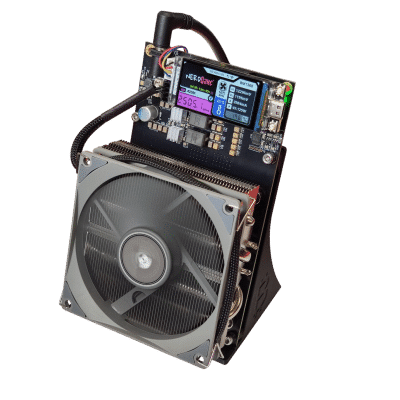
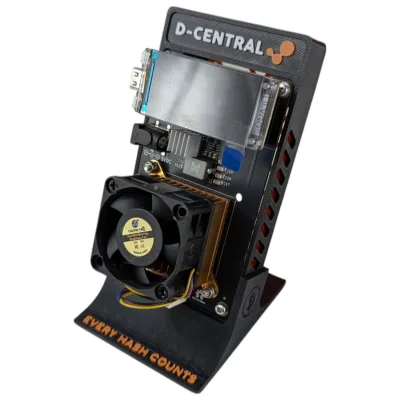
Bitcoin’s answer to capture is energy and math: a ledger no one owns, secured by miners anyone can join. The open-hardware end of that story is a movement in its own right — the open-source hardware community building solo miners and tools that anyone can build, audit, and improve.
Mesh secures communication
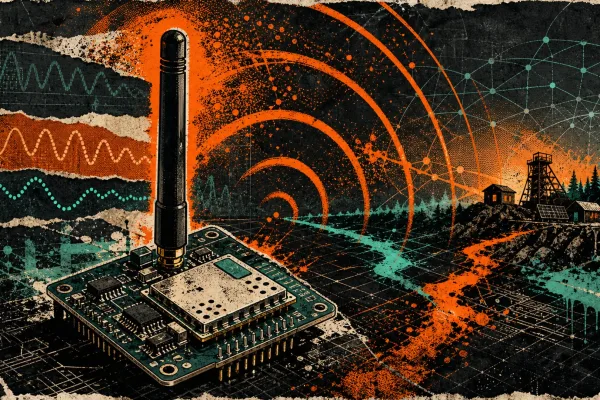
On the radio side, the building block is LoRa — short for “Long Range,” a chirp-spread-spectrum modulation invented and commercialized by Semtech, whose SX126x transceiver silicon shows up in inexpensive boards like the Heltec V3, LILYGO T-Beam, and RAK WisBlock. LoRa runs on license-free ISM bands — 915 MHz in the US and Canada (902–928 MHz under FCC/ISED), 868 MHz in Europe (ETSI, with a roughly 1% duty-cycle cap) — so no carrier sits between two radios.
What it buys you is range from processing gain, not brute transmit power: a receiver can hear signals down around −137 dBm from a transmitter putting out roughly 22 dBm. You trade speed for distance with the spreading factor — SF7 is faster and shorter, SF12 reaches much farther and much slower — and in practice a stock board with a decent antenna covers a few hundred metres to a few kilometres per hop in town, ten to twenty-plus kilometres line-of-sight, with record balloon and mountaintop links past 300 km in a single hop. LoRa is line-of-sight and conditions-dependent, so treat every range figure as an “up to,” not a promise. It is long range, low power, and low throughput — pick the two that serve you, because you do not get broadband.
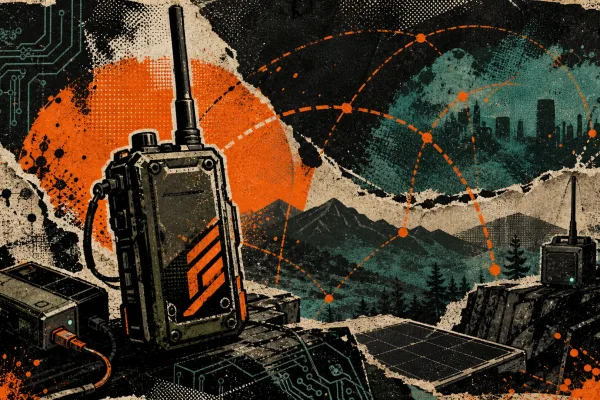
The piece that turns lone radios into a network is the Meshtastic project and community: open-source firmware and an app that make those sub-$40 boards form an encrypted, self-healing, auto-relaying mesh you pair to over Bluetooth. Every node quietly relays for its neighbours, so the mesh routes around the one that drops. If you want to hold one in your hand, our getting-started guide for Bitcoiners walks the first flash, and our LoRa airtime calculator lets you feel the real trade-offs — how spreading factor and bandwidth turn into time-on-air and how little data a shared channel can actually carry. (Meshtastic’s named presets, like LongFast, shift their underlying settings across firmware versions, so check current values rather than trusting a number you read once.)
Two more open projects round out the picture, and they are distinct — don’t conflate them. Reticulum (RNS), created by Mark Qvist, is a separate, cryptography-first networking stack that is transport-agnostic: it runs over LoRa radios, packet radio, serial links, or ordinary TCP/IP, with end-to-end encryption and no central addressing authority to seize. And Nostr — “Notes and Other Stuff Transmitted by Relays,” created by fiatjaf — gives speech the same property money already has: every message is a small, cryptographically signed event your keypair publishes to any relay, so there is no central server to take down. We cover that identity-and-reach layer in why Nostr matters for Bitcoiners.
The same network — where the two converge
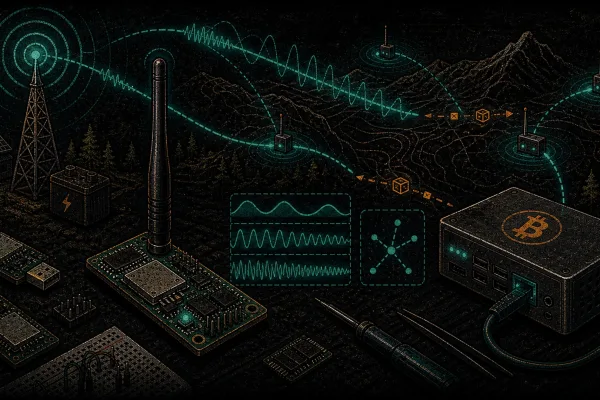
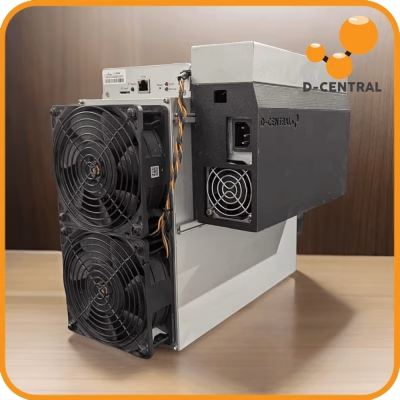
Here is the part that gets us out of bed. The convergence is not theoretical; the hardware is already sitting in people’s homes. A Bitcoin node or a home miner is an always-on, powered, often roof-adjacent box — exactly the kind of stable, elevated, never-sleeping host a mesh relay wants. The node that secures your money can sit beside the radio that keeps your communication alive, and the two reinforce each other.
One honest caveat, because accuracy is the whole point of this site: the mesh relay does not run on the miner’s ASIC. Mining chips are fixed-function SHA-256 silicon — they hash and do nothing else. The relay, the agent, the small bit of software that ferries messages, runs on a companion single-board computer or CPU next to the miner, never on the hashing silicon itself. The ASIC mines; the little board beside it talks.
What does that buy a sovereign setup? A backup nervous system. As we lay out in keeping your node and miner reachable when the ISP drops, the pattern is simple: your primary internet carries the heavy traffic, while an always-on mesh sits underneath for telemetry going out, authenticated commands coming in, and — in the genuinely last-resort case — ferrying a single signed transaction. Pair that with Nostr and a constrained local link gains global, authenticated reach the moment any node in the chain touches the internet.
Keep the framing honest. Mesh is the backup nervous system, not the bloodstream. You will not sync a chain or stream over a few hundred bits per second; broadcasting Bitcoin over Meshtastic is the narrow, slow, last-resort case — a few hundred bytes of signed transaction squeezing through when the normal path is gone, which is exactly the question behind our older explainer, can you send Bitcoin with mesh networks. For builders who want the full off-grid picture, our off-grid Hashcenter mesh comms guide ties the layers together at site scale. Independent but interconnected, each node holding its own keys and its own radio — that is the true sovereign network, and a network like that is genuinely hard to stop.
Shoulders of giants
None of this is our work, and saying so plainly is the most important paragraph here. The LoRa modulation and silicon come from Semtech. The mesh that makes it usable comes from the Meshtastic project and its community. The transport-agnostic, cryptography-first alternative comes from Mark Qvist and the Reticulum community. Censorship-resistant identity and reach come from fiatjaf and the Nostr community. And on the mining side, the open-hardware spark we keep pointing to is the Bitaxe, the open-source solo miner created by Skot (Skot9000), with the wider effort carried by OSMU (Open Source Miners United). We learn from all of them. We build on top of their work, in their spirit, and we try to credit them every time.
What D-Central believes
We believe Bitcoiners and mesh builders are natural allies, and that the next layer of sovereignty is the one where they stop working in separate rooms. A monetary network that no one can freeze deserves a communications network that no one can switch off, and the people who care enough to run their own node tend to be exactly the people willing to run their own radio. Now is the time to combine forces and build that resiliency layer together — a sovereign web of independent but interconnected nodes, an unstoppable force precisely because it has no center to attack.
That is a conviction, not a launch. We are not announcing a device or a date here; we are saying where we think the open community should aim, and committing to help get there. If it resonates, start where it is most useful to you: read the plebs’ sovereign stack manifesto for the wider picture, flash a board with the Meshtastic getting-started guide, and play with the trade-offs in the LoRa airtime calculator. Run the node. Add the radio. Sign the message. One more layer, decentralized.