Build a Bitcoin mining setup: choose the site before the miner
A mining setup is a continuous electrical and thermal load, not just a miner on a shelf. Start with the available voltage, service capacity, product approval, heat path, noise limits and permission to operate at the site. Then select equipment that fits those constraints.
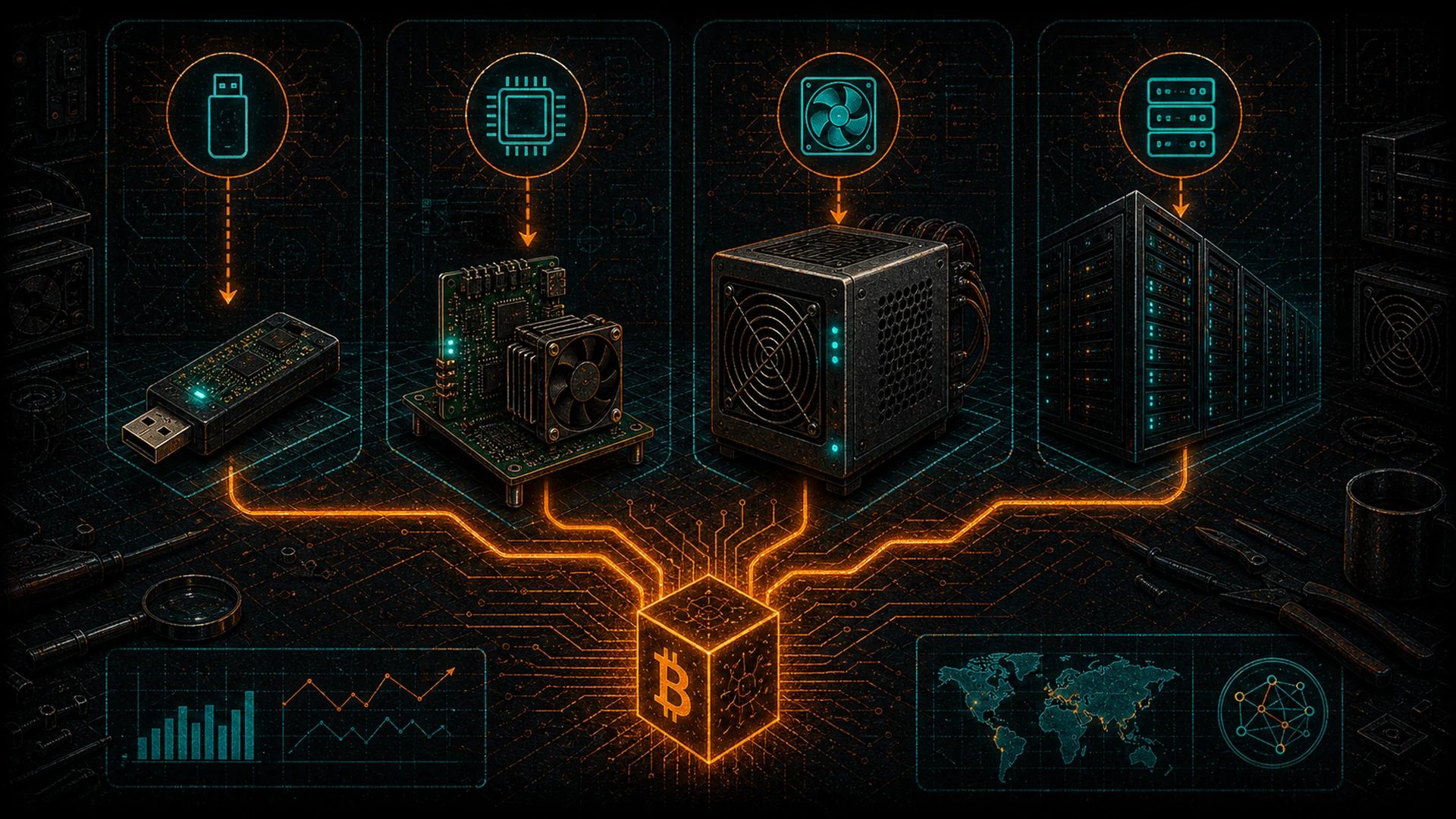
This guide covers four practical paths: a low-power open-source miner, one full-size ASIC, a purpose-built heat-reuse appliance, or a multi-miner room. Prices, hashrate revenue and payback are intentionally treated as live inputs rather than fixed promises.
Choose the right build path
| Path | Best use | Primary constraint |
|---|---|---|
| Low-power open-source miner | Learning, development and solo-mining experimentation | Correct low-voltage supply and active cooling |
| One full-size ASIC | Serious SHA-256 hashrate at a suitable site | Approved high-voltage installation, heat and noise |
| Purpose-built heat reuse | Offsetting useful space or water heating | Approved integrated appliance and seasonal heat demand |
| Multi-miner room | Operators with dedicated electrical and ventilation infrastructure | Service load, make-up air, exhaust and operating controls |
If a normal 120 V household circuit is the only safe supply, begin with the 120 V mining guide. Do not adapt a high-voltage ASIC to an outlet for which it was not designed.
The safety gate for every mining build
- Verify product approval: in Canada, the complete miner, power supply, cord and any modified assembly need a certification or field-evaluation mark acceptable to the provincial electrical authority. The Ontario Electrical Safety Authority explains recognized approval marks and field evaluation. FCC or ICES markings address electromagnetic compatibility; they are not electrical-safety approval.
- Design for a continuous load: give the exact equipment nameplate and manufacturer instructions to a licensed electrical contractor. Service capacity, branch circuit, overcurrent protection, conductor ampacity, receptacle or PDU, disconnect and grounding must follow the locally adopted code. In a U.S. workplace, also verify applicable NRTL and local authority requirements.
- Keep the disconnect accessible: use only the specified approved cord and connector. Do not use extension cords, household power strips, improvised adapters or connectors that can be forced into an incompatible inlet.
- Control fire and heat hazards: keep combustibles away, preserve manufacturer clearances, provide make-up air and exhaust, and use detection and emergency shutdown appropriate to the occupancy. Do not leave a new build unattended until temperatures, connectors, alarms and shutdown behavior have been observed under sustained load.
- Respect the building: obtain owner, insurer, utility and permit approvals where required. A technically workable miner is not automatically permitted in every apartment, garage or commercial occupancy.
Approach 1: a low-power open-source miner
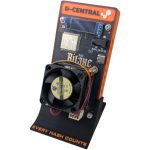
A Bitaxe-class device is the most approachable learning build because it uses low-voltage DC and modest power, while exposing pool configuration, firmware, cooling and hashrate behavior. It is not a miniature guaranteed-income machine. Begin with the Bitaxe resource hub and the setup guide.
For the Bitaxe Gamma, the project’s official hardware repository identifies the BM1370 and specifies 5 V DC at more than 4 A, commonly a quality 25–30 W supply, through a 5.5 × 2.1 mm centre-positive barrel jack. The USB-C connection is for programming, not the normal power input. Confirm the exact board revision before buying a supply; other open-source miners can have different connectors and requirements.
- Place the board on a non-combustible, stable surface with the heatsink and fan unobstructed.
- Fit the specified active cooling before applying power. A stopped fan can overheat the ASIC even though the total wattage is low.
- Use the correct regulated supply polarity, connector and current capacity. Do not substitute a phone charger because the connector appears similar.
- Connect to a trusted network, change default credentials where supported, and enter the pool URL, worker and fallback endpoint carefully.
- Watch chip temperature, fan speed, rejects and supply-connector temperature during the first sustained run.
The Gamma review, block-tracking guide and tuning guide add context. Tuning increases electrical and thermal stress; stable results vary by silicon, supply, firmware and cooling.
Approach 2: one full-size ASIC
Select from documented hashrate, wall power, input-voltage range, inlet, approval, ambient limits, airflow and noise—not hashrate alone. The miner selection guide can narrow the category, but the delivered unit’s nameplate and manufacturer manual control the installation.
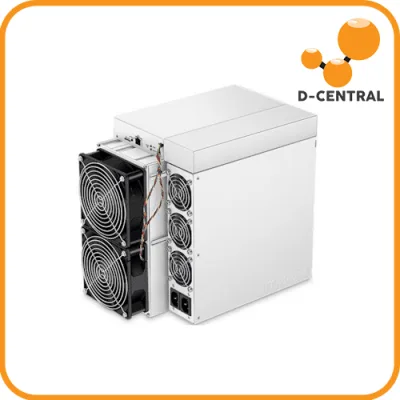
For scale, the air-cooled Antminer S21 is specified at a typical 200 TH/s, 3,500 W and 17.5 J/TH at 25°C, with a 220–277 V AC input. Its APW17-family PSU is part of the server, and the detachable cord varies with the PSU revision. These facts make generic prescriptions such as one universal C19 cord, breaker or wire gauge unsafe. See the current manufacturer specification and cord matrix.
- Have the circuit and disconnect designed for the exact continuous load and local code.
- Inspect the miner, inlet, cord and approval mark before energizing. Keep the upstream disconnect readily accessible.
- Give the intake clean make-up air and route exhaust outdoors or to an engineered useful-heat load. Account for filters, bends and duct static pressure.
- Use wired Ethernet, a DHCP reservation and a separate management network where practical. Change the default password and configure fallback pool endpoints.
- Use only firmware for the exact model and control-board revision. Verify the download source, preserve stable power during updates and understand the recovery path.
Plan for industrial sound. Enclosures, fan substitutions and ducts alter cooling and can void safety assumptions; consult the ASIC noise guide. A mining closet still needs engineered intake, exhaust and fire separation. Immersion cooling is a separate engineered system, not a drop-in fan-removal shortcut.
Approach 3: purpose-built heat reuse
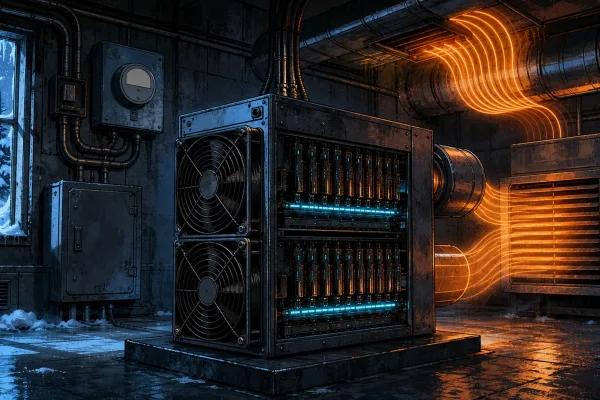
Nearly all miner input power becomes heat within the building or duct boundary. That makes heat reuse attractive only when the heat is useful, controllable and would otherwise be supplied by another system. Choose a purpose-built, approved integrated product or obtain field evaluation for the complete modified assembly; a certified component does not automatically approve a home-built heater.
Review the Bitcoin space-heater options and installation guide. A packaged heat-reuse unit can simplify the mechanical interface, but its exact listing, supply, clearances and installation instructions still govern.
Do not connect an improvised miner duct directly to a home’s existing HVAC return or supply. Backdrafting, smoke spread, pressure imbalance, condensation, filter loading and incompatible temperature limits require a qualified HVAC design. Any thermostat, relay or smart control switching the load must be approved and rated for the exact voltage, current, duty and enclosure.
Credit only useful displaced heat in the economics. One kilowatt-hour of miner input can displace roughly one kilowatt-hour of resistance heat at the point of use, but it does not replace one kilowatt-hour of electricity used by a heat pump with a coefficient of performance above one. Summer heat rejection and control losses still count.
Approach 4: a multi-miner room
Multiple ASICs are a facility project. A licensed electrical contractor should calculate service and panel capacity, continuous branch loads, demand assumptions, fault protection, disconnects and distribution. Do not add nameplate watts and divide by a nominal voltage to declare an installation code-compliant.
Ventilation begins with heat balance. For dry-air sensible cooling near sea level, an initial estimate is:
required CFM ≈ 1.76 × total watts ÷ allowable temperature rise in °C
At 3,500 W and a 10°C allowable rise, that is approximately 616 CFM per miner before duct, filter, altitude, weather and pressure losses. Two miners are roughly 1,232 CFM and three are roughly 1,848 CFM on the same simplified basis. The equipment fans circulate through the miners; they do not, by themselves, provide the room’s make-up air or exhaust. Have an HVAC professional verify the final design.
Use hot-aisle/cold-aisle separation or sealed intake/exhaust paths, temperature and smoke monitoring, remotely accessible shutdown, and a response plan for fan or network failure. Air conditioning is not selected by room area alone: the continuous sensible load, condenser conditions and electrical capacity control the design.
On the network side, isolate miner management interfaces where practical, restrict inbound access, keep firmware current and monitor rejects, missing boards, temperature, fan speed and wall power. The mining-start guide covers pool and operating choices after the site is ready.
Budget and profitability: use measured, current inputs
Separate one-time site costs from recurring operating costs. The budget can include the miner, approved cord or PDU, electrical design and permits, ventilation, noise treatment, network, monitoring, spares, shipping, duties, tax and repair reserve. Keep every item in one currency.
Model revenue with current difficulty, subsidy at the mined height, fees, expected uptime and BTC price. Model cost with measured wall power and the full marginal tariff, including time-of-use, demand and delivery components where applicable. Use the live profitability calculator and the electricity-cost guide, then test downside cases. No static hardware price, annual earnings figure or electricity threshold guarantees a return.
Commissioning checklist
- Record model, serial, nameplate, firmware, approval mark, circuit, cord and disconnect.
- Confirm intake and exhaust paths, make-up air, clearances and monitoring before energizing.
- Start one unit at a time and observe voltage, current, true wall power, connector temperature, inlet temperature, chip temperature, fans and alarms.
- Compare local and pool-side hashrate over a meaningful interval; short dashboard peaks are not sustained performance.
- Test normal and emergency shutdown. Document who responds to temperature, smoke, fan, network and power alarms.
- Inspect again after thermal cycling, then establish dust, filter, connector and log-review intervals for the site.
Common build mistakes
- Buying a miner before verifying voltage, approval, permission, noise and heat rejection.
- Choosing cords, breakers or conductors from a generic web recipe instead of the exact nameplate and local design.
- Counting the miner’s fan rating as room ventilation or ignoring make-up air and static pressure.
- Using a normal household plug meter on a high-voltage ASIC circuit.
- Connecting improvised ducts to building HVAC or hiding a hot miner in an unventilated enclosure.
- Publishing a short hashrate peak, current hardware price or historical revenue as a durable result.
- Assuming low voltage removes the need for a correctly rated supply, polarity, cooling and non-combustible placement.
Frequently asked questions
Can I build a mining rig on a standard 120 V outlet?
Use only equipment whose manufacturer input specification and approval cover 120 V, and stay within the circuit design. Many full-size ASICs require higher voltage; a plug adapter does not change that requirement.
How is a Bitcoin ASIC different from a GPU rig?
An ASIC is purpose-built for one algorithm and normally arrives as an integrated server. A GPU rig is assembled from general-purpose computing components. For current Bitcoin SHA-256 mining, this guide focuses on ASIC and low-power open-source ASIC paths.
What power supply does a Bitaxe Gamma need?
The official project specifies 5 V DC at more than 4 A through a 5.5 × 2.1 mm centre-positive barrel jack; a quality 25–30 W supply is commonly recommended. USB-C is for programming, not normal power. Confirm the board revision.
What breaker and wire gauge does a full-size ASIC need?
There is no universal answer. A licensed electrical contractor must use the exact nameplate, manufacturer instructions, continuous-load rules, conductor conditions and locally adopted code.
How much ventilation does one 3,500 W miner need?
A simplified heat balance gives about 616 CFM for a 10°C air-temperature rise near sea level, before system losses. The final airflow depends on climate, altitude, ducts, filters, pressure and the permitted inlet temperature.
Can I connect miner exhaust to home HVAC?
Not as an improvised project. An HVAC professional must address pressure, smoke, condensation, filtration, temperatures, controls and code. A purpose-built approved heat-reuse product is the safer starting point.
Does mining heat make electricity free?
No. Credit only heat that is useful and actually displaces another cost. Heat pumps can deliver more useful heat per kilowatt-hour than resistance heat, and unwanted heat still requires rejection.
Can a miner run in an apartment?
Only if the exact equipment, electrical installation, ventilation, noise, lease, insurer and local rules all permit it. Low-power equipment may be easier to accommodate, but permission and safe placement still matter.
Should I use third-party firmware?
Only after confirming exact model and control-board support, download authenticity, fees, warranty implications, electrical and cooling headroom, and a recovery path. Begin with manufacturer firmware when uncertain.
How do I know whether mining is profitable?
Measure wall power and sustained pool-side hashrate, enter current network and tariff data, include every fee and site cost, and test downside cases. Recalculate as conditions change.
Start with a site plan
Write down the available voltage, verified continuous capacity, approval requirements, heat destination, noise boundary and operating permissions. Only then select the miner and request an installation quote. Browse documented mining hardware, or contact D-Central for site and equipment questions. Existing equipment with faults belongs with a qualified ASIC repair service.