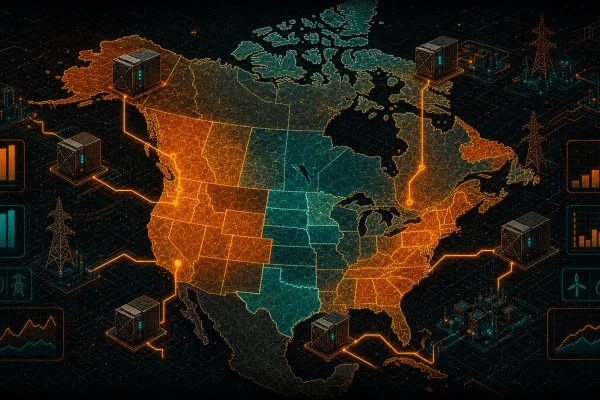
Bitcoin Mining Electricity Cost by State & Province (2026)
Electricity is the single largest ongoing expense in Bitcoin mining. Whether you are running a fleet of Antminer S21 Pros in an industrial facility or…
Everything you need to mine Bitcoin at home. Noise management, heat recovery with space heaters, power optimization, equipment selection, and real-world setup guides from home mining pioneers.
Electricity is the single largest ongoing expense in Bitcoin mining. Whether you are running a fleet of Antminer S21 Pros in an industrial facility or…
Bitaxe and Heatbit represent two fundamentally different philosophies of Bitcoin home mining. Bitaxe is an open-source, community-driven solo miner built for sovereignty — models range…
Somewhere in a basement, a garage, or a spare bedroom, a small device hums quietly. It draws less power than a lightbulb. Its hashrate is…
Every Bitcoiner faces the same question: should I mine Bitcoin or just buy it? The answer is not as simple as running a calculator —…
⚠️ Important Disclaimer This guide is for informational and educational purposes only. D-Central Technologies is not a tax advisor, accountant, or law firm. The information…
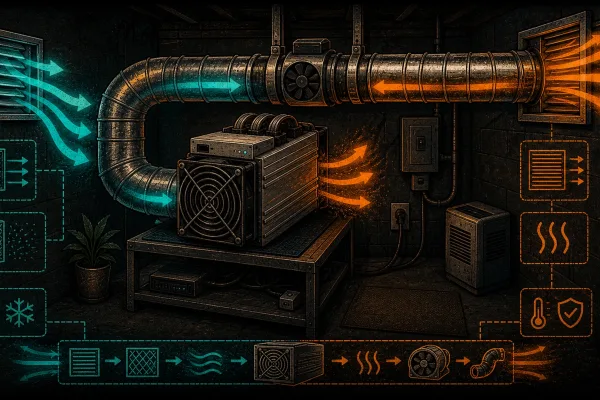
A measurement-first ASIC airflow framework for equipment limits, commissioning evidence, recirculation, seasonal risks, acceptance, and stop gates.
The T21: Where Smart Money Meets Smart Mining Every generation of Bitmain hardware follows the same playbook: launch the flagship S-series at a premium, then…
MicroBT Finally Has Bitmain Sweating For years, the ASIC miner market has been Bitmain’s game. The Antminer brand dominated conversations, shelves, and mining farms. MicroBT…
Montana is one of the most mining-friendly states in America — and that’s not just a slogan. The state has passed explicit legislation protecting Bitcoin…
Wyoming has earned its reputation as the most crypto-friendly state in America — and it’s not close. With over 20 pro-crypto laws on the books,…
North Carolina is an emerging hub for technology and innovation, and Bitcoin mining is no exception. With electricity rates around $0.13–0.15/kWh from Duke Energy —…
Virginia is the data center capital of the world — and that infrastructure advantage extends directly to Bitcoin miners. Northern Virginia’s “Data Center Alley” in…
Michigan presents a paradox for Bitcoin miners: the state has some of the highest electricity rates in the Midwest at ~$0.19–0.23/kWh, but it also delivers…
Minnesota combines two of the most important factors for Bitcoin mining: brutally cold winters and reasonable electricity rates. With Xcel Energy residential rates around $0.13–0.15/kWh…
Oregon stands out as one of the most attractive states for Bitcoin miners in the Pacific Northwest — and for several compelling reasons. The state…
Nevada brings a unique combination of advantages to Bitcoin mining that few states can match: no state income tax, progressive crypto-friendly legislation, competitive electricity rates…
The Avalon Nano 3 is a compact Bitcoin miner that is perfect for home use. It’s known for its easy setup, quiet operation, and dual function as a space heater.
As we approach 2025, the question of whether older Bitcoin mining hardware, such as the Antminer S9, still holds value remains a topic of debate within the cryptocurrency community.
Are you ready to take control of your Bitcoin mining journey? The Bitaxe Hex Line, manufactured by D-Central Technologies, based in Montreal, Quebec, Canada, represents a paradigm shift in…
An ASIC miner (Application-Specific Integrated Circuit miner) is a specialized device designed exclusively for cryptocurrency mining.
Are you still paying sky-high hosting fees just to let your mining heat vanish into thin air? For many Bitcoin miners, hefty monthly invoices and wasted energy are part of the “business…
For a comprehensive guide to every noise reduction technique — from fan swaps to firmware-based sound management — see our ASIC Noise Reduction Guide.
The evolution of Bitcoin mining has been profoundly influenced by the principles of open-source development. Open-source projects have democratized access to mining technology, allowing…
D-Central Technologies is thrilled to announce the pre-sale of the Bitaxe Hex, the latest innovation in our renowned Bitaxe series of ASIC Bitcoin miners.
Discover how you can join the Bitcoin revolution from the comfort of your home with these powerful yet accessible 110V ASIC miners.
Almost every home mining mistake is the same mistake in a different costume: doing the math after you buy, not before. The unvarnished top-10 list, written by the people who repair the casualties.
Your mining operation isn’t the same machine in January as it is in July. Temperature, humidity, and power cost all swing with the calendar — quietly rewriting your hashrate and bill. Run it as the seasonal system it actually is.
The best places to mine Bitcoin — cheap stranded power, off-grid cabins — are exactly the places ISPs never wired. Low-Earth-orbit satellite knocked that wall down. The honest off-grid playbook for remote home miners.
“5G-ready miners” and “5G-optimized pools” are marketing fog. Bitcoin mining is a problem of computation and electricity, not bandwidth. Here’s the honest answer — including the one real case where 5G genuinely matters.
A Bitaxe or Antminer is a small Linux computer on your network, often with default credentials. The most common attack isn’t theft — it’s quietly redirecting the hashrate you pay for. Here’s the real threat model and how to close the gap.
Last reviewed August 6, 2026.