Quick answer
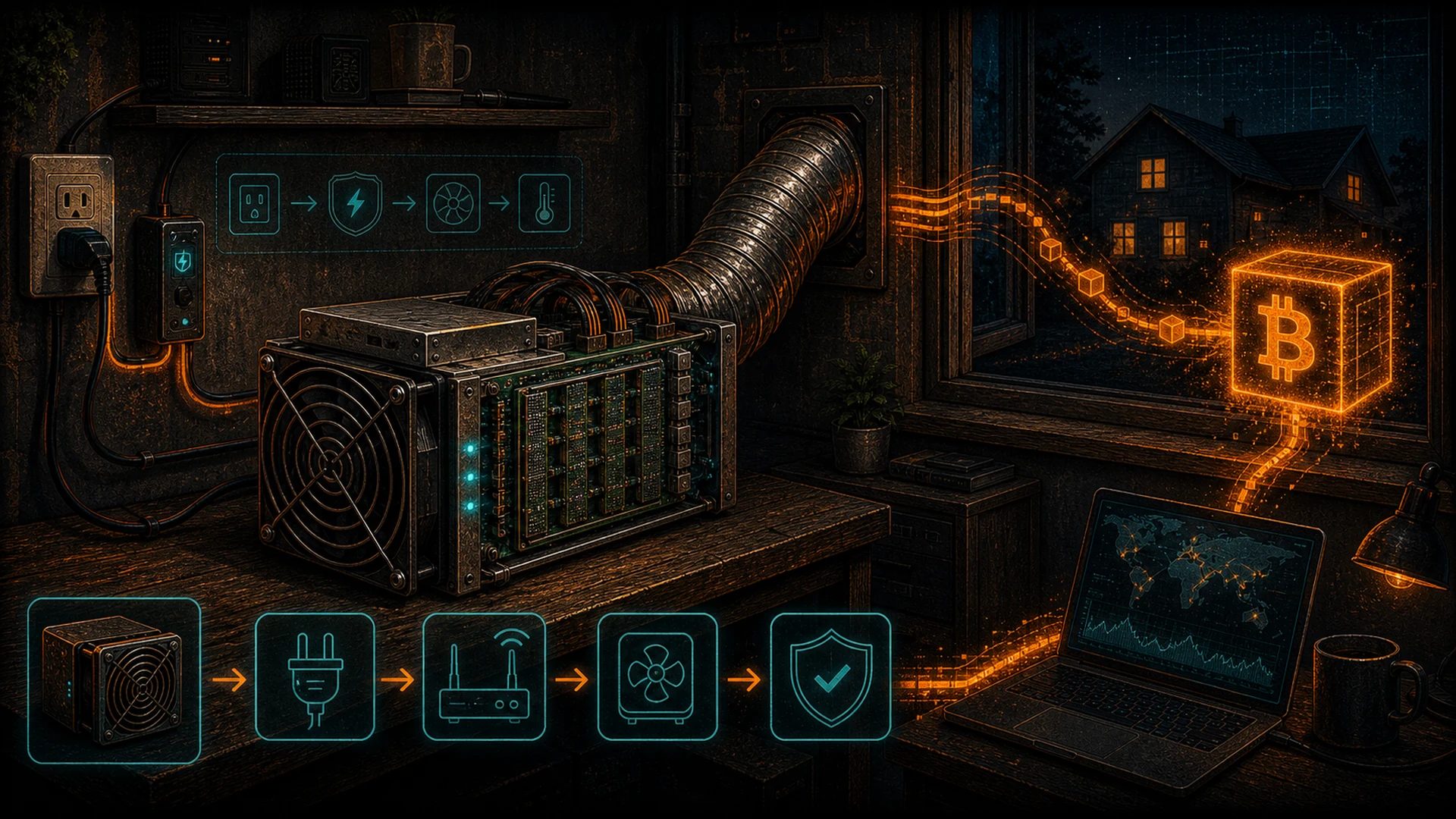
This home-mining guide takes you from zero to hashing on hardware you own — from a USB-powered Bitaxe for solo lottery mining to an Antminer S21 heating a garage. It covers hardware selection, electrical requirements, choosing a location, noise and heat management, mining-pool and networking setup, step-by-step configuration, monitoring, and security — with attention to custody, privacy, and independent control.
Home Bitcoin mining is an equipment and operations project, not a guaranteed investment or an automatic decentralization outcome. A miner contributes candidate work to its selected chain or pool. Fully validating nodes separately enforce consensus rules, and independent control of templates, pools, nodes, firmware, ownership, connectivity, and infrastructure determines the broader effect.
Why Mine Bitcoin at Home?
Home mining can teach protocol operation, reuse heat in suitable conditions, and diversify ownership or geography. Device count, submitted hashes, or residential location alone do not prove censorship resistance. Pool accounts, payouts, hardware purchases, and network services may involve identification and counterparties.
Understanding Bitcoin Mining Basics
Bitcoin mining searches candidate block headers for proof of work. The whitepaper describes the network model, while modern miners and pools use specialized template and hashing infrastructure.
What Mining Actually Does
Mining software or a pool constructs a candidate template. Search inputs can include nonce, coinbase extra data, time, version, and transaction selection. A valid double-SHA256 header is numerically below the target; nodes decide whether the complete block is valid and belongs to the best-work valid chain.
Key Mining Metrics
Hashrate is measured work rate; accepted share rate can differ from device display. Bitcoin Core’s network-hashrate estimate derives work per elapsed block time over a selected block window and is not a directly measured fleet total. Difficulty, pool terms, uptime, wall efficiency, fees, and price are separate variables.
Pool Mining vs. Solo Mining
Pooling generally lowers payout variance, subject to accounting method, fees, thresholds, custody, uptime, and counterparty terms. Direct solo mining and a solo-pool service differ in template control, node infrastructure, payout configuration, service dependency, and fees. Discovery remains memoryless and revenue is not guaranteed.
Choosing Your Mining Hardware
Choose by exact model and hardware revision, PSU, firmware compatibility, measured accepted hashrate, wall power, input rating, connector, acoustics, cooling, temperature, and condition. Product-family names are not specifications.
Quick Reference: Mining by Budget
Use current dated quotes and total installed cost rather than fixed price tiers. Include equipment, power distribution, permits, ventilation, noise control, networking, maintenance, financing, taxes, and spares.
Tier 1: Compact and Open-Source Miners
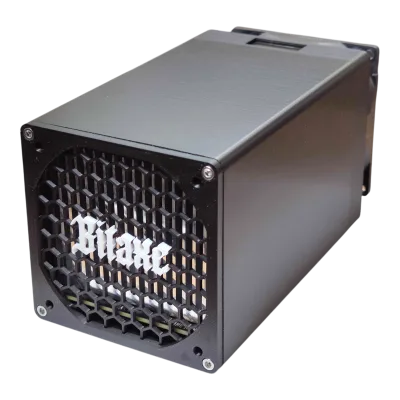
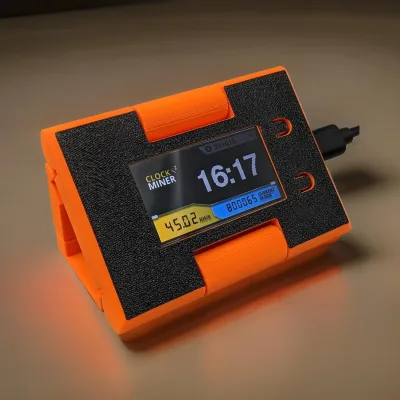
Compact devices vary in input voltage, connector, supply rating, wall power, acoustics, firmware, and measured hashrate. Follow the exact board revision documentation; do not assume USB power or a practical block-discovery interval.
Tier 2: Heat-Reuse Miners
Heat-reuse configurations are still electrical appliances and mining systems. Evaluate exact nameplates, enclosure and airflow, controls, useful-heat demand, noise, maintenance, and the displaced heating system.
Tier 3: Full-Size ASIC Miners
Full-size units often require purpose-designed power, ventilation, and noise control, but requirements come from the exact miner/PSU documentation and site design—not a universal voltage or wattage table.
Tier 4: Custom and Modified Builds
Modification can affect input ratings, cooling, protection, warranty, and equipment listing. A firmware power limit does not change the PSU input rating, connector rating, branch-circuit requirements, or product certification.
Electrical Requirements for Home Mining
Electrical design depends on the exact equipment, premises, adopted code edition, amendments, utility rules, permits, inspection, and authority having jurisdiction (AHJ). This guide does not approve a site or replace a qualified site-specific load calculation.
Before You Start: Electrical Checklist
Record every nameplate and manual; obtain the site load calculation; verify service, feeder, branch circuit, conductors, terminations, overcurrent and fault protection, grounding/bonding, receptacle/cord, ambient derating, clearances, and emergency isolation before energization.
120 V vs. 240 V: Which Do You Need?
Use only a supply explicitly permitted by the exact PSU and equipment documentation. Physical plug fit, underclocking, or an adapter does not establish compatibility. Voltage choice and circuit design require local professional/AHJ review.
Calculating Your Electrical Capacity
Do not multiply panel amperage by nominal voltage and subtract an average household load. Service and circuit capacity require a jurisdiction-specific calculation covering existing and proposed loads, duty, conductor and terminal ratings, derating, power quality, protection, and site conditions.
Outlet and Plug Types
Every receptacle, plug, cord, connector, and distribution component must be listed and rated for voltage, current, continuous duty, conductor, and environment. Do not improvise adapters, alter blades, or treat an existing dryer/EV outlet as pre-approved.
Setting Up Your Mining Location
Select a dry, stable, serviceable location with required clearances, airflow, physical security, suitable electrical supply, network access, and a controlled shutdown path.
Location Requirements by Miner Type
Requirements are model- and configuration-specific. Consider mass, airflow direction, intake quality, exhaust routing, acoustic transmission, combustible clearances, condensation, dust, moisture, children/pets, and maintenance access.
Environmental Requirements
Stay within exact temperature, humidity, altitude, contamination, and airflow limits. Filters, ducts, fan changes, enclosures, and immersion systems change thermal and electrical assumptions and require documented engineering.
Noise Management
Acoustics vary with model, fan curve, power mode, ducting, room, distance, reflections, and measurement method. Do not present a product family as a fixed decibel value.
Noise Reduction Strategies
Measure at a stated distance and operating condition. Preserve cooling and fire clearances; verify temperatures and fan response after any shroud, enclosure, duct, or fan change. Hearing and neighborhood requirements may apply.
Heat Management and Space-Heater Mining
Nearly all miner wall input ultimately becomes heat within a defined boundary, but useful heat is not automatic. Placement, timing, distribution, controls, losses, noise, maintenance, and demand determine credit.
The Space-Heater Strategy
Useful miner heat may displace some resistance-heating demand. A heat pump can deliver more useful heat per kilowatt-hour, and mining continues to incur electricity, capital, maintenance, and opportunity costs.
HVAC Integration
Integration requires airflow and pressure calculations, makeup air, filtration, condensation/weather control, backflow/fire considerations, failure modes, and local mechanical/electrical requirements. Do not connect equipment to HVAC from a generic diagram.
Choosing a Mining Pool
Compare payout accounting, variance, fees, thresholds, custody, reputation, uptime, jurisdiction, failover, template policy, and job-negotiation support. Pool branding does not prove independent template construction or non-custody.
Internet and Networking Requirements
Requirements vary by firmware, protocol, pool, proxies, node use, telemetry, and update behavior. Plan for latency, packet loss, availability, failover, DNS, time, access control, and monitoring.
Bandwidth Requirements
Do not rely on one bandwidth figure for every miner. Measure the exact deployment, including updates, monitoring, pool failover, node traffic, and remote-management tools.
Wired vs. Wi-Fi
Either can work when properly engineered. Wired links often reduce radio variability; Wi-Fi may be adequate for supported devices. Security, coverage, interference, segmentation, and recovery matter more than a categorical rule.
Network Setup Tips
Change default credentials, restrict management access, verify firmware sources and hashes, segment untrusted devices, maintain time/DNS reliability, document addressing, and avoid exposing miner administration directly to the internet.
Setting Up Your Miner: Step by Step
Use the exact manufacturer and integrator instructions for the model/revision. Stop if documentation, ratings, connectors, or site conditions do not match.
Step 1: Unbox and Inspect
Check shipping damage, loose parts, contamination, fan freedom, heatsinks, connectors, cord/PSU identity, labels, and documentation. Do not energize damaged equipment.
Step 2: Connect Power
Only after electrical verification, connect listed/rated mating components with power de-energized. Do not use measurement as permission to energize an unverified circuit.
Step 3: Connect Network
Connect to a controlled network segment and verify link state without exposing administration externally.
Step 4: Find Your Miner on the Network
Use router/DHCP records or documented discovery tools from a trusted host. Verify the device identity before entering credentials.
Step 5: Configure Mining Pool
Verify endpoint, transport/security options, worker identity, payout address and pool terms through an independent channel. Configure failover deliberately.
Step 6: Verify Operation
Confirm accepted hashrate, rejected/stale shares, wall power with appropriately rated methods, temperatures, fan operation, pool credit, connections, logs, noise, and abnormal odor/heat. De-energize on unsafe behavior.
Monitoring and Optimization
Optimization stays inside exact equipment and site limits. Establish baselines and rollback/recovery before changes.
What to Monitor
Monitor accepted/rejected shares, wall power, chip and board temperatures, fans, pool connectivity, protective-device events, connection temperature where safely observable, errors, and environmental conditions.
Monitoring Tools
Tools must be appropriately listed/rated and used by qualified persons where exposed conductors or panels are involved. Consumer plug meters may be unsuitable for continuous high loads.
Optimization Tips
Change one variable at a time, measure at the wall and pool, retain safe thermal margin, verify fee terms, and preserve a known-good rollback. Claims of universal firmware efficiency gains are not durable.
From heights 840,000 through 1,049,999, the maximum subsidy is 3.125 BTC; a coinbase may underclaim and add included fees. Its output matures after 100 blocks. The next subsidy rule begins at height 1,050,000; calendar timing is approximate. Future fee revenue and long-run security expenditure are uncertain market outcomes, not protocol guarantees.
Profitability Considerations
Profitability is uncertain and time-varying. No price, tariff, location, or efficiency threshold guarantees a return.
The Profitability Framework
Operating electricity cost equals measured wall kilowatts × runtime × all-in tariff. Model revenue using accepted hashrate, live difficulty/hashrate methodology, subsidy at height, fees, pool terms, uptime, price, cooling, maintenance, financing, taxes, curtailment, and residual value.
Live Break-Even Electricity Rate
Use current dated inputs and sensitivity ranges. A calculator is an illustration, not a quote; difficulty retargets under the 2,016-block consensus rules and individual block intervals remain random.
The Heat Credit
Credit only useful heat actually delivered when demanded, net of controls, distribution, noise, maintenance, and the displaced system’s efficiency/cost. Do not treat heat credit as eliminating mining cost.
Canadian Considerations for Home Mining
There is no universal legal clearance. Check current federal, provincial/territorial, municipal, utility, electrical, fire, zoning, noise, tax, insurance, tenancy, and condominium requirements for the exact site.
Security Best Practices
Use authentic software, verified downloads, unique credentials, least-privilege access, network segmentation, backups, payout-address verification, physical security, update/rollback plans, and monitoring. A full node validates what it receives but does not eliminate network-isolation risk.
Troubleshooting Common Issues
Repeated trips, arcing, heat damage, odor, connector discoloration, unstable fans, water/condensation, or unexplained shutdowns require de-energization and qualified diagnosis. Do not upsize protection or bypass safety controls.
Next Steps: Deep-Dive Guides
Use the linked resources below as topic guides, then verify every current product, firmware, pool, code, legal, and economic claim against primary dated documentation.
Frequently Asked Questions
Is Bitcoin mining at home still profitable?
It depends on exact measured wall power and accepted hashrate, all-in tariff, difficulty, subsidy and fees, pool terms, uptime, price, cooling, maintenance, financing, taxes, and useful-heat demand. No location or electricity rate guarantees profit.
How much does it cost to start mining Bitcoin at home?
Prices and installation scope change. Obtain dated quotes for exact hardware, PSU, electrical work, permits, ventilation, noise control, networking, maintenance and spares. Do not infer total cost from a model-family price.
Will mining damage my home’s electrical system?
Continuous loads can expose unsafe equipment, connections or wiring. Use exact nameplates and instructions, a jurisdiction-specific load calculation, adopted-code/AHJ review, listed/rated components, required permits/inspection, ventilation and monitoring. Correct installation reduces but does not eliminate risk.
How loud is a Bitcoin miner?
Noise varies by exact model, revision, power mode, firmware, fans, cooling, room and measurement distance. Use dated measurements for the intended configuration and preserve cooling after any noise modification.
Can I mine Bitcoin on 120 V power?
Only equipment explicitly rated for that supply may be considered. Exact PSU input ratings, maximum configured load, connectors and a site-specific circuit design control; underclocking does not change an incompatible PSU input rating.
Do I need special internet for mining?
Requirements depend on firmware, protocol, pool, proxies, monitoring and node use. Reliability, latency, packet loss, failover, DNS, access control and security matter; measure the exact deployment rather than relying on a universal bandwidth number.
How much Bitcoin will I earn per month?
There is no fixed amount. Expected revenue varies with accepted hashrate, difficulty, subsidy, fees, uptime and pool terms. Solo discovery is memoryless and may occur sooner, later or never.
Is home mining legal in Canada?
Requirements vary by jurisdiction and site. Verify current laws, zoning, permits/inspection, utility tariffs, insurance, tax, fire/noise rules, tenancy and condominium terms with official local sources and qualified advisers.
What is solo mining vs. pool mining?
Pooling generally lowers payout variance under pool accounting and counterparty terms. Direct solo mining controls local node/template infrastructure; a solo-pool service may provide templates, payout configuration and coordination. Neither guarantees payment.
Can I use a Bitcoin miner to heat my home?
Nearly all wall input becomes heat within a defined boundary, but useful heat depends on demand, placement, controls, distribution, noise, maintenance and the displaced system. A heat pump may provide more useful heat per kilowatt-hour.
What custom firmware should I use?
Choose only firmware compatible with the exact model/revision and verify source, signatures/hashes, fees, pool compatibility, power limits, warranty/listing implications, recovery and rollback. Measure wall efficiency; no universal percentage gain applies.
Where can I buy mining hardware in Canada?
Compare exact model/revision, condition, documentation, price, tax, shipping, warranty, support, returns, lead time and payment risk. Verify current terms before purchase rather than relying on evergreen superlatives.
Home Mining Knowledge Base
heat recovery · Bitaxe · solo lottery mining · Antminer S21 · Getting Started guide · height-based subsidy guide · ASIC · Nerdminer · Bitaxe Supra · Bitaxe Gamma · Bitaxe Hex · NerdQAxe · S9 Space Heater · BitChimney · Antminer S19j Pro · Bitaxe Hub guide · Nerdminer · NerdAxe · QAxe · Bitaxe Mesh Stand · accessories · Bitaxe Hub · Browse Bitaxe Miners → · space heater · Bitcoin Space Heaters · S17 Space Heater · S19 Space Heater · BitChimney · S9 Space Heater Edition · Antminer S19j Pro · Antminer S19 XP · Antminer S21 · Antminer S21 Pro · Whatsminer M50S · noise reduction · Antminer Slim Edition · Loki · Antminer Pivotal Edition
Related D-Central Knowledge Bases
electricity cost · complete 120V mining guide · NerdAxe · Noise Reduction Guide for Home Bitcoin Miners · BraiinsOS · Immersion cooling · Antminer S21 pro · solo mining · Mining Pool Comparison Guide · Ocean Mining · LuxOS firmware · Stratum V2 · Bitaxe · Bitaxe Supra setup · Bitaxe Hex setup · Bitaxe Gamma setup · parts · chips · BraiinsOS+ · LuxOS · live mining profitability calculator · ASIC Repair Service · Bitaxe Hub: The Complete Guide · Bitaxe Supra Setup Guide · Bitaxe Hex Setup Guide · Bitaxe Gamma 601 Setup Guide · Solo Bitcoin Mining Guide · Mining Pool Comparison Guide · Noise Reduction Guide · 120V Mining Guide · Bitcoin Space Heaters Hub · BraiinsOS Setup Guide · LuxOS Setup Guide · ASIC Mining Profitability Guide · Our mining consultants · Browse All Mining Hardware → · ASIC Mining Profitability Guide
Bitaxe Deep-Dives
120V mining guide · Space Heater Editions · Noise Reduction Guide · 120V Mining Guide · Bitcoin mining in Canada · Bitaxe · Solo Mining Guide · Pool Comparison Guide · Bitcoin Space Heaters · BraiinsOS+ · LuxOS · every Bitaxe variant · Bitcoin Space Heaters · Browse our full catalog here · The independent miner’s blueprint · Home mining on 120V · Getting started with the Antminer S19 XP · How to join the home-mining movement · Why home mining is the future · Home mining on solar power · Keep your home rig cool with shrouds · When home runs out of space · Bitcoin mining starter kit · Setting up a home mining rig · Scaling a home mining farm · ASIC Repair Knowledge Base · Firmware Knowledge Base · Bitaxe & Open-Source Miner Knowledge Base · Bitcoin Heating Knowledge Base · Solo & Lottery Mining Knowledge Base · Quiet Mining Knowledge Base · Hydro & Water-Cooled Mining Knowledge Base · The NerdQaxe · What is a NerdMiner? · Solo mining with a Bitaxe · How Bitaxe is paving the way · The Bitaxe series, detailed
Getting the heat and the noise out of the room
Airflow is the part of a home build people solve last and regret first. Work out where the hot air is actually going before you buy anything: measure the fan face, choose a duct size, then match a shroud to the machine. Fitment is dimensioned from published fan spacing, so confirm your own fan size before ordering.