
ASIC Miner Shrouds and Fan Adapters
Adapters and shrouds: a complete airflow system for an ASIC miner
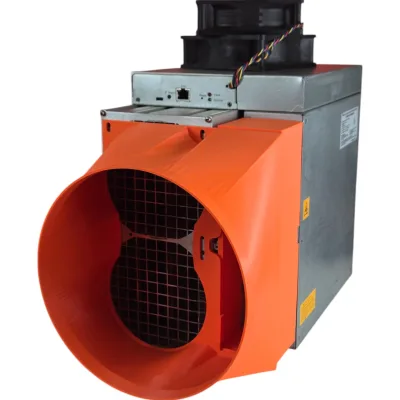
A miner shroud is a sealed hood that hands a machine's exhaust fans to a round duct collar, and an adapter is any part that makes two mismatched things — a fan and a mount, a duct and a fitting, imperial and metric — join properly. This is the home of D-Central's whole airflow line: shrouds for the fan face, silencers with acoustic geometry built in, ducting and fittings for the run, and the small fan-face accessories that go with them, all drawn in-house in Montreal, Quebec and printed to order in PETG, in black or D-Central orange.
The reason to buy the chain from one place is that it was cut to one set of numbers. Every 6-inch collar in this catalogue carries the retention bead crest at 152.4 mm and the clamp land at 150.4 mm behind it; every 8-inch part does the same at 203.2 mm nominal. Shroud, elbow, coupler, window port — they mate on the first try, without a shim, an adapter or a wrap of foil tape at the one joint that turns out to be the wrong size.
The four families in the line
ASIC shrouds — the part at the machine
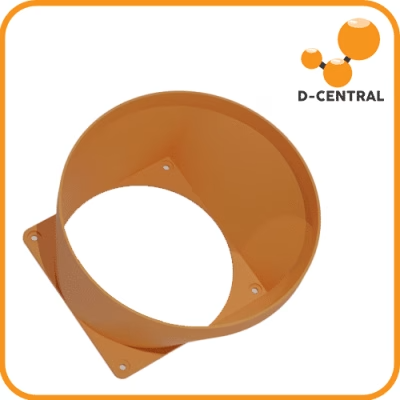
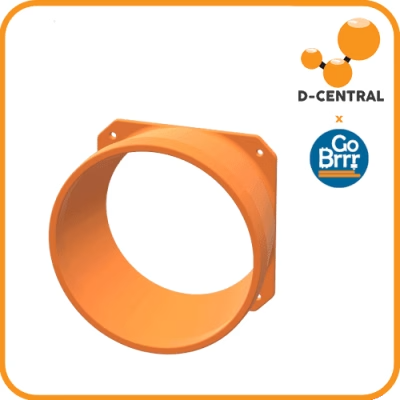
Forty-five bodies covering single 120 mm, dual 120 mm, single and dual 140 mm, stacked-fan Avalon faces and full-chassis wraps, in 6-inch, 8-inch and metric 150, 160 and 200 mm collars. A plain plenum such as the Antminer S19 / S21 Dual 120 mm to 6" Duct Shroud merges the fan columns and rounds down to the collar; a venturi body contracts through a throat instead of a step; a full wrap encloses the whole chassis end rather than the fan flanges alone. Start here: nothing downstream matters until the exhaust is captured.
Shroud silencers — acoustic work on the way through
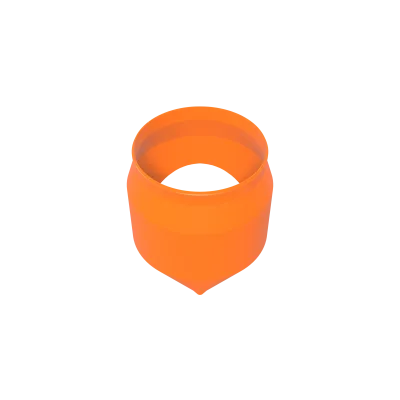
Seven bodies that do the shroud's job and run the air across a reactive expansion chamber on the way, so part of the fan's sound energy reflects back toward the machine instead of riding the air column into the house. The 6-inch expansion chamber is the compact broadband body; the v2 adds a tuned quarter-wave side branch aimed at the tonal whine specifically. No foam, no fibre, nothing in the airstream to shed.
Ducting and fittings — the run
Twenty-three parts in 4-inch, 6-inch and 8-inch: couplers, tapered reducers, 45° and 90° elbows, shallow-angle wyes, flex adapters, quick-release duct receivers and flanged window ports. This is where a captured exhaust either reaches the outside cleanly or spends everything the shroud gained.
Shroud accessories — the fan face and the collar
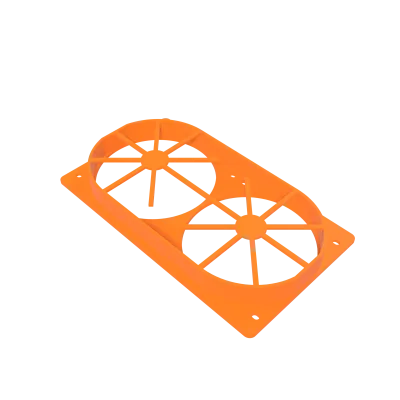
Fan adapters in both directions between 120 mm and 140 mm mounts, intake filter rings that move the dust job outside the machine, and a threaded blank-off cap that seals an idle miner's collar so it stops bleeding flow out of a shared trunk.
How the system fits together
Read it as four stages, machine to outside air. Filter the intake so room dust stops on a frame you can reach. Capture the exhaust with a body drawn to the fan face. Carry it with fittings shaped so the air is turned rather than stopped. Terminate it through a sealed port so the exhaust leaves without room air being drawn back in around it.
- Intake — a filter ring on the cold end, sized to the fan face.
- Capture — a shroud, or a silencer if the machine lives where people are.
- Run — couplers, elbows and reducers on one collar standard, supported so the clamps only ever have to seal.
- Termination — a window or wall port with a gasket groove and a screen, mounted through a filler panel you can unmake.
The last stage is the one people skip and the one that decides whether the run works. A duct hanging out of a gap is not a closed system: warm exhaust leaves through the top of the gap while room air is pulled back in around the bottom, which is why an unsealed window setup can run all day and never really cool the room.
Sizing: the three numbers that decide your order
Fan face — 120 mm or 140 mm
Put a tape across one exhaust fan frame. A 120 mm fan carries its four screws on a 105 mm square; a 140 mm fan carries them on 124.5 mm. That measurement chooses your shroud family, and it is decided by the fan rather than the badge on the front, because manufacturers change a chassis far more often than they change a fan size. If the fan you want is not the size the chassis was drilled for, a 120 mm to 140 mm fan adapter moves the mount in either direction.
Duct size — 6-inch or 8-inch
Six inch is 152.4 mm nominal and 8-inch is 203.2 mm. Because open area goes with the square of the bore, an 8-inch collar carries roughly 1.8 times the cross-section of a 6-inch one, and that extra area is headroom the run spends on length, bends and anything else between the fan and the outside air.
| Take 6-inch | One machine, short and reasonably direct: through a nearby wall, out an adjacent window, into the next room. The size stocked everywhere in flexible hose and window hardware, and the size common inline fans are built around. |
|---|---|
| Take 8-inch | The run climbs, turns more than once, joins a shared trunk, or has an inline booster on it. Also the right call on a 140 mm machine, and on any acoustic body, since a chamber and a duct draw on one budget. |
| Take 4-inch | Auxiliary lines only: a power supply, a cabinet fan, a small branch. Not the size to terminate a full ASIC exhaust in. |
| Take a metric collar | If you buy ventilation in millimetres. 150 mm is not 6-inch; the 2.4 mm gap is exactly what turns a clamped joint into a taped one. Metric bodies are cut at 150, 160 and 200 mm with the crest at duct nominal and the clamp land 2.0 mm behind it. |
Plain adapter, or a silencer
A plain shroud is the part that gets the heat out of the room, and for many installs that is the entire fix, because ducting moves sound with the air. A silencer earns its price when the duct passes through space you occupy on its way out, when the exhaust terminates near a neighbour, or when the tonal whine is what carries through a floor. It asks two things in return: real space behind the machine — the acoustic bodies span 152 mm to 242 mm across their largest cross-axis — and a share of the same pressure budget the run spends. On a machine already sitting at the top of its thermal range, or a route long and full of bends, buy the plain shroud and win the noise back with placement.
What we build for
Fitment across this category is keyed to fan faces and duct sizes, which is what lets a few dozen bodies cover a long tail of hardware. Between them the shroud families serve the Antminer S9, S9i, S9j, S9k and S9 SE; the S17, S17 Pro, S17+, T17 and T17+; the S19, S19 Pro, S19j, S19j Pro, S19k Pro and S19 XP; the standard Antminer S21 and T21; the Antminer S21 Pro on its 140 mm fan pair; the MicroBT Whatsminer M30S, M50, M50S, M60 and M60S; and the Canaan Avalon A13xx, A14xx and 15XP with their vertically stacked 120 mm fans on a 122.0 mm pitch. Rebuilds, benches and fan-swapped machines are covered by the fan-referenced universal bodies.
Hydro, Hyd and immersion chassis are the exception, and it is a clean one: they move their heat into liquid, they have no exhaust fan face, and nothing in this category mounts to one.
Build to order, in Montreal, Quebec
Every part here is printed for the order it belongs to, in PETG — black or D-Central orange, your pick — and shipped worldwide from Canada. That is deliberate and it is what makes the range possible: one shop can carry this many bodies, collar sizes and mount styles at a single tolerance standard instead of warehousing a guess at which variant sells. It is also why the geometry keeps improving. A wider mounting plate, a venturi throat or a metric crest enters the line the week it is drawn rather than waiting out a container of the old shape.
PETG is the material across the whole line, in two colours: black, and the D-Central orange you can spot behind a rack from across a room. The same body is offered either way, so a run assembled from a shroud, an elbow and a coupler reads as one object. Nothing in the system is bonded or fastened together — each part comes out as a single continuous body, which is why there is no joint to work loose under a fan that never stops. And every design in this line is D-Central's own drawing, released open source under CC BY-SA 4.0 at the 3D models download center — free to download, modify, print and sell. If you own a printer and an evening, make your own. What these listings sell is the finished part, and D-Central's fund page backs the open work directly.
- One collar standard end to end, so shroud, elbow, coupler and port mate without adapters
- Single continuous PETG bodies — no seams to leak, no fasteners, nothing to assemble
- Mounts on stock fan screws: no drilling, no wiring, no firmware, nothing modified on the miner
- Imperial and metric collars cut for the duct you already own
- Designed, drawn and printed in Montreal, Quebec, and shipped worldwide
The full compatibility matrix, mount styles and sizing guide live on the D-Central shroud and ducting system page.
Frequently asked questions
What does an ASIC miner shroud actually do?
It seals over the machine's exhaust fan face and gives the air one defined exit — a round duct collar — instead of letting it leave in every direction at once. That single change turns an uncontrolled heat and noise source into a steerable exhaust path: out a window in July, into a workshop that wants the warmth in January.
Where do I start if I have never ducted a miner?
With the shroud, because nothing downstream matters until the exhaust is captured. Identify your fan face, pick 6-inch or 8-inch by the length and shape of the run, then add a coupler, an elbow if the route turns, and a sealed window port at the end. The shroud and ducting system page lays the chain out in order.
Will any of this modify or damage my miner?
No. These are mechanical parts that sit outside the chassis: no holes drilled, no connectors unplugged, no soldering, no firmware, stock fans and stock screws retained. A shroud seats on the fan face and lifts off in one movement, leaving the machine exactly as its manufacturer shipped it.
Do you ship outside Canada?
Yes, worldwide from Montreal, Quebec, and the metric collars exist for that reason — 150, 160 and 200 mm bodies for European and Australian ducting, cut properly rather than stretched over an imperial collar. The design files are also free at the 3D models download center, which is often the faster route if there is a printer within reach.
Why are these made to order rather than held in stock?
Because the range only exists that way. Holding stock means choosing a handful of bestsellers and letting every other fan face and collar size go unserved, which is precisely the gap this line was drawn to fill. Building to order is what keeps 80-plus variants alive at one tolerance standard, and what lets an improved body ship the week it is finished.
Can I print these myself instead of buying them?
Yes, and that is the intent. Every design in this line is D-Central's own work, published under CC BY-SA 4.0 at the 3D models download center: download it, modify it, print it, sell what you make. Buying the finished part is a convenience and what funds the next design. The geometry was never the price of admission.
Shop Adapters and Shrouds from D-Central. 93 products available with checkout-confirmed shipping, support, and product terms.
Browse adapters and shrouds with sorting and key product specs surfaced first.
-
Best Seller
Built to order · within 1 week
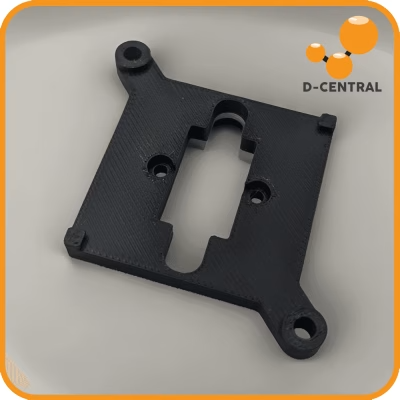
Configure for Bitaxe Ice Cooler Tower 52pi Socket -
Built to order
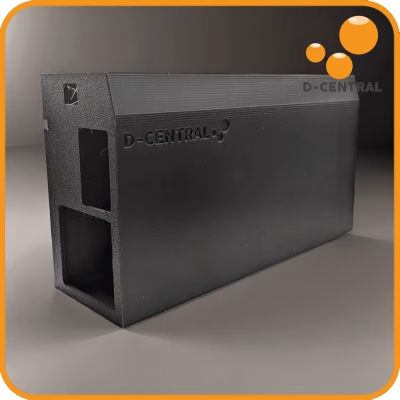
Configure for APW3 Side Hodler PSU Mount -
Accessories
Antminer Modular Dual 120mm ASIC and PSU Shroud to 8”
- Type:PSU
Price range: $45.00 through $90.00 CAD -
Accessories
Antminer Hashboard Airflow Inlet Divider For Dual-Hashboard Mining
- Type:Hashboard
$19.99 CAD -
Built to order
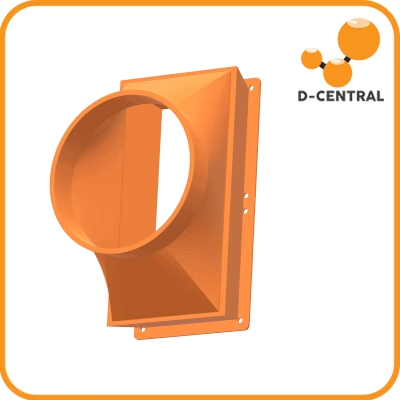
View details for Antminer Dual 120mm Silencer -
Built to order
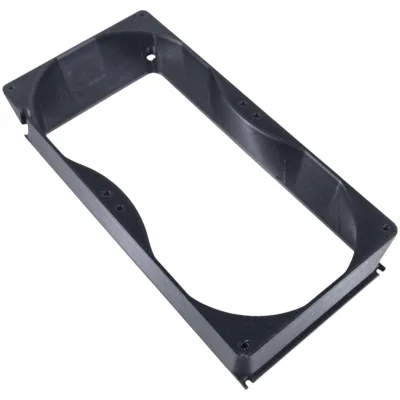
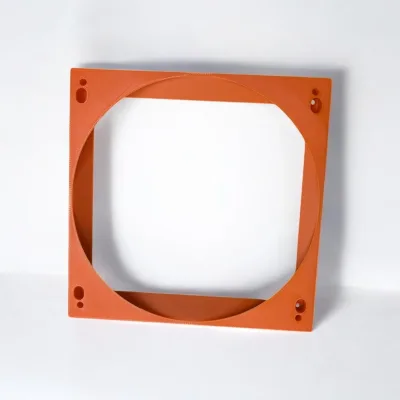
Select options for Antminer Dual 120mm to 140mm Adapter -
Built to order
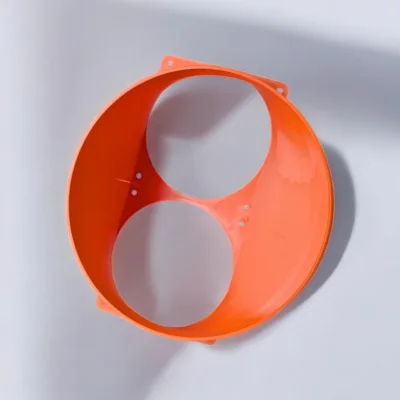
View details for Antminer 120mm to 140mm Adapter -
 Accessories
S19 Flexible 8″ Duct Adapter – Durable 3D-Printed ASIC Cooling Shroud
- Fits:Antminer S19
- Type:Airflow
$29.99 CAD -
Accessories
Hashboard Airflow Deflector for Antminer 19/21 Series
- Fits:Antminer S19, Antminer S21
- Type:Hashboard
$21.00 CAD -
Adapters and Shrouds
Whatsminer 140 mm to 8″ Expansion-Chamber Shroud Silencer
- Type:Airflow
- Condition:New
$52.99 CAD -

Built to order
View details for Whatsminer 140 mm Fan to 6" Duct Shroud -
Accessories
Antminer Hashboard Airflow Inlet Divider for Single Hashboard Mining
- Type:Hashboard
$19.99 CAD -
Adapters and Shrouds
Antminer S19 / S21 Dual 120 mm Intake Filter Ring
- Fits:Antminer S19 series +2
$24.99 CAD -

Built to order
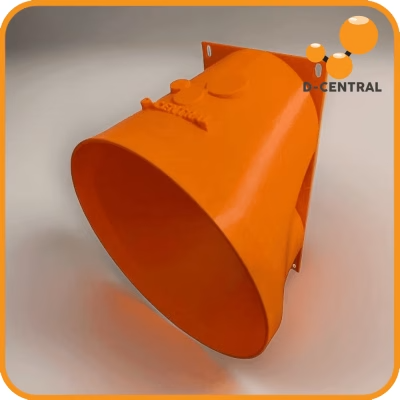
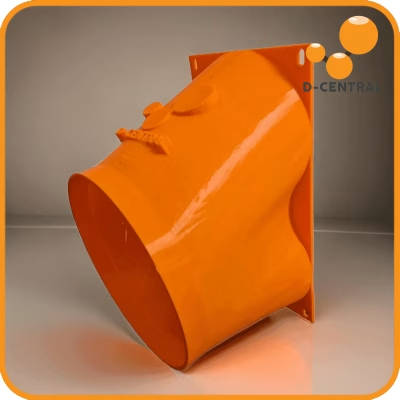
View details for 8-Inch Flex Duct Window Vent Port -

Built to order
View details for 6-Inch Flex Duct Window Vent Port



Getting the heat and the noise out of the room
Airflow is the part of a home build people solve last and regret first. Work out where the hot air is actually going before you buy anything: measure the fan face, choose a duct size, then match a shroud to the machine. Fitment is dimensioned from published fan spacing, so confirm your own fan size before ordering.
Adapters and shrouds: a complete airflow system for an ASIC miner
A miner shroud is a sealed hood that hands a machine’s exhaust fans to a round duct collar, and an adapter is any part that makes two mismatched things — a fan and a mount, a duct and a fitting, imperial and metric — join properly. This is the home of D-Central’s whole airflow line: shrouds for the fan face, silencers with acoustic geometry built in, ducting and fittings for the run, and the small fan-face accessories that go with them, all drawn in-house in Montreal, Quebec and printed to order in PETG, in black or D-Central orange.
The reason to buy the chain from one place is that it was cut to one set of numbers. Every 6-inch collar in this catalogue carries the retention bead crest at 152.4 mm and the clamp land at 150.4 mm behind it; every 8-inch part does the same at 203.2 mm nominal. Shroud, elbow, coupler, window port — they mate on the first try, without a shim, an adapter or a wrap of foil tape at the one joint that turns out to be the wrong size.
The four families in the line
ASIC shrouds — the part at the machine
Forty-five bodies covering single 120 mm, dual 120 mm, single and dual 140 mm, stacked-fan Avalon faces and full-chassis wraps, in 6-inch, 8-inch and metric 150, 160 and 200 mm collars. A plain plenum such as the Antminer S19 / S21 Dual 120 mm to 6″ Duct Shroud merges the fan columns and rounds down to the collar; a venturi body contracts through a throat instead of a step; a full wrap encloses the whole chassis end rather than the fan flanges alone. Start here: nothing downstream matters until the exhaust is captured.
Shroud silencers — acoustic work on the way through
Seven bodies that do the shroud’s job and run the air across a reactive expansion chamber on the way, so part of the fan’s sound energy reflects back toward the machine instead of riding the air column into the house. The 6-inch expansion chamber is the compact broadband body; the v2 adds a tuned quarter-wave side branch aimed at the tonal whine specifically. No foam, no fibre, nothing in the airstream to shed.
Ducting and fittings — the run
Twenty-three parts in 4-inch, 6-inch and 8-inch: couplers, tapered reducers, 45° and 90° elbows, shallow-angle wyes, flex adapters, quick-release duct receivers and flanged window ports. This is where a captured exhaust either reaches the outside cleanly or spends everything the shroud gained.
Shroud accessories — the fan face and the collar
Fan adapters in both directions between 120 mm and 140 mm mounts, intake filter rings that move the dust job outside the machine, and a threaded blank-off cap that seals an idle miner’s collar so it stops bleeding flow out of a shared trunk.
How the system fits together
Read it as four stages, machine to outside air. Filter the intake so room dust stops on a frame you can reach. Capture the exhaust with a body drawn to the fan face. Carry it with fittings shaped so the air is turned rather than stopped. Terminate it through a sealed port so the exhaust leaves without room air being drawn back in around it.
- Intake — a filter ring on the cold end, sized to the fan face.
- Capture — a shroud, or a silencer if the machine lives where people are.
- Run — couplers, elbows and reducers on one collar standard, supported so the clamps only ever have to seal.
- Termination — a window or wall port with a gasket groove and a screen, mounted through a filler panel you can unmake.
The last stage is the one people skip and the one that decides whether the run works. A duct hanging out of a gap is not a closed system: warm exhaust leaves through the top of the gap while room air is pulled back in around the bottom, which is why an unsealed window setup can run all day and never really cool the room.
Sizing: the three numbers that decide your order
Fan face — 120 mm or 140 mm
Put a tape across one exhaust fan frame. A 120 mm fan carries its four screws on a 105 mm square; a 140 mm fan carries them on 124.5 mm. That measurement chooses your shroud family, and it is decided by the fan rather than the badge on the front, because manufacturers change a chassis far more often than they change a fan size. If the fan you want is not the size the chassis was drilled for, a 120 mm to 140 mm fan adapter moves the mount in either direction.
Duct size — 6-inch or 8-inch
Six inch is 152.4 mm nominal and 8-inch is 203.2 mm. Because open area goes with the square of the bore, an 8-inch collar carries roughly 1.8 times the cross-section of a 6-inch one, and that extra area is headroom the run spends on length, bends and anything else between the fan and the outside air.
| Take 6-inch | One machine, short and reasonably direct: through a nearby wall, out an adjacent window, into the next room. The size stocked everywhere in flexible hose and window hardware, and the size common inline fans are built around. |
|---|---|
| Take 8-inch | The run climbs, turns more than once, joins a shared trunk, or has an inline booster on it. Also the right call on a 140 mm machine, and on any acoustic body, since a chamber and a duct draw on one budget. |
| Take 4-inch | Auxiliary lines only: a power supply, a cabinet fan, a small branch. Not the size to terminate a full ASIC exhaust in. |
| Take a metric collar | If you buy ventilation in millimetres. 150 mm is not 6-inch; the 2.4 mm gap is exactly what turns a clamped joint into a taped one. Metric bodies are cut at 150, 160 and 200 mm with the crest at duct nominal and the clamp land 2.0 mm behind it. |
Plain adapter, or a silencer
A plain shroud is the part that gets the heat out of the room, and for many installs that is the entire fix, because ducting moves sound with the air. A silencer earns its price when the duct passes through space you occupy on its way out, when the exhaust terminates near a neighbour, or when the tonal whine is what carries through a floor. It asks two things in return: real space behind the machine — the acoustic bodies span 152 mm to 242 mm across their largest cross-axis — and a share of the same pressure budget the run spends. On a machine already sitting at the top of its thermal range, or a route long and full of bends, buy the plain shroud and win the noise back with placement.
What we build for
Fitment across this category is keyed to fan faces and duct sizes, which is what lets a few dozen bodies cover a long tail of hardware. Between them the shroud families serve the Antminer S9, S9i, S9j, S9k and S9 SE; the S17, S17 Pro, S17+, T17 and T17+; the S19, S19 Pro, S19j, S19j Pro, S19k Pro and S19 XP; the standard Antminer S21 and T21; the Antminer S21 Pro on its 140 mm fan pair; the MicroBT Whatsminer M30S, M50, M50S, M60 and M60S; and the Canaan Avalon A13xx, A14xx and 15XP with their vertically stacked 120 mm fans on a 122.0 mm pitch. Rebuilds, benches and fan-swapped machines are covered by the fan-referenced universal bodies.
Hydro, Hyd and immersion chassis are the exception, and it is a clean one: they move their heat into liquid, they have no exhaust fan face, and nothing in this category mounts to one.
Build to order, in Montreal, Quebec
Every part here is printed for the order it belongs to, in PETG — black or D-Central orange, your pick — and shipped worldwide from Canada. That is deliberate and it is what makes the range possible: one shop can carry this many bodies, collar sizes and mount styles at a single tolerance standard instead of warehousing a guess at which variant sells. It is also why the geometry keeps improving. A wider mounting plate, a venturi throat or a metric crest enters the line the week it is drawn rather than waiting out a container of the old shape.
PETG is the material across the whole line, in two colours: black, and the D-Central orange you can spot behind a rack from across a room. The same body is offered either way, so a run assembled from a shroud, an elbow and a coupler reads as one object. Nothing in the system is bonded or fastened together — each part comes out as a single continuous body, which is why there is no joint to work loose under a fan that never stops. And every design in this line is D-Central’s own drawing, released open source under CC BY-SA 4.0 at the 3D models download center — free to download, modify, print and sell. If you own a printer and an evening, make your own. What these listings sell is the finished part, and D-Central’s fund page backs the open work directly.
- One collar standard end to end, so shroud, elbow, coupler and port mate without adapters
- Single continuous PETG bodies — no seams to leak, no fasteners, nothing to assemble
- Mounts on stock fan screws: no drilling, no wiring, no firmware, nothing modified on the miner
- Imperial and metric collars cut for the duct you already own
- Designed, drawn and printed in Montreal, Quebec, and shipped worldwide
The full compatibility matrix, mount styles and sizing guide live on the D-Central shroud and ducting system page.
Frequently asked questions
What does an ASIC miner shroud actually do?
It seals over the machine’s exhaust fan face and gives the air one defined exit — a round duct collar — instead of letting it leave in every direction at once. That single change turns an uncontrolled heat and noise source into a steerable exhaust path: out a window in July, into a workshop that wants the warmth in January.
Where do I start if I have never ducted a miner?
With the shroud, because nothing downstream matters until the exhaust is captured. Identify your fan face, pick 6-inch or 8-inch by the length and shape of the run, then add a coupler, an elbow if the route turns, and a sealed window port at the end. The shroud and ducting system page lays the chain out in order.
Will any of this modify or damage my miner?
No. These are mechanical parts that sit outside the chassis: no holes drilled, no connectors unplugged, no soldering, no firmware, stock fans and stock screws retained. A shroud seats on the fan face and lifts off in one movement, leaving the machine exactly as its manufacturer shipped it.
Do you ship outside Canada?
Yes, worldwide from Montreal, Quebec, and the metric collars exist for that reason — 150, 160 and 200 mm bodies for European and Australian ducting, cut properly rather than stretched over an imperial collar. The design files are also free at the 3D models download center, which is often the faster route if there is a printer within reach.
Why are these made to order rather than held in stock?
Because the range only exists that way. Holding stock means choosing a handful of bestsellers and letting every other fan face and collar size go unserved, which is precisely the gap this line was drawn to fill. Building to order is what keeps 80-plus variants alive at one tolerance standard, and what lets an improved body ship the week it is finished.
Can I print these myself instead of buying them?
Yes, and that is the intent. Every design in this line is D-Central’s own work, published under CC BY-SA 4.0 at the 3D models download center: download it, modify it, print it, sell what you make. Buying the finished part is a convenience and what funds the next design. The geometry was never the price of admission.
Hardware buying guide
Check miner model, power, cooling, compatibility, and support before adding hardware or parts to the cart.